Compare FCL, 20GP, 40HQ, LCL and air freight costs, including China origin charges, Australian destination fees, customs and delivery. This guide explains the main decisions and cost components an importer should confirm before booking.
1. China to Australia freight rates in 2026
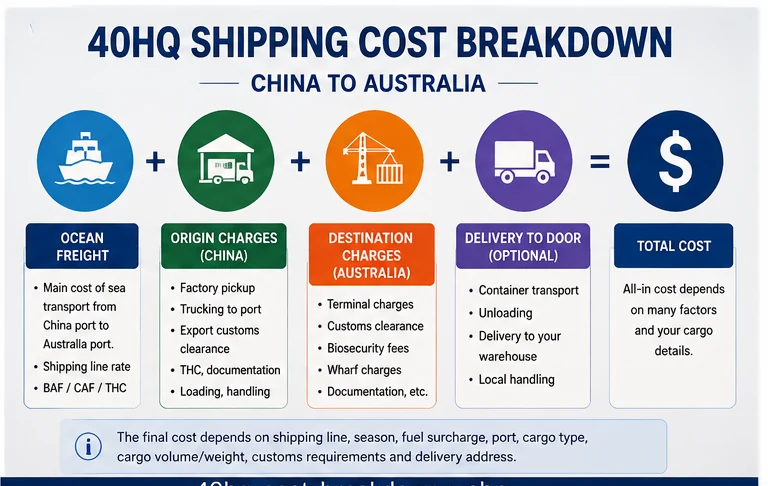
International freight rates can change quickly. Based on our own China–Australia quotations, some 40HQ ocean freight services were available at around USD 1,800 in early 2026, while more recent quotations on some routes have reached approximately USD 4,800 to major Australian ports.
Important: these figures are market examples from specific periods and services—not a permanent tariff. The actual rate depends on the carrier, origin, destination, sailing, equipment and available space.
For an accurate comparison, every quote should show the sailing date and validity period.
| Shipping method | Best for | Pricing basis | Cost characteristic |
|---|---|---|---|
| 20GP FCL | Dense / heavy cargo | Per container | Container-based freight plus origin and destination charges |
| 40HQ FCL | Large-volume cargo | Per container | Often better cost per CBM when well loaded |
| LCL | Smaller commercial shipments | CBM / revenue ton | Lower commitment, but handling charges rise with volume |
| Air freight | Urgent / high-value cargo | Chargeable weight | Much faster, generally more expensive |
| Door-to-door | Importers wanting one coordinated solution | Shipment-specific | Combines multiple logistics stages |
2. FCL shipping cost from China to Australia
FCL means Full Container Load. You book the whole container rather than sharing space with other shippers. For most commercial cargo, the main comparison is between a 20GP and a 40HQ.
20GP
A 20-foot general-purpose container is often suitable for dense goods such as metal products, machinery and heavy building materials where weight becomes a constraint before volume.
40HQ
A 40-foot high-cube container is commonly used for furniture, kitchen cabinets, lighting, building materials, household goods, packaging and mixed supplier cargo. For bulky goods, it often produces a lower transport cost per usable cubic metre.
Actual loading capacity depends on carton dimensions, palletisation, cargo shape, weight distribution and stacking restrictions—not only theoretical container volume. See our Ocean Freight from China service page for FCL support.
3. What is included in a 20GP or 40HQ quote?
When someone says “a 40HQ from China to Australia costs USD X,” ask immediately: what exactly is included?
| Stage | Typical cost items to confirm |
|---|---|
| China origin | Factory pickup, trucking, warehouse handling, container loading, export customs declaration, documentation and local charges |
| International transport | Ocean freight and carrier surcharges applicable to the service |
| Australia destination | Shipping-line local charges, documentation / release, customs clearance, depot or terminal charges, delivery |
| Government / compliance | GST, customs duty where applicable, biosecurity inspection or treatment, permits or other statutory costs |
Ocean freight ≠ total logistics cost. A lower base freight can still produce a higher landed cost if destination charges, free time or delivery are less favourable.
4. LCL shipping cost from China to Australia
LCL—Less than Container Load—allows your cargo to share container space with other shippers. It can be practical for first orders, small commercial shipments, samples, spare parts or goods collected from multiple suppliers.
LCL may be priced by CBM or revenue ton depending on the cargo and tariff. The quote can also include China consolidation warehouse charges, CFS handling, documentation, destination deconsolidation, warehouse handling, customs clearance and final delivery.
This is why an origin quote that looks extremely cheap can become expensive after destination handling is added.
5. When does FCL become cheaper than LCL?
There is no universal rule such as “15 CBM always means FCL.” The break-even point changes by route, container rate, cargo weight, LCL minimum charges and Australian deconsolidation costs.
When the shipment reaches a meaningful volume, compare total LCL cost against total 20GP or 40HQ cost on the same origin and destination scope. Read our dedicated FCL vs LCL China to Australia guide for CBM, destination charges, handling and decision factors. For an all-in delivered structure, see our DDP Shipping China to Australia guide.
6. Air freight cost from China to Australia
Air freight is suitable for urgent spare parts, samples, electronics, high-value products and time-sensitive commercial cargo. Pricing normally uses chargeable weight, so a lightweight but bulky shipment can be billed above its actual gross weight.
For an accurate air quote, provide carton quantity, exact dimensions, gross weight, product description, China pickup city and Australian destination postcode. See our Air Freight Services.
7. China origin charges
Before the cargo reaches the port, potential origin costs can include factory pickup, export trucking, warehouse receiving, consolidation, labelling, repacking, palletising, export customs declaration, documentation and container loading.
For importers buying from several Chinese factories, consolidation can reduce repeated shipments and simplify document and loading coordination. Our China warehousing and consolidation service supports multi-supplier orders.
8. Australian destination charges
Destination charges are one of the most important areas to confirm before booking. They can vary by carrier, port, container type, FCL/LCL status and local service arrangement.
- Shipping-line local charges
- Documentation and delivery-order / EDO-related charges
- Terminal or depot charges
- Customs clearance
- Biosecurity processing if applicable
- Final trucking and delivery
Two quotes with the same ocean rate can therefore produce very different landed costs.
9. Australian GST and import duty
Australian Border Force states that GST on taxable importations is generally 10% of the Value of the Taxable Importation (VoTI). VoTI can include the customs value, applicable duty, international transport and insurance to Australia, and any applicable wine tax.
Customs Value + applicable Duty + qualifying international Transport & Insurance + applicable Wine Tax = Value of Taxable Importation GST = 10% × VoTI
Official reference: Australian Border Force — GST and other taxes when importing.
Import duty is product-specific. Under ChAFTA, preferential rates depend on tariff classification, qualifying origin and compliance with the applicable rules of origin. Goods that do not satisfy the rules of origin do not receive the preferential ChAFTA rate.
Official reference: DFAT — Guide to using ChAFTA to export or import.
10. Biosecurity costs can change the final price
Australia regulates biosecurity import conditions by commodity and country of origin/export. Importers should check the relevant conditions in BICON before shipment.
Additional costs can arise from inspection, treatment, cleaning, contaminated cargo, timber packaging issues, document problems or storage while waiting for release.
DAFF states that solid timber packaging used to support imported goods must meet the applicable BICON conditions. Non-compliant solid timber packaging can require mandatory treatment on arrival, or may be exported or disposed of at the importer’s expense.
Official references: DAFF — Importing goods · DAFF — Timber and bamboo packaging.
11. Sydney, Melbourne, Brisbane and Fremantle costs
The destination port can change both freight and final delivery cost. Sydney, Melbourne and Brisbane are major East Coast gateways, while Fremantle is the main container gateway for Perth and Western Australia.
The cheapest ocean freight port is not necessarily the cheapest total option. Compare:
Ocean Freight + Destination Charges + Customs / Biosecurity + Inland Delivery = More useful route comparison
Saving USD 200 on ocean freight may not make sense if the alternative route adds significantly more inland delivery cost.
12. Why China–Australia freight rates change
- Peak-season demand and Chinese holidays
- Carrier capacity, blank sailings and vessel schedules
- Container and equipment availability
- Port congestion and route disruptions
- Fuel and carrier surcharges
- Shipping-line pricing strategy and available space
This is why freight quotes normally have a limited validity period. A rate obtained several weeks before cargo is ready should be rechecked before booking.
13. How to compare freight quotations properly
Always create a like-for-like comparison:
| Item | Forwarder A | Forwarder B |
|---|---|---|
| Origin / pickup point | ||
| Australian destination / postcode | ||
| Container / CBM / chargeable weight | ||
| Shipping line / airline | ||
| Direct or transshipment | ||
| Transit time | ||
| Ocean / air freight | ||
| China local charges | ||
| Australia destination charges | ||
| Customs / biosecurity scope | ||
| Final delivery | ||
| Free time | ||
| Quote validity |
A quote that is USD 200 cheaper may not be cheaper overall if transit is longer, destination charges are higher, free time is shorter or important fees are excluded.
14. Example of total landed logistics cost
Do not stop the calculation at “ocean freight = USD X.” A better logistics model is:
China Trucking + Export Customs + China Local Charges + Ocean Freight + Australian Destination Charges + Customs Clearance + Duty (if applicable) + GST + Biosecurity Costs (if applicable) + Final Delivery = Actual Landed Logistics Cost
This number is more useful for purchasing and supplier comparison than ocean freight alone.
15. How to reduce shipping costs from China to Australia
Consolidate multiple suppliers
Combine several supplier orders at one China warehouse instead of shipping small consignments separately.
Improve container loading
Carton dimensions and pallet use directly affect usable container space. A better packing plan can sometimes save more than negotiating a small freight reduction.
Compare FCL and LCL
When volume grows, calculate both methods rather than automatically continuing with LCL.
Book earlier during peak periods
Earlier planning gives more carrier, sailing and equipment options.
Check packaging and documents before shipment
Preventing biosecurity or customs problems in China is generally cheaper than resolving them after arrival.
Prepare clearance before arrival
Early document review can reduce the risk of storage, demurrage and detention.
Want a like-for-like cost comparison? Send your cargo details and Australian postcode. We can compare suitable FCL, LCL, air or door-to-door options based on the current sailing market.
Request Current Rates
16. Information required for an accurate quote
- Product name and cargo description
- Pickup city in China
- Destination city and postcode in Australia
- Carton / crate quantity
- Exact dimensions
- Gross weight and total CBM
- HS code if available
- Packaging type and whether timber is used
- Battery, liquid, chemical or dangerous-goods information if applicable
- Incoterm and cargo-ready date
For FCL, specify 20GP / 40GP / 40HQ if known. For LCL or air freight, exact packing dimensions and weight are especially important.
17. Frequently asked questions
How much does a 40HQ cost from China to Australia?
There is no fixed annual rate. The price changes with the Chinese loading port, Australian destination, carrier, sailing date, available space and service. Request a current rate for the cargo-ready date.
Is LCL cheaper than FCL?
For small volumes, usually yes. As volume grows, LCL origin and destination handling charges can make FCL more competitive.
How much GST do I pay when importing into Australia?
GST on taxable importations is generally 10% of the Value of the Taxable Importation, not simply 10% of the supplier invoice value.
Do I always pay customs duty on goods from China?
No. Duty depends on classification, origin, applicable concessions and whether the goods qualify for preferential treatment such as ChAFTA.
Can wooden pallets increase shipping costs?
Potentially. Timber packaging must meet Australian biosecurity requirements. Non-compliant packaging can result in treatment, delay, export or disposal costs.
Which Australian port is cheapest?
There is no universally cheapest port. Compare ocean freight, destination charges and final delivery to the actual postcode.