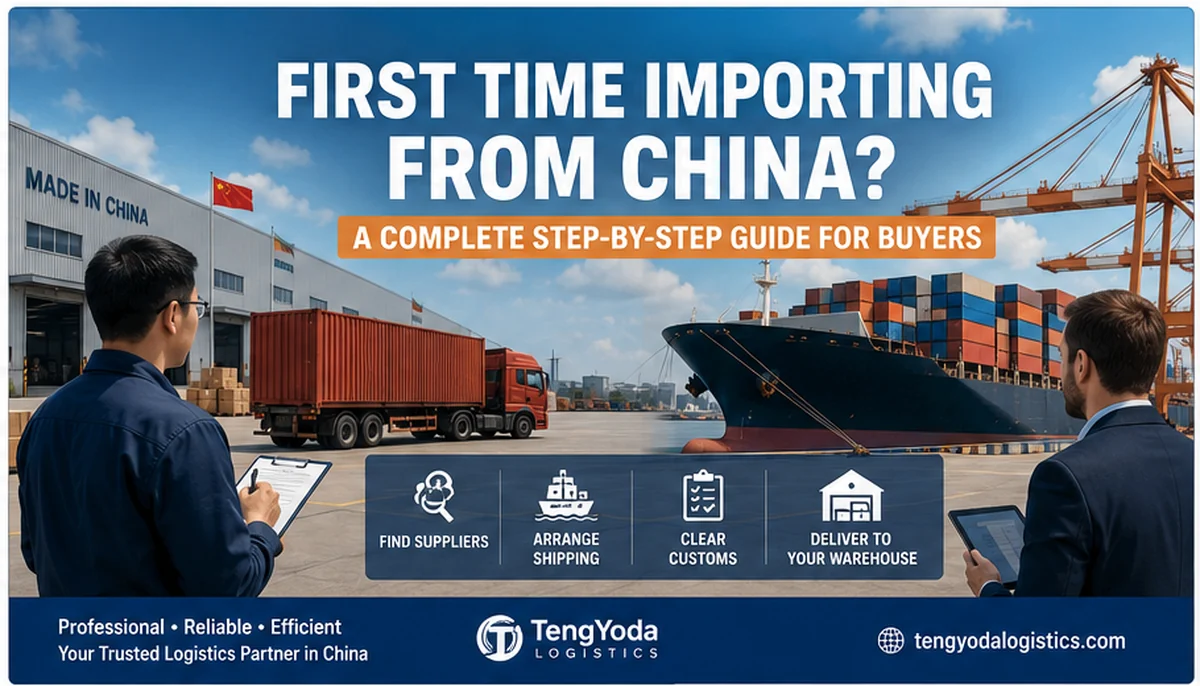
Importing products from China for the first time can seem complicated. You need to find suppliers, negotiate prices, arrange payments, confirm product quality, choose a shipping method, prepare export documents, clear customs and finally deliver the goods to your warehouse. The good news is that the process becomes much easier once you understand who is responsible for each step. A typical import process looks like this: Product Research → Supplier Selection → Quotation → Samples → Purchase Order → Production → Inspection → China Logistics → Export Customs → International Shipping → Import Customs Clearance → Duty & Tax → Local Delivery This guide explains the complete process for first-time buyers importing products from China.
1. Check Whether the Product Can Be Imported
Before paying a Chinese supplier, your first question should not be:
"How much is the shipping?"
It should be:
"Can this product legally and commercially be imported into my country?"
Different countries have different regulations.
Depending on the product, you may need to check:
- HS code
- Import duty
- Anti-dumping or countervailing duties
- Product certification
- Safety standards
- Labeling requirements
- Import licences or permits
- Biosecurity requirements
- Dangerous goods classification
- Intellectual property restrictions
Products such as food, chemicals, batteries, electrical equipment, medical products, timber products and children's products may require additional attention.
Checking these requirements before placing the order can prevent expensive problems later.
2. Find and Verify Chinese Suppliers
Buyers can find Chinese suppliers through online B2B platforms, trade fairs, sourcing agents, industry contacts or direct factory referrals.
Finding a supplier, however, is only the beginning.
Before placing a large order, verify:
- Company name and business information
- Factory or trading company status
- Production capabilities
- Export experience
- Product certifications where applicable
- Payment terms
- Lead time
- Quality control procedures
For a new supplier, requesting samples before mass production is highly recommended.
A low price is useful only if the supplier can consistently produce the product you actually ordered.
3. Confirm Product Specifications
Many purchasing disputes happen because the buyer and supplier have different understandings of the product specifications.
Do not rely only on chat conversations.
Confirm important specifications in writing, including:
- Material
- Dimensions
- Color
- Model
- Quantity
- Accessories
- Packaging
- Logo
- Labeling
- Carton dimensions
- Gross weight
- Quality standard
If the product is customized, drawings, samples or approved specifications should be confirmed before mass production.
4. Understand EXW, FOB, CIF, DAP and DDP
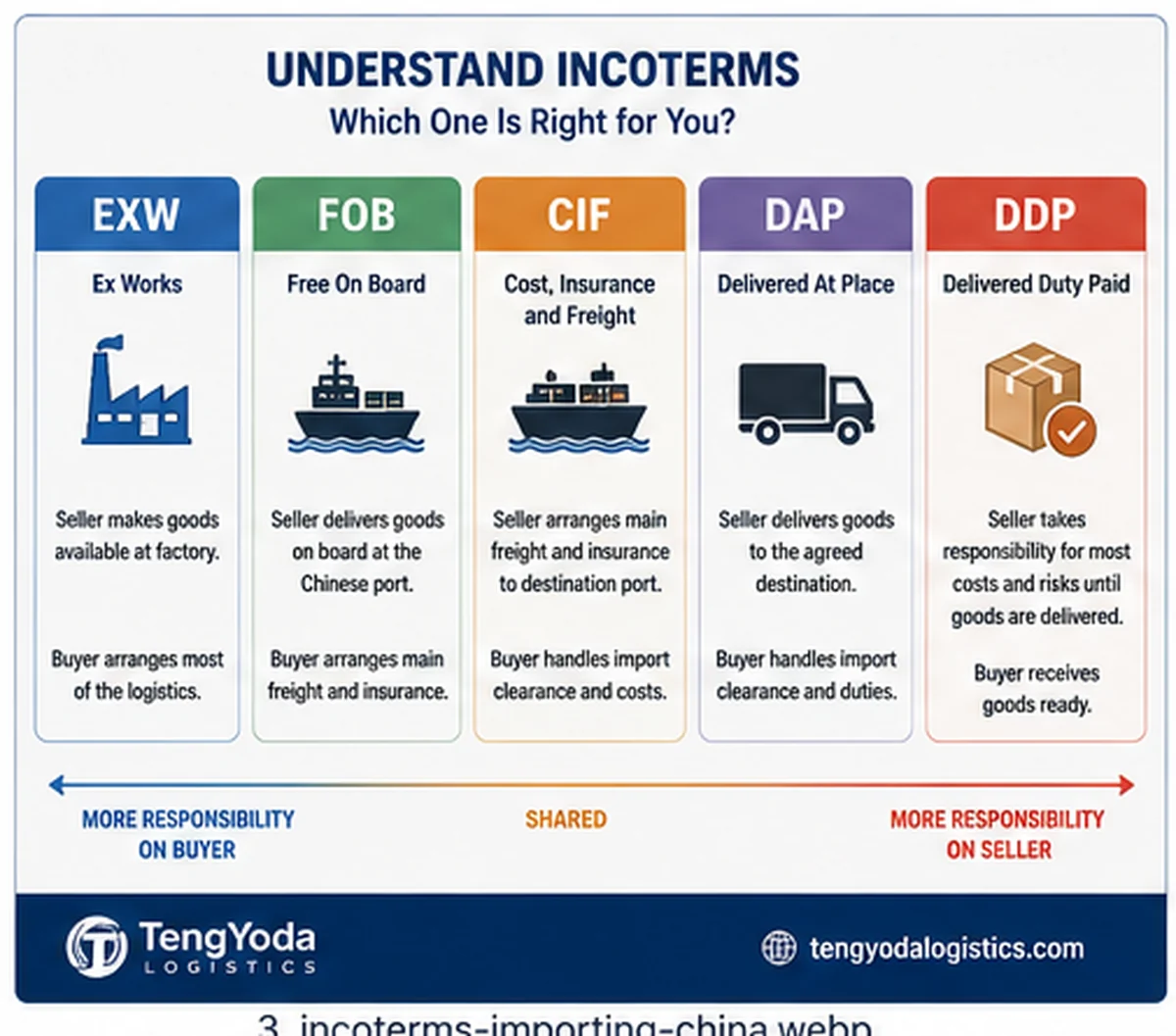
One of the most important things for a first-time importer to understand is the Incoterm.
The Incoterm determines how costs, responsibilities and risks are allocated between the buyer and seller.
EXW
Under EXW, the seller makes the goods available at the agreed location, commonly the factory.
The buyer takes on a significant part of the transportation arrangements from China.
FOB
FOB is commonly used for sea freight.
The seller and buyer each have defined responsibilities under the agreed FOB terms, with the buyer normally controlling the main international freight after the FOB delivery point.
CIF
Under CIF, the seller arranges the main carriage and insurance to the named destination port according to the agreed terms.
However, CIF does not mean every destination charge is included.
DAP
Under DAP, transportation is arranged to the named destination, while import clearance and import duties/taxes generally remain the buyer's responsibility.
DDP
Under DDP, the seller takes on significantly more responsibility, including the agreed import-side obligations.
However, the feasibility of DDP depends on the destination country, product and import arrangements.
Before accepting any DDP quotation, understand exactly who will act as importer and what costs and taxes are included.
Never compare two supplier prices without checking their Incoterms.
5. Calculate the Total Landed Cost Before Ordering
One of the biggest mistakes first-time importers make is calculating only:
Product Cost + Ocean Freight
Your actual landed cost can be much higher.
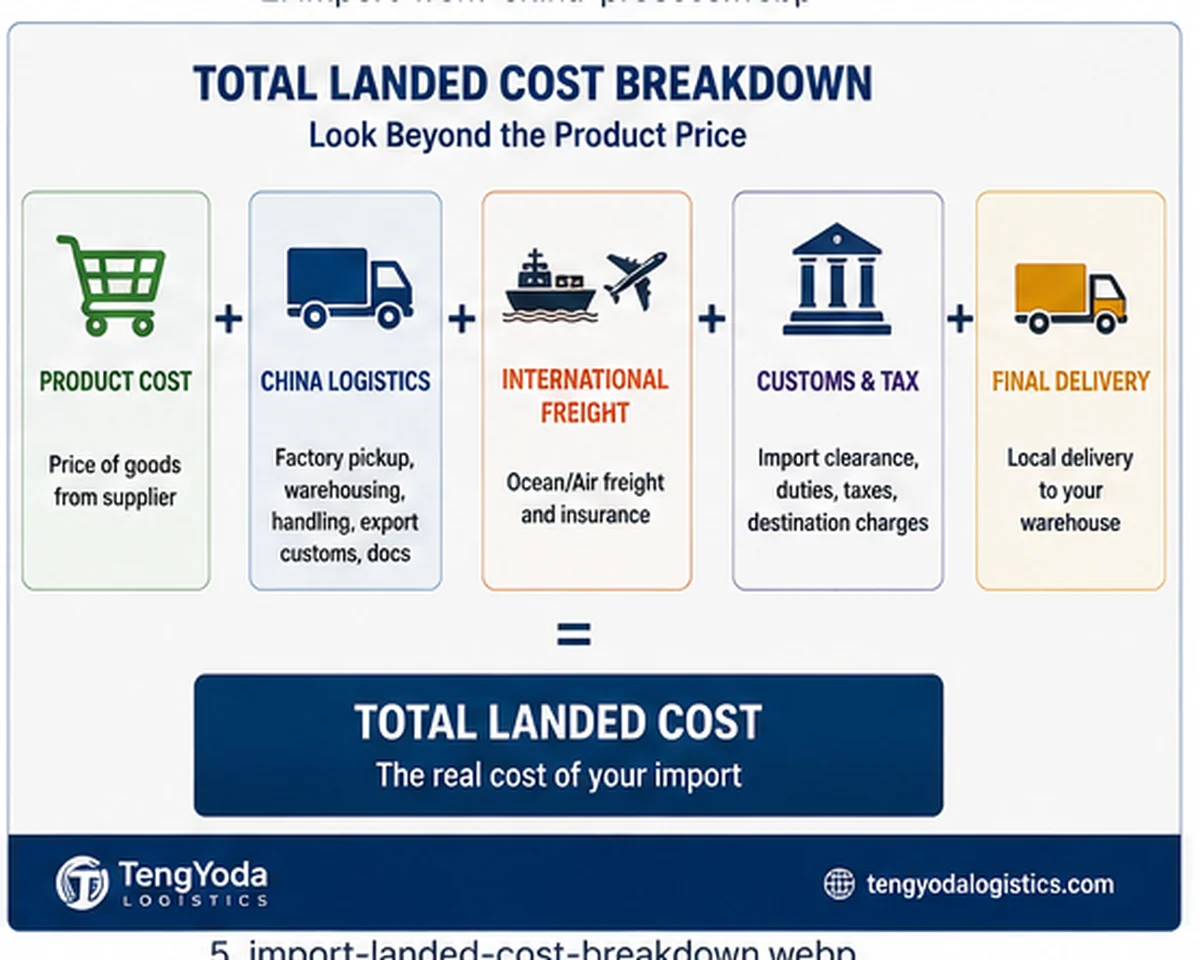
A more useful calculation is:
Total Landed Cost = Product Cost + China Logistics + International Freight + Insurance + Destination Charges + Customs Duty/Tax + Customs Clearance + Final Delivery
Depending on the shipment, other costs may include:
- Inspection
- Storage
- Demurrage
- Detention
- Quarantine or biosecurity processing
- Treatment
- Special handling
Calculating the landed cost before placing a large order helps you determine whether the product will still be profitable after it reaches your warehouse.
6. Place the Order and Arrange Payment
Once the product, specifications, price and Incoterm have been confirmed, the buyer can place the purchase order.
A common commercial structure may look like:
Deposit → Production → Inspection → Balance Payment
The actual payment arrangement depends on the supplier and commercial agreement.
For a new supplier, appropriate verification is particularly important before making a large payment.
Carefully verify beneficiary information and treat unexpected requests to change bank account details with caution.
7. Monitor Production
Do not simply pay the deposit and wait until the supplier says the cargo is ready.
Stay in communication during production.
Confirm:
- Production start date
- Expected completion date
- Packaging
- Carton markings
- Quantity
- Shipping marks
- Estimated CBM
- Estimated gross weight
These details also help your freight forwarder prepare the transportation plan in advance.
8. Inspect the Goods Before Shipping
For a first order, inspection can be particularly valuable.
Depending on the product and order value, buyers may arrange:
- Factory inspection
- During-production inspection
- Pre-shipment inspection
- Container loading supervision
A pre-shipment inspection can check items such as:
- Quantity
- Appearance
- Dimensions
- Function
- Packaging
- Labels
- Carton condition
It is usually much easier to resolve a product problem while the goods are still in China than after they arrive overseas.
9. Choose the Right Shipping Method
The best transportation method depends on cargo volume, weight, urgency, value and destination.
Courier
Suitable for samples and very small shipments.
Air Freight
Suitable for urgent, relatively high-value or time-sensitive cargo.
LCL Sea Freight
LCL means Less than Container Load.
Your cargo shares container space with other shipments and is often suitable when you do not have enough cargo for a full container.
FCL Sea Freight
FCL means Full Container Load.
Common container types include:
- 20GP
- 40GP
- 40HQ
For larger shipments, FCL can provide better control over loading and reduce cargo handling compared with LCL.
Do not automatically assume LCL is cheaper. As cargo volume increases, compare the total LCL cost against the total FCL cost.
10. Understand the Complete Import Process
The international shipping process involves much more than moving a container from one port to another.
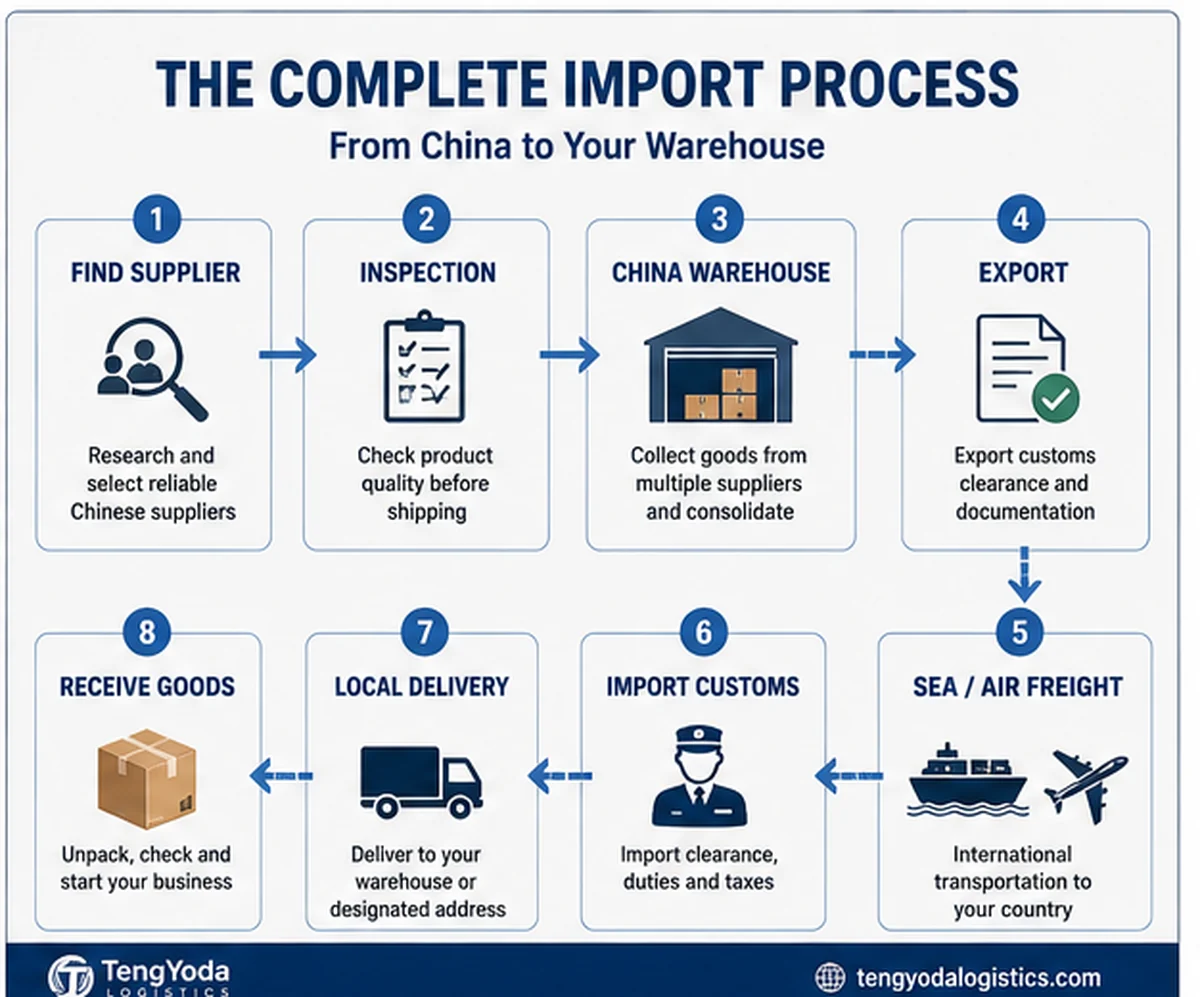
A typical shipment may involve:
Chinese Supplier → Inspection → China Warehouse → Export Customs → Sea/Air Freight → Import Customs → Local Delivery → Your Warehouse
Important parties can include:
- Supplier
- Freight forwarder
- Warehouse
- Trucking company
- Shipping line or airline
- Export customs
- Import customs
- Customs broker
- Local delivery company
Understanding who is responsible for each stage reduces confusion when problems occur.
11. Buying from Multiple Suppliers? Consider Consolidation
This is particularly useful for overseas buyers sourcing several products from China.
For example, you might purchase:
- Furniture from Foshan
- Lighting from Zhongshan
- Hardware from Guangzhou
- Accessories from Yiwu
- Building materials from another supplier
You do not necessarily need every supplier to arrange a separate international shipment.
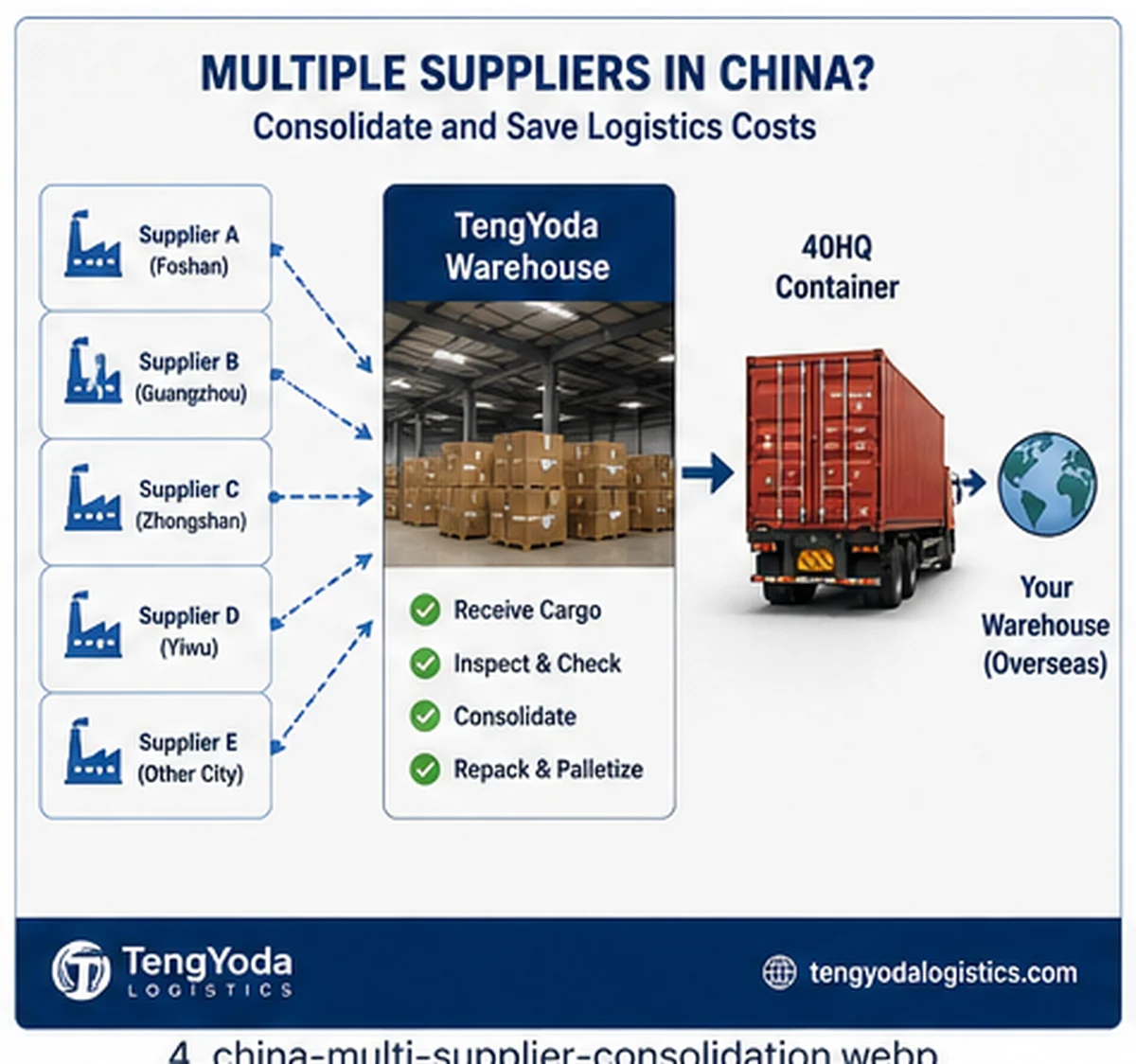
A freight forwarder can arrange:
Supplier A + Supplier B + Supplier C + Supplier D → China Warehouse → Consolidation → LCL or FCL Shipment → Your Country
At the China warehouse, the logistics provider can coordinate cargo receiving, consolidation and shipment preparation.
For larger orders, products from multiple suppliers may be loaded together into a 20GP, 40GP or 40HQ container where appropriate.
This can simplify the supply chain and reduce repeated logistics arrangements.
12. Prepare Shipping Documents
Typical international shipping documents may include:
- Commercial Invoice
- Packing List
- Bill of Lading or Air Waybill
- Certificate of Origin where applicable
- Packing Declaration where applicable
- Treatment/Fumigation Certificate where applicable
- MSDS for applicable products
- Product certificates where required
- Import permits where required
The exact documentation depends on the product and destination country.
One incorrect or missing document can delay an entire shipment.
Whenever possible, have the relevant shipping and import documents checked before the cargo arrives at destination.
13. Complete Export Procedures in China
Before international departure, commercial cargo normally needs to complete the applicable Chinese export procedures.
Depending on the transaction and Incoterm, the supplier, exporter or freight forwarder may coordinate:
- Export declaration
- Customs documentation
- Cargo information
- Container information
- Shipping documentation
Before booking, make sure you understand who is responsible for China-side export procedures.
14. International Transportation Begins
Once the cargo has been prepared and the required export procedures completed, international transportation begins.
For ocean freight, important information may include:
- Booking number
- Container number
- Shipping line
- Vessel name
- ETD
- ETA
- Port of loading
- Port of discharge
- Bill of Lading
Keep these records.
Also remember:
ETA is the estimated arrival date at the relevant destination point — it is not necessarily the date the cargo will arrive at your warehouse.
Customs clearance, release and local delivery still need to be completed.
15. Prepare Import Customs Clearance Before Arrival
Do not wait until the container arrives before thinking about customs clearance.
Where possible, prepare documents in advance.
Your customs broker may require:
- Commercial Invoice
- Packing List
- Bill of Lading
- HS code
- Importer information
- Product description
- Customs value
- Country of origin
- Certificates or permits where applicable
Requirements vary by country and product.
Early preparation can help reduce unnecessary delays and storage costs.
16. Pay Duties, Taxes and Destination Charges
Depending on the destination country, product and Incoterm, import-side costs may include:
- Customs duty
- Import VAT/GST or other taxes
- Customs processing charges
- Shipping line charges
- Terminal-related charges
- Customs brokerage
- Biosecurity/quarantine charges
- Final delivery
This is why a quotation showing only:
"Ocean Freight: USD XXXX"
does not tell you the complete cost of importing.
Always ask:
"What is included in this quotation, and what will I still need to pay at destination?"
17. Arrange Final Delivery
Once the cargo has received the necessary release, it can move to the final destination.
For an FCL shipment, the process may look like:
Port → Container Pickup → Your Warehouse → Unloading → Empty Container Return
Pay attention to the applicable free time.
If the container or cargo remains too long at the terminal or outside the agreed free period, additional storage, demurrage or detention charges may apply.
18. Check the Goods After Arrival
When the shipment reaches your warehouse:
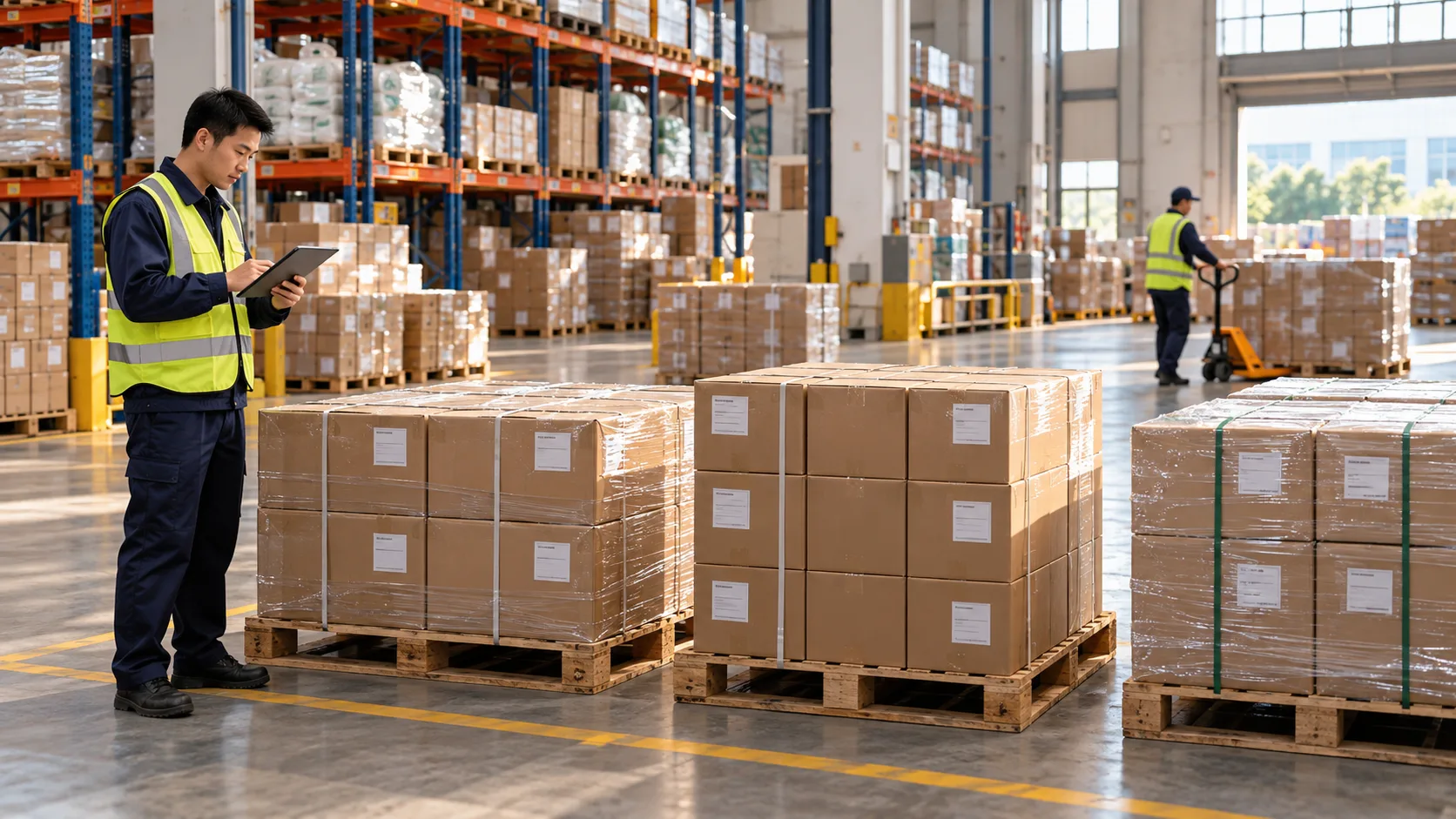
- Check the number of cartons/packages
- Inspect the packaging condition
- Check for visible damage
- Compare the goods with the packing list
- Record any problems
- Photograph damaged cargo before unpacking where appropriate
Keep your purchasing, customs and shipping records.
For your next order, record what worked well and what should be improved.
The Complete Import Process at a Glance
For a first-time buyer, the process can be summarized as:
Product Research → Import Requirement Check → Supplier Verification → Samples → Specifications → Incoterm → Landed Cost → Purchase Order → Production → Inspection → Shipping → Export Customs → International Freight → Import Customs → Duty/Tax → Final Delivery → Receive Goods
The most important principle is simple:
Plan the logistics before the cargo is ready — not after production has finished.
Common Mistakes First-Time Importers Should Avoid
Some common mistakes include:
- Choosing a supplier only because they offer the lowest price
- Not requesting samples
- Not confirming specifications in writing
- Not understanding EXW, FOB, CIF, DAP and DDP
- Ignoring HS codes and import requirements
- Comparing only ocean freight
- Ignoring destination charges
- Shipping before checking documentation
- Waiting until arrival to arrange customs clearance
- Ignoring container free time
- Failing to calculate the total landed cost
Many expensive import problems can be prevented before the goods leave China.
Frequently Asked Questions
Is importing from China difficult for a first-time buyer?
Not necessarily. The process becomes much easier when the responsibilities of the supplier, buyer, freight forwarder and customs broker are clearly defined before the order is placed.
When should I contact a freight forwarder?
Ideally, contact a freight forwarder before placing a large purchase order.
Providing the product name, supplier location, estimated quantity, CBM/weight and destination allows the logistics provider to identify potential transportation issues and estimate shipping costs earlier.
Can I combine goods from several Chinese suppliers?
Yes. Goods from multiple factories can be collected into a China warehouse and consolidated into an LCL or FCL shipment where appropriate.
Should I choose EXW or FOB?
There is no single answer for every shipment. Compare the responsibilities and total cost under each option rather than looking only at the supplier's quoted product price.
Should a first-time importer use DDP?
DDP may simplify certain shipments, but buyers should understand exactly what is included, who handles the import formalities and whether the arrangement is suitable for the product and destination country.
Planning Your First Import from China?
For first-time importers, logistics planning should ideally begin before the goods are produced, not when the supplier suddenly says:
"Your cargo is ready. Please arrange shipping."
TengYoda Logistics helps overseas importers coordinate shipments from China, including:
- Factory pickup
- China warehousing
- Multi-supplier consolidation
- LCL sea freight
- FCL container shipping
- Air freight
- Export customs coordination
- Shipping documentation
- Door-to-door logistics solutions
If you are preparing your first shipment from China, send us:
Product name + supplier city + quantity + CBM/weight + destination country/postcode + Incoterm
We can help you evaluate the appropriate shipping method and logistics process based on the actual cargo.
Need help planning your first shipment from China? Contact TengYoda Logistics for a shipping solution based on your cargo and destination.