A shipping quotation can include an ocean rate and still leave an importer with unanswered questions: Who will act as the importer of record? What happens if Customs requests more information? Can the receiving site safely unload the cargo? Who pays if a container cannot be returned on time? These questions matter especially when a company imports under its own name for the first time. A recent enquiry to TengYoda illustrates the decisions involved. The buyer needed to move an industrial fiberglass-reinforced plastic cover system from Tianjin, China, through Los Angeles to a mining site in Arizona. The shipment consisted of two long packages weighing approximately 5.5 tonnes in total, with a packed volume of about 33 cubic metres. The buyer requested two delivery options: keep the cargo in its ocean container until arrival at the site, or unload it near Los Angeles and deliver it on a dedicated, tarped flatbed. This article uses that enquiry as a planning example. It is not a completed-shipment case study; customer identifiers and commercial pricing have been omitted.
Your US import plan at a glance
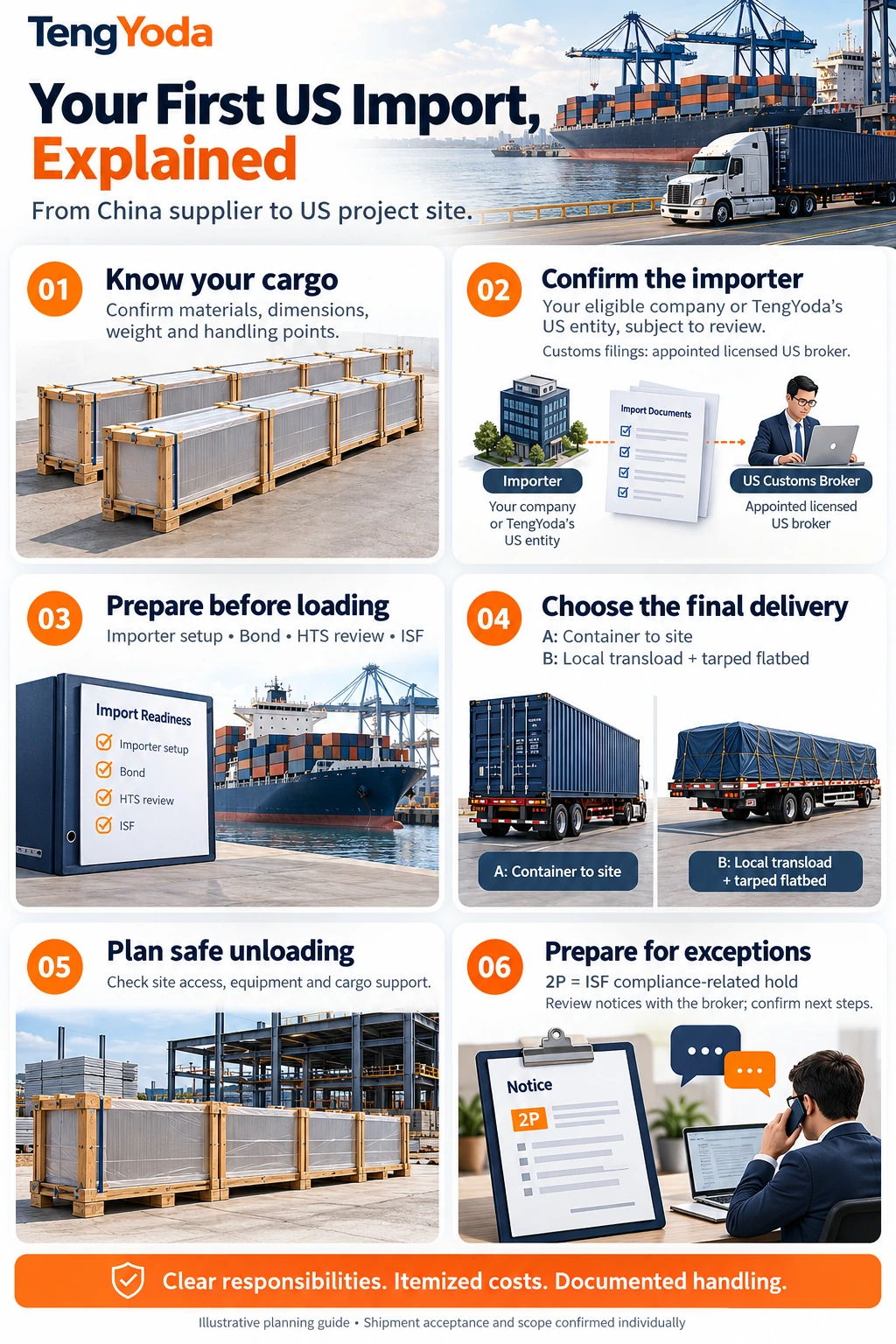
Confirm your importer, customs preparation, delivery method and unloading arrangements before the cargo leaves China. TengYoda coordinates these steps with suppliers, the appointed licensed US customs broker and transport providers.
1. Start with the product—not the freight rate
The cargo was described as a sliding cover system installed over an existing industrial process tank. It included FRP cover sections and associated rails, rollers, brackets and fasteners. According to the buyer’s description, it was not a tank, pressure vessel or powered machine.
That distinction needs to remain consistent across the commercial invoice, packing list, technical information, broker instructions and insurance application. Calling the same cargo “plastic parts” on one document and “machinery” on another can create avoidable questions.
Before requesting a customs assessment, collect the material composition, product drawings, photographs, intended use and a component breakdown. Explain whether the components form one complete system or are being sold separately. The licensed US customs broker can then assess the appropriate classification and whether any other agency requirements apply.
TengYoda can coordinate this information with the Chinese supplier so the buyer is not left trying to resolve technical questions after the container arrives.
2. Agree who will be the importer of record
The importer of record is a legal responsibility, not simply a company name added to shipping documents. CBP expects the importer to exercise reasonable care over matters including classification, value and the information provided for entry. Appointing a broker does not remove that responsibility. [1]
For a first-time importer, the broker’s onboarding process should be completed early enough to address identity verification, the power of attorney, importer registration and bond arrangements before shipment.
CBP Form 5106 creates or updates importer identity information in CBP systems. It is not a blanket import licence or a guarantee that a particular product will be admitted. [2]
TengYoda can coordinate clearance using a customer-provided importer of record, subject to eligibility checks, broker acceptance, proper authorization and consistent shipment documents. Providing a company name or tax number alone is not sufficient.
TengYoda has a separate US company that can serve as the importer of record for accepted shipments, subject to eligibility, product and transaction review. Before booking, we identify the actual legal importing entity and agree its responsibilities in writing. Customers should know which entity is responsible for the entry, duties, records and official correspondence. This arrangement is separate from the licensed customs broker’s role.
Our approach is to use genuine, accountable parties and accurate declarations. We do not support fictitious importers, false product descriptions or undervaluation. Customs brokerage work is handled by the appointed licensed US customs broker; TengYoda’s freight coordination role and any agreed importer role must be identified separately.
3. Separate bond costs from duties and brokerage
A buyer may request a continuous customs bond because it expects repeated imports. Ask the broker to explain the required bond amount, the annual premium, any underwriting or collateral requirements and whether the arrangement covers the relevant entry and ISF obligations.
The bond’s face amount is not the premium paid to obtain it. A customs bond is also not cargo insurance and does not replace payment of duties or other amounts owed.
An itemized proposal should distinguish importer setup assistance, bond premium, ISF filing and customs entry services. This makes it easier to compare proposals without treating unlike services as one “clearance fee.”
4. Review the complete US tariff classification before promising a duty rate
The enquiry supplied the six-digit HS reference 3926.90. That is useful background, but it is not enough to confirm the final US duty calculation or an exclusion.
Ask the broker to identify the applicable US HTS classification, country of origin, customs value, relevant Chapter 99 provisions and any additional duties in effect for the entry date. The review should consider the actual product and components, not just the supplier’s suggested code.
Section 301 exclusions require a match to the applicable exclusion wording and effective dates. A product should not be advertised as exempt merely because its broad HS heading appears familiar. USTR publishes exclusion notices, and the broker should check the current notice and supporting product evidence before claiming one. [3]
For this enquiry, no final duty rate or exclusion eligibility has been established. A useful quotation will show the broker’s duty assumptions separately from transportation charges and identify what still requires confirmation.
5. Confirm that the cargo can be loaded—and unloaded
The proposed shipment required a 40-foot high-cube container. Its two packages measured approximately:
| Package | Packed dimensions, L × W × H | Gross weight |
|---|---|---|
| 1 | 4.05 × 2.15 × 2.35 m | 3,200 kg |
| 2 | 3.80 × 1.40 × 2.35 m | 2,300 kg |
Their combined length is 7.85 metres if positioned end to end, but arithmetic alone is not a loading approval. Check the actual container’s door opening and internal dimensions, packaging tolerances, lifting access, load distribution, securing space and the unloading method.
For FRP products, package design should protect against bending, abrasion and concentrated loads. The supplier should identify approved support positions, lifting points and any areas that must not carry straps or compression loads.
A long package can change a forklift’s effective load centre substantially. A nominal lifting-capacity label is not enough to approve handling. The loading and receiving teams must verify the equipment’s rated capacity at the actual load centre and agree a safe method.
Before dispatch, obtain photographs of the finished packaging, supports, securing arrangement and container seal. Ask for an unloading sequence that the receiving site can actually follow. Airbags and lashings do not compensate for an unsuitable package or an unworkable extraction method.
6. File ISF before the ocean shipment reaches its deadline
ISF preparation should start before loading, not after sailing. CBP states that eight required data elements must be provided no later than 24 hours before cargo is loaded aboard the US-bound vessel; other elements have their own timing provisions. The appointed filer should manage the applicable deadlines and updates. [4]
Confirm who will file, who supplies the information, which bill of lading reference will be used and how acceptance and matching will be checked. A supplier’s promise to send documents later is not a substitute for a filing plan.
TengYoda can help coordinate supplier information and shipment references with the appointed filer. The importer should retain the filing records and make sure changes are communicated promptly.
7. Compare two delivery plans using the same scope
Option A: Keep the shipment in the container to the site
This option avoids an intermediate unpacking and reloading operation. It can be attractive for fragile cargo when the receiving site has a confirmed method to unload the long packages safely.
However, the quotation needs to address chassis provision, the full inland movement, empty-container return, appointments, permitted waiting time and possible extra days. The container may travel a considerable distance from its return depot.
The site must confirm whether it can accept the truck and chassis, whether the delivery point is the security gate or an unloading area, and who supplies the unloading team and equipment. A closed-top container cannot simply be unloaded through its roof with a crane.
Option B: Transload near Los Angeles and deliver by flatbed
A suitable warehouse can remove the packages from the container and reload them onto a dedicated flatbed. This may help when the site needs side or overhead access for unloading, and it can allow an earlier empty-container return.
The trade-off is an additional handling operation. Quote warehouse receiving, unloading, lifting equipment, storage if needed, flatbed loading, load securing, tarping and final transport separately.
For FRP cargo, tarping should protect the load without rubbing or concentrating pressure on vulnerable surfaces. It is not a replacement for suitable packaging. Confirm support positions, weather protection and acceptance with the warehouse and trucker before booking.
Neither option is automatically cheaper. Compare the complete delivery cost and handling risk, including the receiving site’s capabilities. Any road permits or route restrictions must be assessed against the actual loaded vehicle configuration.
8. Ask for a quotation the purchasing team can audit
For a FOB Tianjin enquiry, first confirm the seller’s agreed origin responsibilities and the precise handover. Avoid duplicating charges already included in the supplier’s contract.
| Cost group | Items to identify separately |
|---|---|
| Ocean movement | Container freight, applicable carrier surcharges, validity and routing assumptions |
| Importer onboarding | Setup assistance, broker authorization processing and bond premium |
| Filing and clearance | ISF, customs brokerage and any separately charged entry services |
| Government charges | Estimated duties, additional tariffs and applicable processing or harbour fees |
| Destination terminal | Applicable terminal charges, PierPASS and Clean Truck Fund charges, with inclusions checked to avoid duplication |
| Container delivery | Trucking, fuel surcharge, chassis, empty return and agreed waiting allowance |
| Flatbed alternative | Transloading, handling equipment, storage, securing, tarping and dedicated trucking |
| Insurance | Premium, insured value, deductible and the agreed coverage scope |
| Conditional charges | Exams, exam transfers, storage, demurrage, detention, extra waiting and unsuccessful delivery |
Every conditional charge should have a trigger, charging basis and approval process where practicable. A separate contingency allowance helps the board see what is estimated and what remains uncertain.
There is no defensible fixed delivered price for this enquiry until the carrier, broker, warehouse and trucker confirm their scopes. A low ocean rate alone cannot establish the project’s final cost.
9. Check insurance through the final unloading stage
The buyer requested insurance at 110% of CIF value. Ask the insurance provider to confirm the valuation basis and the exact transit being insured, including any warehouse transloading and the agreed point at which cover ends.
“All risks” does not mean every possible loss is covered. Obtain the policy wording and confirm exclusions, deductibles, packaging requirements and the treatment of loading and unloading damage. Do not assume delay, customs penalties, inadequate packing or every form of FRP damage is insured.
Retain packing photographs and delivery-condition records. If damage is visible on arrival, document it and follow the insurer’s notification and survey instructions promptly.
10. Prepare for 2P holds, information requests and possible return movements
CBP’s disposition-code guidance identifies 2P as an ISF compliance-related hold. It is not a universal term for all inspections and does not itself mean the cargo must be returned. [5]
If a hold appears, the first step is to obtain the full message and have the appointed broker or filer establish the reason. Review the filing, bill references and importer information, provide corrections or evidence where required, and follow the relevant CBP instructions. Submitting a correction does not itself prove that release has been granted.
At the same time, coordinate the operational consequences: terminal availability, delivery cancellation, free-time deadlines, possible storage and any authorized movement. A customs release alone may not remove separate carrier or terminal holds.
If return or re-export becomes necessary, assess it as a separate regulated movement. The broker must confirm whether and under what conditions it is allowed; the carrier must accept the movement; and the shipper must address handling, storage, documentation and the receiving arrangements overseas. Seizure, an admissibility restriction or another agency’s action may limit the available options.
TengYoda can help organize the response, obtain operational options and keep the buyer informed. No responsible provider can promise that every hold will be lifted, that every shipment can be returned or that a compliant importer will never face an audit or penalty.
11. Keep compliance responsibilities active after delivery
Delivery does not end the importer’s obligations. When TengYoda’s US company acts as the importer of record, it receives and responds to CBP correspondence, maintains the required records and recognizes the potential for customs reviews, audits and penalties. Customers importing under their own entity should also maintain a monitored address and responsible contact for official correspondence. Retain the relevant commercial, entry, classification, origin, payment and transport records under the applicable retention requirements.
If CBP sends a request for information or other notice, record the deadline and coordinate the response with the broker and, where needed, customs counsel. Do not assume that the freight forwarder automatically receives every notice addressed to the importer.
Our compliance position is straightforward: genuine parties, truthful declarations, complete supporting documents and a defined response when questions arise. Long-term reliability comes from accountable execution, not promises of guaranteed clearance.
How TengYoda helps connect the whole shipment
TengYoda can coordinate supplier documents, packaging and loading requirements in China; compare ocean and inland delivery options; arrange an importer role through its separate US company for accepted shipments or support the customer’s own eligible importer, working with the appointed licensed broker; and organize agreed destination handling and delivery services through the relevant providers.
The buyer remains responsible for truthful transaction information, authorizing the correct importer arrangement, approving costs and confirming site access and receiving capability. The broker handles the agreed customs work. The supplier, warehouse and transport teams each need clear handling responsibilities.
Planning your first commercial shipment from China to the United States? Send TengYoda your product description, photographs, final packed dimensions and weights, cargo-ready date, importer details and delivery requirements. We can develop a shipment-specific proposal showing the transport options, customs preparation, exclusions and decisions needed before departure.
Explore our China-to-USA shipping services or email vinson_xie@tydscc.cn.
Reference sources
Sources reviewed on 23 October 2026. Rules, tariffs, exclusions and provider acceptance should be checked again for the actual shipment date.