A 900-tonne slag shipment to Lagos needs more than an ocean freight rate. Cargo acceptance, packaging, loading terms and destination receiving arrangements all affect whether the quoted plan can actually be delivered. TengYoda received an enquiry for approximately 900 tonnes of slag bound for Lagos, Nigeria, with breakbulk shipping under consideration. This guide explains how we would evaluate the shipment before booking. It describes an enquiry-stage plan, not a completed shipment; the origin port, packing method, sailing and price remain to be confirmed.
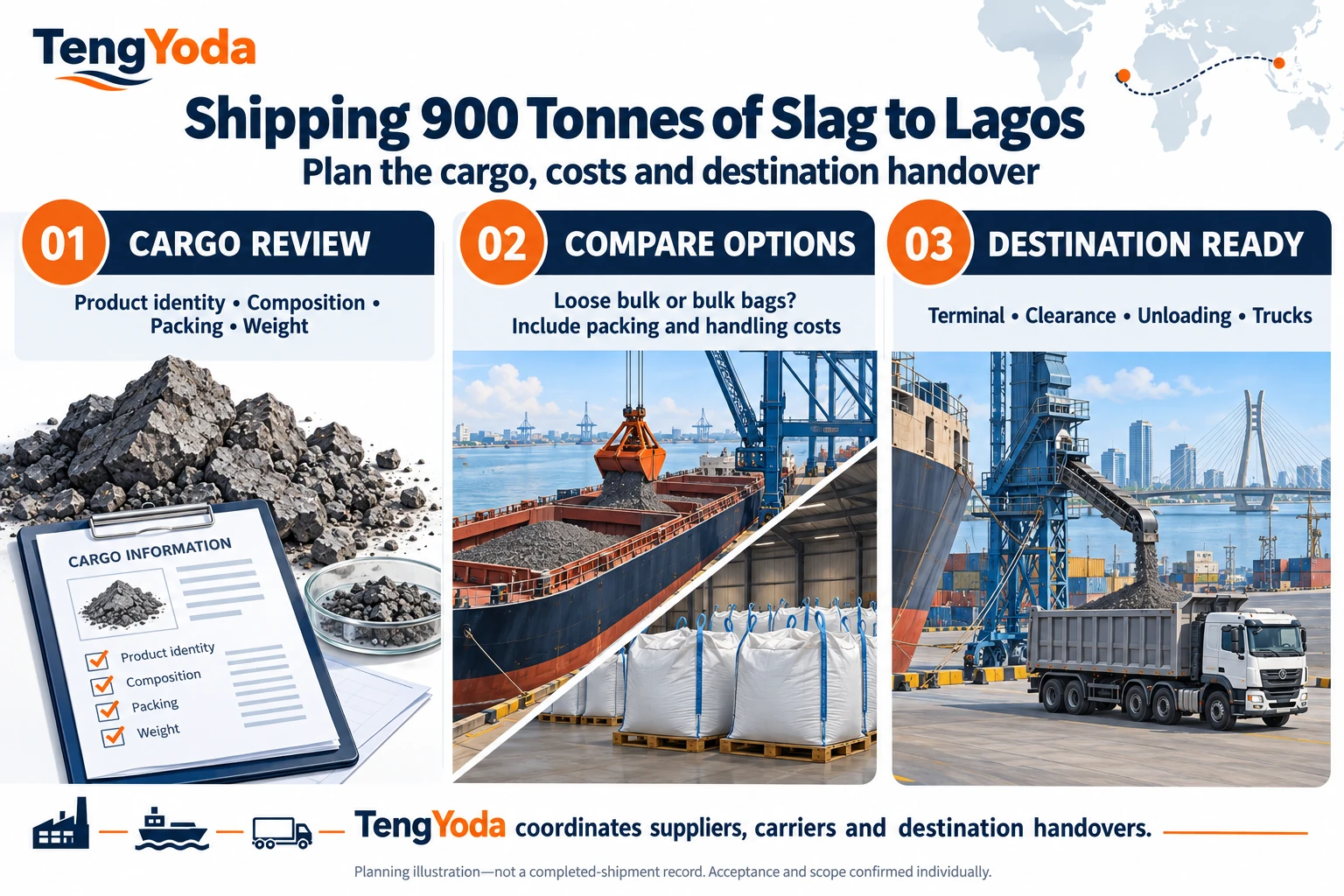
A visual guide to the shipment plan
1. Identify the cargo before asking for vessel space
“Slag” is not a complete shipping specification. Its production source, composition, particle size and physical condition help determine the information needed for carrier acceptance, handling and customs review.
Ask the supplier for the precise product name, source, intended use, composition, photographs, packing proposal and gross weight. Establish whether the material is powder, granules or larger pieces, and obtain the relevant information about moisture and storage conditions. Bulk density or stowage factor also helps the vessel operator assess the space required.
For cargo shipped loose in a vessel’s hold, the applicable IMSBC Code requirements and cargo classification must be reviewed. Do not assume that every material called slag has the same transport characteristics. TengYoda can coordinate supplier information for review by the relevant shipping and declaration parties.
2. Compare loose bulk and bagged cargo as different plans
Loose cargo loaded directly into a ship’s hold is a different operation from material packed into bulk bags and handled as individual units. The enquiry’s reference to breakbulk shipping does not yet establish which arrangement is suitable.
Match the terminals and equipment
Check cargo acceptance, grabs or other handling equipment, dust and spillage controls, segregation, trimming where applicable, and storage conditions. Lower packaging expenditure does not necessarily mean lower delivered cost.
Match the bags and handling method
Confirm bag capacity, condition, lifting loops, lining or moisture protection where needed, stacking limits and unloading arrangements. Include filling, packaging and handling costs in the comparison.
3. Match 900 tonnes to a workable sailing
A shipment of this size does not automatically require an entire vessel. Nor does it guarantee that any vessel calling in West Africa will accept the cargo. Vessel availability, cargo properties, hold space, other cargo and the loading and discharge ports all matter.
Before comparing rates, confirm cargo acceptance, space and handling feasibility. Then match the cargo-ready date to the proposed loading window. Sending cargo to port too early can create storage costs; arriving too late may jeopardize the intended sailing.
4. Specify the Lagos receiving point
“Lagos” identifies the destination city, but an executable quotation needs the actual discharge port or terminal and the agreed delivery endpoint. Terminal acceptance, equipment, charges and receiving arrangements must be checked for the proposed cargo.
The buyer and its local service providers should confirm the importer, clearance requirements, discharge arrangements, storage location, truck availability and receiving warehouse capacity before shipment. Identify whether the service ends at the vessel, terminal, warehouse or factory.
Confirm the destination receiving plan before the cargo leaves the supplier.
5. Compare complete costs—not just dollars per tonne
Two freight rates can cover different responsibilities. Ask what is included in loading and discharge, how chargeable quantity is determined, and whether minimum charges or additional operations apply. Check the supplier contract to avoid counting the same charge twice.
| Cost group | Scope to confirm |
|---|---|
| Supplier to port | Collection, local transport, weighing, packing and loading onto trucks |
| Origin terminal | Receiving, storage, truck unloading, vessel loading and applicable handling |
| Export preparation | Customs services, documents and applicable inspection or testing |
| Ocean freight | Charging unit, quantity basis, validity, routing and surcharges |
| Destination | Discharge, terminal handling, storage, clearance, duties and taxes |
| Final delivery | Truck loading, inland transport, unloading and waiting allowances |
| Exceptions | Applicable vessel waiting, extra storage, rehandling and cleanup |
No verified total price is available for this enquiry yet. The budget should separate confirmed charges, estimates and conditional costs, with charging triggers and approval procedures wherever practicable.
6. Agree how quantity and weight will be recorded
For cargo traded by weight, agree whether the commercial basis is dry or wet weight, whether 900 tonnes is an exact requirement or a target, whether any quantity tolerance is permitted, and how packaging weight is treated.
Confirm the measurement and inspection arrangements at loading and discharge, which records will be retained, and how discrepancies will be addressed. The appropriate method depends on the cargo and facilities; it should not be left until unloading to decide which record governs the commercial settlement.
7. Define loading time and waiting exposure
Equipment, trucks, terminal availability, weather and document readiness can affect the operation. If the transport contract includes laytime or demurrage, review the applicable start conditions, time allowance, calculation and treatment of interruptions.
Vessel demurrage, terminal storage and truck waiting are separate charges with different triggers. TengYoda can help align supplier readiness, port delivery and the receiving plan so the parties work from the same schedule.
8. Keep the declaration consistent with the actual material
The material’s actual nature and intended use may affect classification, admissibility and carrier acceptance. A previous shipment of a similarly named commodity is not enough to establish the requirements for this one.
The supplier, buyer and responsible customs providers should confirm the applicable export and Nigerian import requirements. If the material has a waste or regulated-material status, that must be assessed before booking; simply changing its description to “raw material” does not resolve the issue.
9. Give every task a clear owner
| Task | Responsibility to agree |
|---|---|
| Composition, source and actual condition | Supplier provides accurate information; buyer confirms the purchase specification |
| Packing, weight and readiness | Supplier prepares; TengYoda coordinates the agreed checks |
| Carrier enquiries and booking | TengYoda coordinates within the agreed scope |
| Import and destination receipt | Buyer and appointed local providers confirm eligibility and receiving arrangements |
| Commercial terms and cost approval | Buyer and seller agree the transaction terms; customer approves expenditure |
| Insurance, inspections and exceptions | Arrange the required services and contacts in writing before dispatch |
How TengYoda helps buyers control the shipment
TengYoda can coordinate cargo information with the supplier, obtain carrier feedback, compare transport options using the same cost scope, and align cargo readiness with the port and sailing arrangements. We can also work with the customer’s destination providers to clarify the receiving plan and operational handover.
The objective is a practical plan with documented responsibilities and identifiable costs. Acceptance, schedule and service scope are confirmed for the actual shipment, rather than promised from a commodity name and tonnage alone.
Planning a bulk or bagged cargo shipment to Nigeria?
Send the precise product name, photos, composition and use, packing method, quantity, cargo location, ready date and destination requirements. TengYoda can help identify what must be confirmed before a reliable quotation and booking.
Technical background: IMO — International Maritime Solid Bulk Cargoes Code. Specific requirements must be checked against the actual cargo and applicable rules.
For related services, explore China-to-Nigeria shipping and RoRo and project cargo.