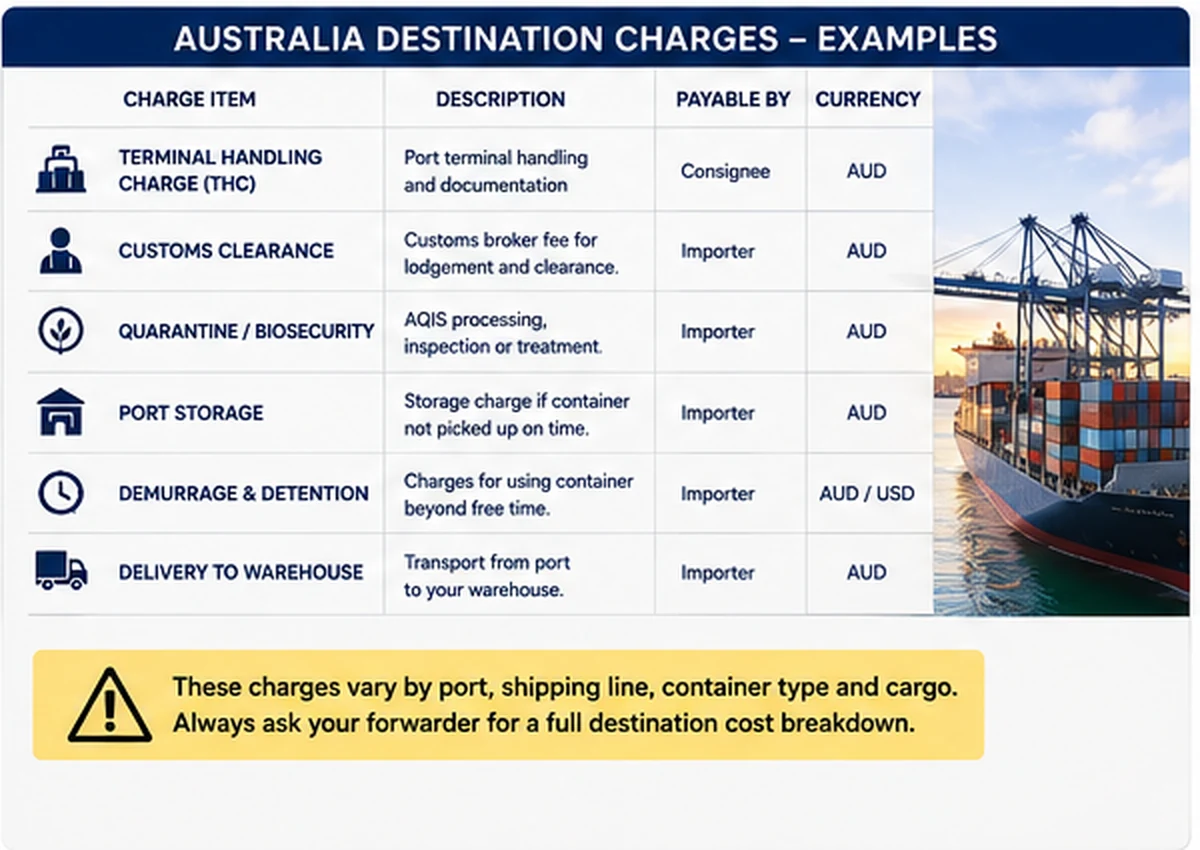
A first-time Australian importer may receive a booking number, bill of lading number, container number, arrival notice, freight invoice and destination-charge invoice for the same shipment. These references have different purposes, and no single status means the container is immediately ready for collection. Shipping lines also use different billing and release systems. One carrier may email an invoice automatically. Another may require the consignee to register on its website, link the company account and download the invoice. A third may require an email to the local office or agent. The amount can also vary by carrier, port, container type, route and contract. The difference between two carriers' ordinary local charges may be modest, but a delayed payment, missing release instruction or late empty return can create a much larger cost. This guide explains the practical sequence from freight payment and final transport document to Australian customs clearance, carrier release, terminal collection and empty-container return.
1. Why Shipping-Line Invoices Are Not All the Same
Each shipping line publishes and administers its own local charges and operating procedures. The invoice description, timing and payment method may therefore differ even when two containers arrive at the same Australian port.
Common carrier or destination items can include:
- Documentation or import service fees
- Delivery order or cargo-release fees
- Terminal-related charges collected by or through the carrier
- Equipment, seal or administration charges
- Demurrage, detention or combined equipment charges
- Special handling or amendment fees
- Applicable GST
Some terminal, depot, customs, biosecurity, trucking or warehousing costs may be billed separately by other parties. For this reason, “port charges” is often too broad a description for invoice checking.
Ask the issuer to identify:
- The bill of lading number
- The container number or containers covered
- The charge period and applicable tariff
- Whether GST is included
- The payment reference required for allocation
- The action that will be released after payment
The cheapest-looking invoice is not automatically the lowest total destination cost. The important comparison is the complete release and delivery scope.
2. Container Number and Bill of Lading Number Have Different Jobs
New importers often send the wrong reference because both numbers appear throughout the shipment.
| Reference | What it identifies | Where it is commonly used |
|---|---|---|
| Container number | One physical shipping container | Terminal pickup, tracking, equipment condition, depot return and detention enquiries |
| Bill of lading number | The carrier's transport document and shipment record | Freight payment, arrival notice, document release, customs records and cargo release |
| Booking number | The original carrier booking instruction | Origin operations, equipment collection, loading and pre-departure communication |
| Seal number | The seal fitted to a loaded container | Security checks, transport documents and delivery verification |
A bill of lading can cover one container or several containers. Each container still has its own equipment number and may have its own pickup, damage and return record.
Why the container number matters
The container number follows the physical equipment. The truck driver, terminal and empty-return depot use it to identify the exact unit. If a shipment has two containers, one can be collected or returned at a different time from the other.
Why the bill of lading matters
The bill of lading connects the cargo, carrier, shipper, consignee, route and freight terms. Depending on its form, it may also control who is entitled to request delivery. The bill number is therefore the main reference for carrier invoices and document-release questions.
For a broader document checklist, see Documents Required for Shipping from China.
3. What a Bill of Lading Does
A bill of lading commonly performs three important functions:
- It records the carrier's receipt of the cargo for carriage.
- It provides evidence of the contract of carriage and its terms.
- In negotiable form, it can function as a document of title.
However, importers should not use “formal bill of lading” as a universal term. The release method may be:
- Original negotiable bill of lading: an appropriately endorsed original may need to be surrendered under the carrier's terms.
- Sea waybill: generally non-negotiable and often allows release to the named consignee after identity, payment and other requirements are satisfied.
- Telex or electronic release: the origin office confirms that the required surrender or release instruction has been completed, subject to carrier procedures.
The transport document is important, but it is not the only condition for collecting a container. Outstanding freight, local charges, customs or biosecurity holds, terminal availability and delivery arrangements may still need to be completed.
4. Why the Importer Has Paid but the Final Bill of Lading Is Still Not Available
This is a common source of confusion in international shipping.
The importer may have sent money, but several separate events still have to occur:
- The importer's bank sends the international payment.
- Intermediary and receiving banks process the transfer.
- The freight forwarder receives cleared funds and identifies the correct shipment.
- The forwarder reconciles the payment against its invoice.
- The forwarder pays the contractual carrier or consolidator where payment is still outstanding.
- The carrier receives and allocates the funds.
- Documentation, freight and release conditions are checked.
- The final bill, sea waybill or release instruction is issued according to the shipment arrangement.
Sending a bank remittance slip proves that payment was instructed; it does not always prove that cleared funds have reached the final recipient or been allocated to the correct bill.
International transfers can be delayed by weekends, bank processing, intermediary banks, compliance reviews, an incorrect payment reference or short payment caused by bank charges.
To reduce delay, send the forwarder:
- Payment date and amount
- Currency
- Invoice number
- Booking or bill of lading reference
- Bank remittance confirmation
- UETR or bank trace reference where available
Then ask for confirmation that the funds have been received and allocated, not only that the payment instruction was sent.
5. Payment to a Freight Forwarder and Payment to the Carrier Are Different Events
Where a freight forwarder is the contracting party with the shipping line, the importer may pay the forwarder rather than the carrier directly. The forwarder then completes its own settlement with the carrier or consolidator.
Carrier terms can allow the carrier to hold freight documents, cargo release or a delivery order until outstanding freight and charges are received. For example, MSC's published bill of lading terms state that the applicable original bill and outstanding freight and charges may be required in exchange for the goods or delivery order.
This does not mean every shipment needs a paper original. It means the agreed document type and all carrier release conditions must be identified early.
Before departure, confirm in writing:
- Who invoices the international freight
- Whether freight is prepaid or collect
- Who is responsible for paying the carrier
- Which bill of lading type will be used
- What must happen before the carrier issues the release instruction
- Which email addresses should receive invoices and arrival notices
6. When Does the Shipping Line Issue the Destination-Charge Invoice?
There is no universal timing rule.
Depending on the carrier, port and shipment, the destination invoice may be available before arrival, around the arrival-notice stage or after cargo discharge information is processed. The invoice may be:
- Automatically emailed to the consignee or notify party
- Downloaded from the carrier's customer portal
- Requested from the carrier's local office
- Sent to the appointed customs broker or freight representative
- Issued in more than one part as additional charges arise
The bill of lading number is normally the most useful reference when requesting the invoice. The consignee may also need to provide company details, customer-account information or proof of authority.
Do not wait until the last free day to ask where the invoice is. Several days before arrival, confirm:
- Which carrier or local agent will invoice the destination charges
- Whether portal registration is required
- Which email address is recorded against the shipment
- Whether the broker or importer is responsible for requesting the invoice
- Which payment methods are accepted
- How long payment allocation normally takes
The previous guide on destination shipping charges explains the other cost items importers should check.
7. Does Paying the Destination Invoice Automatically Release the Container?
Not necessarily.
Container collection normally requires several separate statuses to align:
- The vessel has discharged the container and the terminal shows it as available
- Australian customs clearance is complete
- Biosecurity clearance or any directed action is complete
- The carrier's freight and destination invoices are paid and allocated
- The bill of lading or electronic document-release condition is satisfied
- The carrier or agent has issued the required cargo release or delivery authority
- The terminal appointment and transport booking are confirmed
The practical question is not simply, “Has the invoice been paid?” It is:
Which release condition is still outstanding before the truck can collect this container?
8. When Should the Importer Appoint an Australian Customs Broker?
The importer should appoint the broker before the vessel arrives—ideally before the cargo leaves China when the goods are unfamiliar, regulated or high value.
Early appointment gives the broker time to review:
- Importer identity and authorisation
- Commercial invoice and packing list
- Tariff classification and customs value
- Bill of lading or cargo-report details
- Permits, concessions or origin documents
- Biosecurity information and packing declarations
- Product descriptions, materials and intended use
The Australian Border Force encourages first-time or infrequent importers to use a licensed customs broker. For consignments over AUD 1,000 being entered for home consumption, an Import Declaration is generally required, and applicable duties, taxes and charges must be paid before customs release.
An import declaration can be prepared or lodged before arrival when sufficient and accurate transport and commercial information is available. However, the broker cannot responsibly complete the entry using guesses or incomplete supplier descriptions.
Recommended timing
- Before booking: ask the broker whether the goods have obvious import, tariff or permit concerns.
- After departure: send the final commercial documents and transport details.
- Several days before arrival: confirm declaration, customs and biosecurity status and respond to outstanding questions.
- After clearance: continue monitoring carrier release and terminal availability; customs clearance alone does not book the truck.
For the wider sequence, read What Happens After China Customs Release?.
9. How Many Days Does the Importer Have to Return the Empty Container?
There is no single Australian rule that gives every importer the same number of days.
The free-time calculation depends on:
- Shipping line
- Contract or spot-booking terms
- Port and terminal
- Container size and type
- Dry, reefer or special equipment
- Whether demurrage and detention are separate or combined
- The event from which time starts
- Calendar-day or working-day rules
- Public-holiday treatment
- Any negotiated free time
The empty-return clock is also different from terminal storage in many tariffs. Importers must obtain the booking-specific free-time confirmation and the nominated empty depot.
Current published examples—not a quotation
As an illustration of how tariffs differ, Maersk's Australia import page currently publishes combined detention and demurrage for standard non-spot imports with days 1–8 free. It lists dry-container charges of AUD 100 per day for a 20-foot container and AUD 200 per day for a 40-foot container on days 9–20, rising to AUD 150 and AUD 300 respectively from day 21. The page states that these figures exclude GST and that separate spot terms may apply.
ONE Australia's tariff effective 1 April 2026 publishes a different structure: three days of import demurrage free time for wharf storage and eight days of detention free time for container rental, with separate tariff conditions and charges.
These examples must not be applied automatically to another carrier or booking. Always check the tariff and free-time notice connected to the actual bill of lading.
10. How to Calculate a Late Empty-Return Charge
A simplified calculation is:
Chargeable Days × Applicable Daily Rate = Estimated Detention Charge
But the rate may increase in stages.
For example, if a hypothetical tariff provides eight free days, AUD 200 per day for the next twelve days and AUD 300 per day afterward, a 40-foot dry container returned on day 23 could involve:
- Days 1–8: free
- Days 9–20: 12 × AUD 200 = AUD 2,400
- Days 21–23: 3 × AUD 300 = AUD 900
- Estimated equipment charge: AUD 3,300, before any applicable GST or separate costs
This is only an illustration. The real start date, return event, tariff slabs, tax and exceptions must be confirmed with the carrier.
11. Actions to Take Immediately After Container Pickup
The responsibility does not end when the truck leaves the terminal.
The importer or transport provider should:
- Confirm the container number and seal before leaving the terminal.
- Record visible container damage where appropriate.
- Deliver within the receiver's confirmed opening and unloading window.
- Unpack the container safely and without unnecessary delay.
- Remove cargo, packing material and securing materials as required.
- Check the carrier's nominated empty-return depot before dispatch.
- Return the correct empty container within free time.
- Retain the empty-return receipt or electronic interchange record.
Depot directions can change. A truck should not assume that the empty unit returns to the same place from which the loaded container was collected.
12. A Practical Release Checklist for First-Time Importers
Before vessel departure
- Confirm the bill of lading type and release method
- Check consignee and notify-party contact details
- Confirm who pays international freight
- Appoint the Australian customs broker
- Send permits and product documents early
During ocean transit
- Obtain and check the final transport document
- Send invoice, packing list and bill details to the broker
- Register for the shipping-line portal if required
- Confirm who receives the arrival notice and destination invoice
- Check the published and booking-specific free time
Before Australian arrival
- Confirm customs and biosecurity status
- Obtain the destination-charge invoice
- Use the correct bill number and payment reference
- Allow time for bank funds to clear and be allocated
- Confirm document or electronic cargo release
Before terminal collection
- Confirm the container is discharged and available
- Confirm customs, biosecurity and carrier releases
- Check terminal free time and last-free-day information
- Book the truck and delivery appointment
- Confirm unloading equipment and empty-return depot
After collection
- Unpack promptly
- Monitor the container-return deadline
- Reconfirm the nominated depot
- Keep the return receipt
- Query incorrect detention charges using the bill and container numbers
13. Frequently Asked Questions
I paid the freight forwarder. Why has the shipping line not released the bill?
The international payment may still be clearing, awaiting allocation or waiting for the forwarder's settlement with the carrier. Documentation or release instructions may also remain incomplete. Ask whether cleared funds were received, allocated and paid through to the relevant carrier account.
Can I collect the container with the container number only?
No. The number identifies the physical equipment, but customs, biosecurity, carrier document release, payment, terminal availability and transport arrangements may all be required.
Must I have a paper original bill of lading?
Not always. The shipment may use an original negotiable bill, sea waybill or electronic/telex release. Confirm the agreed document type before departure.
Will every shipping line email the Australian local-charge invoice?
No. Some lines use portals, some email invoices and others require contact with the local office or agent. Confirm the process before arrival.
Does customs clearance mean the container is ready for pickup?
Not by itself. Carrier release, biosecurity status, payment, terminal availability and transport booking may still be outstanding.
Is empty-container free time always eight days?
No. Eight days appears in some current published tariffs, but the actual allowance depends on the carrier, booking, equipment and applicable terms.
14. Control the Shipment by Tracking Responsibilities, Not Just Status Words
The safest import process assigns one person to every action: receiving carrier invoices, checking the bill of lading, authorising the customs broker, paying duties and local charges, booking delivery and returning the empty container.
A shipment can be “customs cleared” but still unavailable. An invoice can be “paid” but not allocated. A container can be “collected” but already approaching its detention deadline.
TengYoda coordinates China-side pickup, loading, export documentation and international freight communication. For an Australia-bound shipment, provide the product details, supplier city, packed dimensions, gross weight, destination port, consignee information and appointed customs-broker contact so the handovers can be planned before the vessel arrives.
Official references include the Australian Border Force Import Declarations guidance, the carrier's applicable bill of lading and local tariff, Maersk Australia import information, and ONE Australia local charges and tariffs. Carrier tariffs and procedures can change, so confirm the terms applying to the actual booking.