Importing a full container from China to Australia? Understanding the total cost of shipping a 40HQ container is essential before placing an order or confirming a shipment. The ocean freight rate is only one part of the total logistics cost. Importers may also need to consider China origin charges, Australian destination charges, customs clearance, biosecurity requirements, taxes and final delivery. This guide explains the main costs involved and how to get an accurate 40HQ shipping quote from China to Australia.
What Is a 40HQ Container?
A 40HQ (40-foot High Cube) is one of the most commonly used containers for shipping goods from China to Australia.
Compared with a standard 40-foot container, a 40HQ provides additional internal height and more usable cubic capacity.
Typical specifications are approximately:
| Specification | 40HQ |
|---|---|
| External Length | 12.19 m |
| External Width | 2.44 m |
| External Height | 2.90 m |
| Typical Internal Volume | Around 76 CBM |
| Practical Loading Volume | Often around 65–70 CBM |
| Maximum Cargo Weight | Depends on container, carrier and transport restrictions |
The theoretical container capacity is not the same as the actual amount of cargo that can be loaded.
Carton dimensions, pallets, wooden crates, irregular cargo, cargo density and weight distribution can all affect usable capacity.
For relatively bulky products such as furniture, kitchen cabinets, lighting, building materials and household products, a 40HQ is often an efficient FCL shipping option.
What Is Included in the 40HQ Shipping Cost?
The total cost of shipping a 40HQ container from China to Australia normally consists of several components.
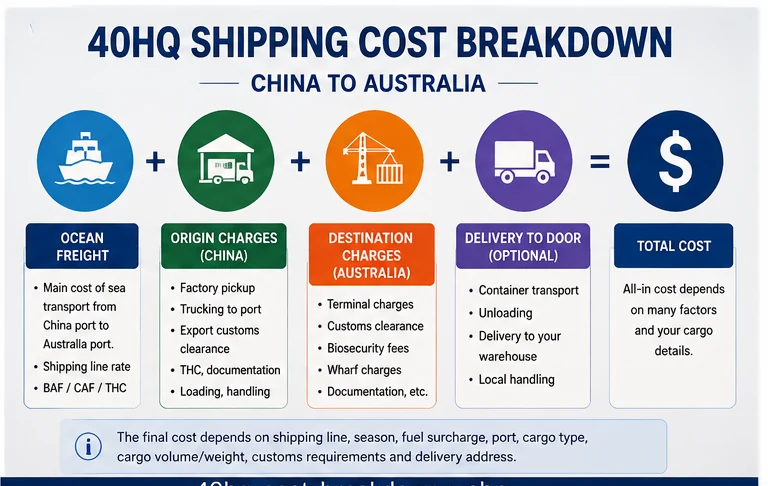
A simplified calculation is:
Total Logistics Cost = China Origin Charges + Ocean Freight + Australian Destination Charges + Customs/Biosecurity Costs + Applicable Duty/GST + Final Delivery
Not every shipment includes exactly the same charges.
The final amount depends on the cargo, Incoterm, ports, shipping line and delivery requirements.
1. China Origin Charges
Depending on the Incoterm agreed with your supplier, China-side costs may include:
- Factory pickup
- Trucking to the loading port
- Container loading
- Export customs declaration
- Documentation
- Terminal handling
- Warehouse handling
- Special cargo handling
For an EXW shipment, the importer generally needs to arrange more of the origin transportation.
For an FOB shipment, the supplier normally handles the agreed origin-side responsibilities up to the FOB point.
2. Ocean Freight from China to Australia
Ocean freight is the main charge for transporting the 40HQ container between the Chinese and Australian ports.
Common ports of loading in China include:
- Shenzhen / Yantian
- Guangzhou / Nansha
- Shanghai
- Ningbo
- Qingdao
- Xiamen
Common Australian destination ports include:
- Sydney
- Melbourne
- Brisbane
- Fremantle / Perth
- Adelaide
Ocean freight rates are not fixed.
They can change according to:
- Shipping line
- Vessel capacity
- Peak season
- Container availability
- Fuel surcharges
- Port congestion
- Direct or transshipment service
- Market demand
For this reason, an online rate from several months ago should not be used as the final shipping budget.
Importers should request a current freight quotation based on the actual shipment details.
3. Australian Destination Charges
After the container arrives in Australia, destination-side charges may apply before the cargo reaches your warehouse.
Depending on the shipment, these may include:
- Shipping line destination charges
- Terminal-related charges
- Documentation fees
- Customs brokerage
- Biosecurity-related charges
- Inspection or treatment where required
- Container transport
- Local handling
- Storage
- Demurrage
- Detention
This is an important reason why importers should not compare freight forwarders based only on the ocean freight number.
When reviewing a quotation, always confirm whether the price is:
Ocean freight only, port-to-port, or a complete door-to-door logistics quotation.
4. Australian Customs Duty and GST
Australian import costs can also include customs duty, GST and government-related charges depending on the goods and circumstances.
For taxable importations, Australian GST is generally calculated at 10% of the Value of the Taxable Importation (VoTI).
The actual customs treatment depends on factors such as:
- Product classification
- HS code
- Customs value
- Country of origin
- Applicable tariff treatment
- Trade agreements
- Available concessions
- Supporting documentation
Before shipping, importers should confirm the correct HS code and customs requirements for their products.
5. Australian Biosecurity Requirements
Australia has strict biosecurity requirements, so preparation before departure is important.
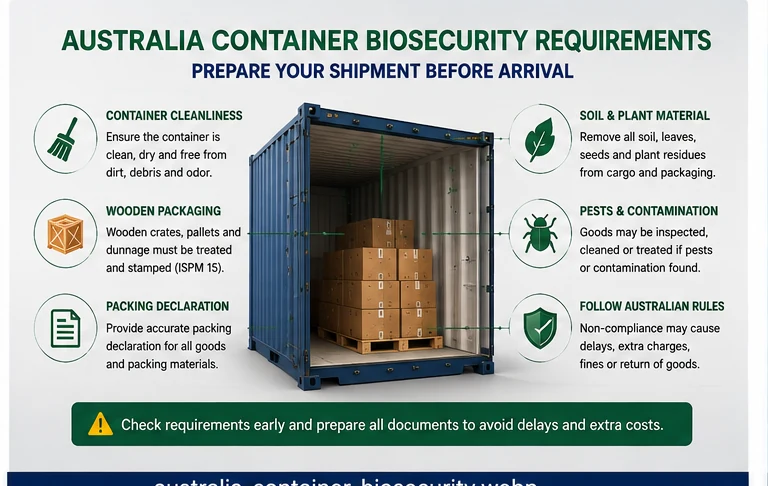
Importers and suppliers should pay attention to:
Container Cleanliness
The container should be clean and free from soil, plant material, seeds, insects and other contamination.
Wooden Packaging
Wooden crates, pallets and dunnage may be subject to biosecurity requirements.
Where applicable, compliant treatment and marking such as ISPM 15 may be required.
Packing Declaration
Accurate shipping and packing documentation should be prepared before the container arrives in Australia.
Inspection and Treatment
If contamination or other biosecurity concerns are identified, cargo or containers may require inspection, cleaning or treatment.
This can result in:
- Additional charges
- Delivery delays
- Storage costs
- Treatment costs
Checking the requirements before loading is usually much easier than resolving a problem after arrival.
6. Main 40HQ Shipping Routes from China to Australia
China has several major container ports serving Australian destinations.
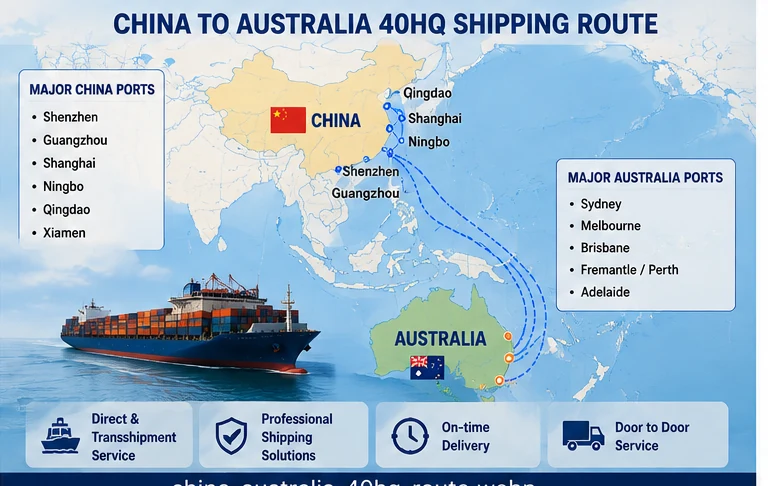
Typical routes include:
Shenzhen / Yantian → Sydney
Shenzhen / Yantian → Melbourne
Shenzhen / Yantian → Brisbane
Guangzhou / Nansha → Sydney
Guangzhou / Nansha → Brisbane
Shanghai → Sydney / Melbourne
Ningbo → Sydney / Melbourne
China → Fremantle / Perth
The best route does not always mean choosing the lowest freight rate.
Importers should also consider:
- Transit time
- Direct vs transshipment service
- Shipping line reliability
- Vessel schedule
- Destination charges
- Final delivery location
7. How Long Does a 40HQ Take from China to Australia?
Transit time depends on the port pair and shipping service.
As a practical planning range, many China-to-Australia container services may take approximately 2–4 weeks port-to-port.
Actual transit time can be affected by:
- Vessel schedules
- Port congestion
- Transshipment
- Weather
- Customs clearance
- Biosecurity inspection
- Documentation issues
- Public holidays
For a time-sensitive shipment, request the current:
ETD + ETA + shipping line + vessel schedule + direct/transshipment information
before confirming the booking.
8. Example of a Complete 40HQ Logistics Chain
Consider an Australian importer purchasing furniture and building materials from suppliers in Foshan, China.
A typical logistics chain may look like:
Factories in Foshan → Cargo collection → Container loading → China export customs → Shenzhen/Guangzhou port → Ocean freight → Australian port → Customs & biosecurity clearance → Container pickup → Delivery to importer → Empty container return
If products are purchased from several Chinese suppliers, the cargo can also be collected into one warehouse before loading.
This is commonly known as multi-supplier consolidation.
For Australian importers purchasing furniture, lighting, sanitary ware and other building materials from different factories, consolidating everything into one 40HQ can simplify the logistics process.
9. How to Reduce 40HQ Shipping Costs
Book Early
Booking early provides more options for shipping lines and sailing schedules.
Waiting until the cargo is already finished can reduce your available choices.
Improve Container Loading
Better carton dimensions and loading arrangements can increase container utilization.
For volume cargo, even a small improvement in loading efficiency can make a significant difference.
Consolidate Multiple Suppliers
If you purchase from several factories in China, consider collecting the goods into one warehouse and loading them into one 40HQ.
Prepare Documents Before Arrival
Prepare and check documents such as:
- Commercial Invoice
- Packing List
- Bill of Lading
- Packing Declaration
- Treatment documents where required
- Product information
- HS codes
before the vessel arrives.
Avoid Port Storage and Delays
Customs clearance, biosecurity processing, shipping-line release and container delivery should be coordinated as early as possible.
Delays at the destination can create unnecessary storage, demurrage or detention costs.
10. 40HQ vs LCL: Which Is Better?
A 40HQ is not always the best shipping method.
If you only have a small volume of cargo, LCL (Less than Container Load) may be more economical.
As cargo volume increases, FCL (Full Container Load) can become more attractive.
Advantages of FCL include:
- Dedicated container
- Less cargo handling
- Better loading control
- Reduced mixing with other shipments
- Easier management of larger orders
The correct choice should be based on:
CBM + weight + cargo type + origin charges + ocean freight + destination charges
rather than container size alone.
11. What Information Is Needed for an Accurate 40HQ Quote?
To receive an accurate shipping quotation, provide:
- Cargo name
- Supplier city in China
- Total number of packages
- Total CBM
- Gross weight
- HS code if available
- Port of loading if known
- Australian destination city
- Delivery postcode
- Incoterm — EXW, FOB, CIF, DAP or DDP
- Whether customs clearance is required
- Whether final delivery is required
For machinery, oversized cargo, dangerous goods or special products, provide additional information such as photos, dimensions, MSDS or relevant technical documents.
Frequently Asked Questions
How much does it cost to ship a 40HQ container from China to Australia?
There is no permanent fixed price. Ocean freight changes according to the shipping line, season, port pair, container availability and market conditions. The total logistics cost also depends on origin charges, destination charges, customs requirements and final delivery.
Can I ship goods from several Chinese suppliers in one 40HQ?
Yes. Goods from multiple suppliers can be collected into a warehouse and consolidated before container loading.
Is 40HQ suitable for furniture and building materials?
Yes. 40HQ containers are commonly used for furniture, cabinets, lighting, household goods and many building materials. Heavy cargo should also be checked against applicable container and road weight restrictions.
Can a 40HQ container be delivered directly to my warehouse in Australia?
Depending on the shipment and destination, a freight forwarder can arrange container pickup from the port and delivery to the consignee's warehouse.
Can I use DDP shipping from China to Australia?
DDP or other door-to-door solutions may be available depending on the cargo type, shipment details and applicable import requirements. The cargo should be reviewed before confirming the service.
Get a 40HQ Shipping Quote from China to Australia
Every shipment is different.
TengYoda Logistics can coordinate China-to-Australia shipments including:
- FCL sea freight
- 20GP / 40GP / 40HQ containers
- Factory pickup
- Multi-supplier consolidation
- Container loading
- Export customs declaration
- Australia customs coordination
- Door-to-door delivery
If you are planning a 40HQ shipment from China to Australia, send us:
Cargo name + supplier city + CBM + weight + Australian destination postcode + Incoterm
and we can prepare a shipping solution based on your actual cargo.
Need a current 40HQ shipping quote from China to Australia? Contact TengYoda Logistics for a tailored freight solution.