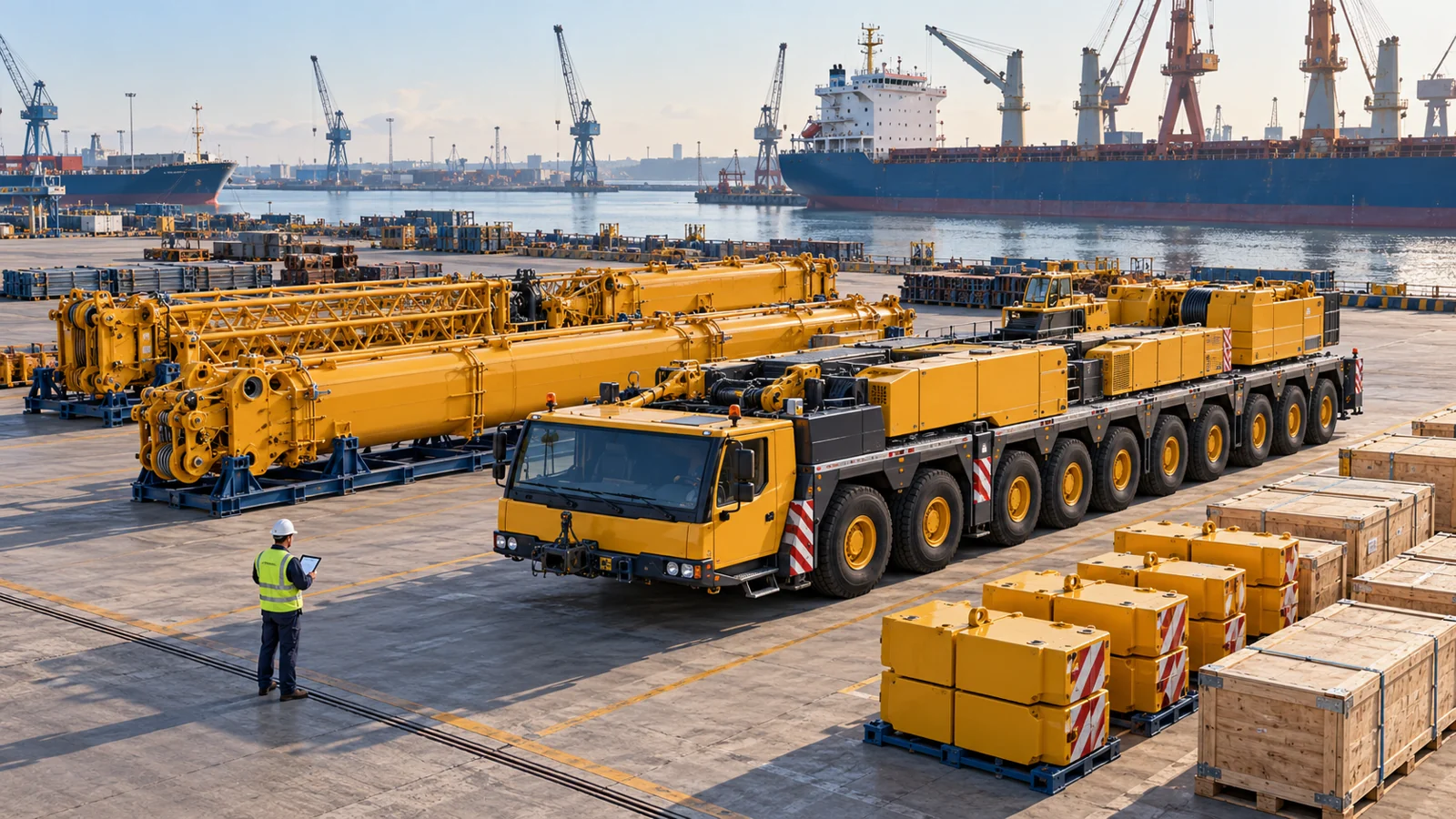
A used heavy machine in China can be attractively priced, but the purchase is only the beginning. Before that machine can work at a Saudi project site, someone must verify its condition, plan its shipping configuration, organise road transport, arrange export and import formalities, and make sure it can be unloaded and reassembled. This Shanghai-to-Jeddah guide follows that journey in working order: before purchase, preparation in China, export and sea transport, then arrival and commissioning in Saudi Arabia. At each stage, it explains the buyer's decisions, the work that can be delegated and the costs that need to be included. The example comes from an inquiry involving a used SANY SAC4000C8-8 crane. It is a planning example, not a completed-shipment case study. The supplied list records a 61.77-tonne main unit and a combined weight of 194.45 tonnes, but its package dimensions and volume totals need verification. No current carrier rate or confirmed sailing is represented here. Some work runs in parallel. Import eligibility, destination reassembly support and preliminary transport feasibility should be checked before purchase; the final packing list and carrier acceptance must be settled before dispatch. Waiting until the vessel arrives to address these questions is too late.
Step 1: Confirm Saudi import eligibility and the final delivery requirement
Have the Saudi importer and its customs broker review the exact equipment description, proposed classification, year, condition, serial number and intended use. Ask them to confirm applicable age or condition restrictions, ownership evidence, conformity and inspection requirements, and any registration needed for road use. Do not apply a generic “machinery duty rate” or assume that every used machine follows the same approval path.
For lifting equipment within its scope, Saudi Arabia's published lifting-equipment regulation requires an inspection certificate for used equipment from an accepted body. It also addresses inspection after installation and before service. It permits separate-part transport where logistics or transport limits prevent fully assembled shipment, with evidence connecting those parts to the approved final model. Obtain the applicable certification route for the actual crane before it is dismantled or shipped.
SASO's model-conformity certificate service for lifting equipment expressly excludes used lifting equipment. That does not by itself mean used cranes are banned; it means the new-equipment service should not be assumed to be the correct procedure. Ask the importer and an accepted assessment body to identify the required process and SABER records for this unit.
Arrange any inspection that needs the machine assembled and operational before taking it apart. TengYoda can coordinate access and document collection in China; the relevant assessment body decides conformity, and the buyer must provide an eligible importing entity and the required authorisations.
At the same time, give the agent the final Saudi site address, intended use and required operating date. “Jeddah port” is not enough to assess the inland journey. State whether the requested service ends at the port, on a truck at the site, after unloading, or after separately contracted commissioning.
The buyer provides the importing entity, authorisations and site requirements. TengYoda can coordinate information from the Chinese seller and the agreed Saudi service providers. Budget for the applicable compliance work and destination assessment before authorising the purchase.
Step 2: Inspect the machine and agree the purchase contract
Before committing to the purchase, establish whether the machine can do the intended job, legally enter Saudi Arabia, reach the final site and be supported there. A video showing an engine starting answers only a small part of that question.
Ask a competent machinery inspector or engineer to assess condition, structural repairs, hydraulics, controls and safety systems within a written inspection scope. Match the nameplate, chassis or serial number and manufacturing year to the sales documents. Check ownership evidence, included attachments, maintenance records and the availability of manuals and replacement parts. A warehouse count or a forwarder's photographs are not a technical condition assessment.
The purchase contract should identify the actual unit, accepted condition, included components, missing items, agreed repairs, dismantling work, documentation and acceptance milestones. Agree who pays for inspection, who bears the cost of a failed inspection and what must happen before the balance is released. An agent can arrange the inspection and report findings; the buyer must decide whether the machine meets the intended use and whether to proceed.
A useful buying condition: require an agreed inspection result, import-feasibility review and workable transport-and-reassembly plan before an irreversible payment milestone. The exact wording belongs in the buyer's contract with the seller.
For the difference between receiving checks and a specialist inspection, read what a freight forwarder can check before shipping.
Step 3: Compare transport configurations and build a preliminary budget
Once the equipment's identity and purchase requirements are clear, collect the seller's location, current configuration, preliminary dimensions, individual weights, photographs and drawings. The goal is to identify a feasible route from the seller's yard to the final site before committing to an expensive shipping configuration.
The main unit in this inquiry is listed as 17.22 × 3.00 × 4.00 m and 61.77 tonnes. Those figures immediately make road access, handling and carrier acceptance important. They are preliminary cargo data, not proof that a particular trailer, crane or vessel can take the load.
Start with the largest piece and the hardest road constraint. Then decide how the remaining components should travel.
| Method | When it may be worth assessing | Acceptance questions |
|---|---|---|
| RoRo for a mobile main unit | Suitable machinery can move safely onto and off the vessel | Running condition, brakes, steering, leaks, ramp capacity, axle loads, clearances and actual route availability |
| RoRo using handling equipment | Non-running pieces or accessories can use an accepted roll trailer or another system | Available equipment, secured load dimensions, deck position and handling at both ports |
| Breakbulk or heavy-lift vessel | Large units need a dedicated lifting and stowage arrangement | Lift plan, port capability, deck or hold loading, securing, weather exposure and discharge method |
| Container or flat rack for suitable pieces | Detached components can meet the chosen equipment's limits | Actual payload, support loads, dimensions, packing, securing and carrier approval |
| A combined shipment plan | Main machine and accessories suit different methods | Extra documents, arrival coordination, handling cost and the risk of a critical component arriving later |
Do not assume the 61.77-tonne main unit belongs on one standard flat rack. Carrier equipment and concentrated-load limits must be checked. Hapag-Lloyd's flat-rack loading guidance is an example of why support and securing details matter in addition to overall weight.
Likewise, non-running cargo is not automatically excluded from every RoRo solution: operators such as Wallenius Wilhelmsen describe specialised handling equipment. That equipment capability does not establish availability for this Shanghai-to-Jeddah shipment. Obtain written acceptance for the actual cargo, equipment, ports and sailing.
For any transshipment, check the intermediate port's handling and weight constraints as well. A proposed sailing is not a confirmed booking. Compare the cargo-ready date, inspections, permits, terminal receiving window and destination readiness against the vessel plan.
Compare minimum dismantling with selective dismantling, using the same delivery scope. Include the buyer's local reassembly estimate in that comparison. TengYoda can coordinate transport proposals; the buyer and its technical provider should approve the configuration and the assumptions behind the budget.
Before the first handling operation, also agree cargo-insurance instructions with the relevant provider: declared value, used-equipment condition, covered transport stages, loading and unloading, exclusions and deductibles. Do not assume dismantling, mechanical defects or commissioning are automatically covered.
At this stage, a budget may be conditional. Identify which costs await verified measurements, inspection results, permits or a firm carrier offer. A budget approval is not yet permission to dispatch the machine.
Step 4: Approve the dismantling plan and organise technical support
Dismantling can reduce shipping height, width or the weight of the largest lift. It may make a road route feasible, allow a lower-cost vessel arrangement, or let detachable accessories travel in a container. Removing counterweights can reduce the main unit's transport weight; separating long structures can improve handling and stowage.
But dismantling does not necessarily reduce the whole shipment's weight or volume. Steel frames, crates and separate supports add weight and space. More packages mean more handling and more opportunities for loss. The machine may cease to be self-propelled in the proposed configuration, changing its suitability for RoRo. Technical labour and reassembly costs may exceed the freight saving.
Ask the manufacturer or a qualified machinery specialist to identify permitted separation points and the technical consequences. Transport dismantling should use the approved procedure; structural cutting or modification should never be improvised to make a quotation work.
| Planning option | Possible benefit | Cost or constraint to check |
|---|---|---|
| Minimum dismantling | Fewer loose components and less reassembly work | Larger road envelope, heavy lifts and restricted vessel choices |
| Selective dismantling | Remove the parts driving height, width or individual-piece weight | Engineering approval, temporary supports, handling and local assembly support |
| More extensive dismantling | Some components may fit ordinary freight equipment | More packages, preservation, inspection, testing and technical labour |
Before removal starts, identify the team that will put the machine back together in Saudi Arabia. Obtain the necessary manuals, drawings, component references and technical-support arrangements. Confirm whether on-site assistance, special tools or replacement items will be needed, and who pays for them.
The seller or qualified technical contractor carries out the approved dismantling. TengYoda can coordinate the work timetable, access and subsequent transport requirements; it does not replace the machinery engineer. The buyer approves the technical scope and the additional costs.
Record the machine's condition before dismantling, photograph the separation points and identify the parts. Finish any inspection that requires the machine to be assembled and operational before changing that condition. Keep dismantling labour, auxiliary lifting, preservation and later reassembly as visible budget lines.
Step 5: Identify, protect and measure every shipping package
A missing pin, connector or control component can delay an otherwise successful delivery. The solution is to connect each physical package to a documented place in the machine.
Create a master register with a package ID, accurate description, quantity, gross weight, transport dimensions, packing method, photographs and the related assembly or drawing reference. Mark components before removal. Record which fasteners belong to each connection and where they are packed. Keep the working document under revision control so the workshop, trucker, broker and carrier are all using the same version.
Use specific descriptions such as “used mobile-crane main unit, model and serial number,” “detached boom section” or “steel counterweight for the identified crane.” A mixed case should have its own contents list. “Machinery parts” alone is usually too vague for effective identification and quotation review. The declarant must confirm the correct customs description and classification for the actual goods.
Small items can be grouped in numbered, secured cases with contents recorded inside and outside. Long sections need suitable supports and protection for vulnerable areas. Heavy counterweights need an approved handling and securing arrangement; an ordinary carton or pallet is not automatically suitable. Technicians should protect disconnected hydraulic and electrical interfaces using the machine's appropriate preservation procedure.
Disclose batteries, residual fuel, lubricants, pressurised components and any accompanying chemicals. Obtain the information needed for carrier review and any required handling or documentation. Used equipment must not be presented as ordinary dry cargo without checking its actual condition.
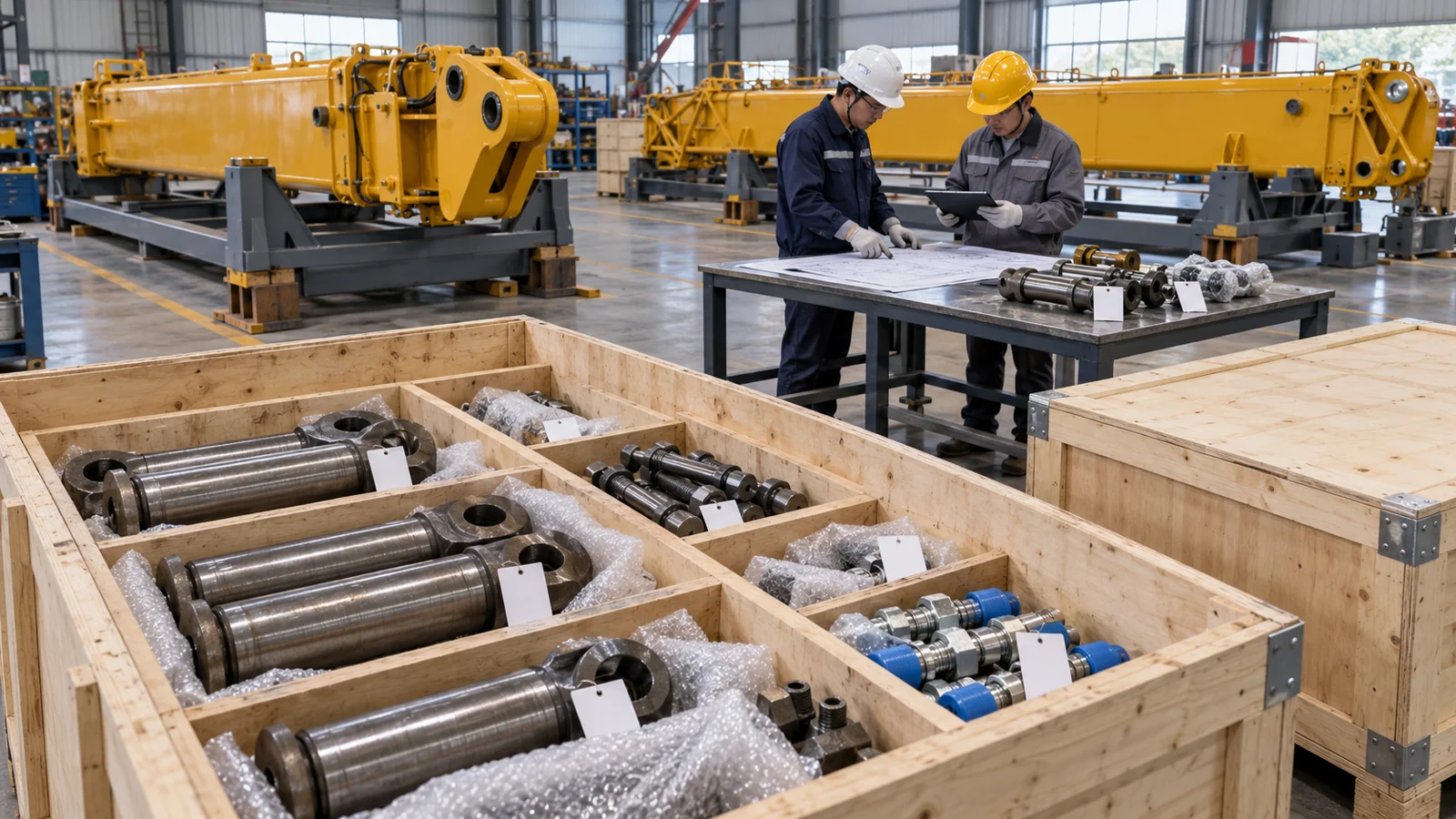
TengYoda can coordinate supplier follow-up, cargo identification, packing arrangements and consolidation. Specialist preservation, disassembly and engineering work should be separately assigned and quoted. Our shipping marks guide explains the basic identification principles.
Replace the preliminary list with a verified shipping register
After packing, measure and confirm each package in its actual transport orientation. Include supports, crates and any projecting parts. Separate gross weight, physical volume and the carrier's charging quantity. Assign a revision number to the list used for booking, road planning and customs review.
The inquiry illustrates why this matters. Its listed unit volumes multiplied by quantities total approximately 624.13 CBM, while the footer states 565.43 CBM. Some total-volume cells appear to contain weight-based figures. Neither total is a verified final shipment volume. The 14.25 m dimension entered under “height” and the separate 35.00 m length entry also need clarification from the seller.
Where a freight offer uses weight or measurement, ask the carrier to define the units, whether comparison is per package or across the shipment, and any minimums. A billing quantity must not be copied into the packing list as if it were a measured physical volume.
The buyer should receive the final register and a photographic record before approving the next stage. Packing, weighing, measuring and additional supports should be included in the agreed preparation charges. Carrier measurement guidance explains why inaccurate dimensions can affect invoicing and cargo operations.
Step 6: Confirm the booking, costs and handover responsibilities
Use the verified shipping register to obtain final carrier acceptance and confirm the selected shipment plan. Preliminary space discussions can happen earlier, but changes in dimensions, weight or condition must be reported and accepted before dispatch.
The booking confirmation should identify the cargo, ports and terminal, proposed vessel or service, cargo-receiving window, documentation cutoff, accepted configuration, freight basis and applicable validity. Clarify any transshipment and the consequences of late cargo or a changed vessel plan.
Ask for a written answer for each handover. “Shanghai–Jeddah freight” does not tell you who pays to lift the machine off a truck, secure it on board, discharge it at Jeddah or unload it at the project site.
| Handover | Questions the quotation should answer |
|---|---|
| Seller's yard to road vehicle | Who supplies the loading equipment, operator and technical method? Is loading included? |
| Origin vehicle to terminal or vessel | Who unloads, stores, lifts or drives the cargo? What are the waiting and storage terms? |
| On board | Who pays for securing, materials, inspection and any special stowage arrangement? |
| Vessel to Jeddah terminal or vehicle | Is discharge included? Who provides special lifting gear and removes securing materials? |
| Port release to final site | Who handles import clearance, taxes, road permissions, delivery and unloading? |
| Delivered components to working machine | Who assembles, tests, obtains required inspection and signs acceptance? |
Sales terms and the freight contract must be read together. If a quotation uses abbreviations such as FIO, FIOS or liner terms, request the exact loading, stowage, securing and discharge inclusions in plain language. Do not infer that every terminal charge is included.
For site delivery, the unloading distinction is particularly important: under Incoterms® 2020, DAP delivery is on the arriving vehicle ready for unloading, while DPU includes unloading at the named place. Neither phrase alone specifies a machinery commissioning service. ICC's explanation of DAP and DPU sets out that distinction. Also see our door-to-door shipping scope guide.
TengYoda can consolidate the transport offers and identify gaps between providers. The buyer approves the selected scope, payment terms and any exclusions. A quotation should specify who may authorise additional charges, rather than leaving that decision until a truck or vessel is waiting.
Step 7: Obtain origin road permissions and move the cargo to the port
All of them matter. Passing one check does not establish that the complete journey is feasible.
For the road leg, the truck or trailer, packing and cargo form a combined transport envelope. A machine standing 4.00 m high may sit higher once placed on a trailer. Cargo weighing 61.77 tonnes is not a 61.77-tonne truck-and-load combination. Trailer tare, axle distribution, bridges, overhead clearances, turning space, gradients and the seller's gate all need review.
China's 2021 amended oversized-road-transport rules include ordinary thresholds of 4.00 m overall height, 2.55 m width and 18.10 m length, with weight thresholds dependent on vehicle configuration and stated exceptions. These are not a complete route assessment. Eligible indivisible abnormal loads need the required permission; a permit is not a way to ignore axle loads or move divisible cargo in an unnecessarily overloaded configuration.
The qualified road carrier should prepare the vehicle-and-load plan and apply to the relevant authority before movement. TengYoda can coordinate the carrier, seller and shipment timetable. The Ministry of Transport's permit guide makes clear the need for a suitably qualified operator and accurate cargo information. In the service order, identify who applies, who pays for route surveys and escorts, and what happens if the proposed route is not approved.
For a mobile crane travelling under its own power, ask the specialist operator to confirm the applicable road-use and permit requirements for that vehicle; do not assume the rules for a cargo unit on a trailer answer every question.
Once the necessary permissions and receiving arrangements are confirmed, schedule the seller's loading equipment and the appointed vehicles. Check that the trucked cargo matches the approved configuration, and record the package handover and condition.
Do not send the machinery to the terminal before its agreed receiving window. Coordinate permits, pickup, port acceptance and vessel timing together. Price the road movement, loading, route survey, applicable escorts, waiting and any intermediate storage as distinct items.
Step 8: Complete export documentation, declaration and terminal handover
Start collecting export documents earlier, alongside preparation and booking. By the time the cargo moves to port, the appointed exporter and declarant should have reviewed the file and confirmed the required filing and inspection arrangements.
Identify the Chinese exporter and the party authorised to submit the export declaration before collection. A seller offering a machine does not automatically mean it has included export formalities in its price. TengYoda can coordinate the agreed export arrangement and the appointed declarant, but the actual exporter, authorisations and documentary responsibilities must be clear.
Prepare accurate commercial and packing documents with the machine's identity, condition, value and component details. Ask the customs specialists on both sides how the disassembled machine is to be presented and classified, particularly if components will sail separately. Do not simply declare everything as unrelated spare parts to bypass the equipment's requirements. Agree how serial numbers, invoices, certificates and packing lists will be linked across any split consignments.
Depending on the agreed transaction and applicable requirements, the working file may include the sales contract, commercial invoice, detailed packing list, declaration information, authorisation, equipment identity and supporting certificates. The appointed declarant should specify the actual requirements; a generic checklist does not settle the classification of a dismantled crane.
At the terminal, reconcile the received packages with the shipment register and record any exceptions. If customs or the terminal requires inspection, opening, rehandling or changes, agree the response and cost approval promptly. Export declaration charges, documentation, terminal handling and inspection-related costs are not automatically part of the ocean-freight figure.
The buyer supplies accurate commercial information and required approvals; the exporter and authorised declarant perform their respective duties. TengYoda coordinates the document and operational handovers within its contracted scope.
Step 9: Load, secure and document the cargo on board
Customs release does not by itself confirm that the machinery can be loaded. The nominated vessel and terminal still need the accepted handling method, cargo configuration and operational arrangements.
For a heavy lift, the competent lifting team must assess the lifted load, rigging, centre of gravity, working radius and the actual equipment capacity. A crane's headline tonnage is not its capacity at every radius. For RoRo, confirm the running condition or approved handling equipment, ramp and deck limits, clearances and securing arrangements.
Record the packages loaded and any exceptions, and obtain the agreed condition photographs or survey records. Identify who provides and pays for lifting gear, supports, securing materials, stevedoring and any required survey. Where the buyer has insurance conditions concerning handling or survey, check that the agreed arrangements meet them.
TengYoda can coordinate the port, carrier and agreed service providers. Loading and securing are performed by the responsible competent operators. The buyer should be informed of material changes to the accepted plan and approve resulting commercial changes before they are implemented where practicable.
Step 10: Manage the sea journey, payments and release documents
After loading, check the shipping documents against the final cargo register: parties, ports, descriptions, package counts, weight and the agreed transport details. Resolve discrepancies promptly through the appointed parties.
Track the sailing and arrival updates, but avoid treating the estimated arrival date as a guaranteed site-delivery date. Port operations, inspections, release procedures and inland permissions still sit between vessel arrival and delivery.
Keep payment allocation, bill-of-lading release, carrier release, customs release and terminal availability as separate status items. A buyer's bank remittance does not instantly settle every downstream account or release condition. Agree the document-release method, payment deadlines and receiving contacts in advance.
During transit, send the Saudi broker the agreed document set and continue arranging destination equipment and permissions. Ask for destination charges and service estimates in time to review and pay the applicable items. Do not wait for the ship to arrive before discovering that the local haulier or unloading equipment has not been arranged.
TengYoda can keep the agreed parties informed and coordinate document handover. The buyer must make timely payments, provide authorisations and keep the receiving side ready. Any financing cost, storage exposure or change charge should be visible in the project budget.
Step 11: Coordinate Saudi import clearance and discharge at Jeddah
The Saudi broker's review begins before shipment, not at this stage. ZATCA's import instructions identify commercial and transport documents, product-specific requirements and advance filing through Fasah, calling for the declaration process at least 48 hours before arrival. A used-machinery file should be prepared well before that minimum.
At arrival, coordinate discharge, terminal handling, any inspection, customs processing and carrier release. These activities may overlap; customs clearance is not necessarily completed before physical discharge. Confirm the actual port process with the local agent and terminal.
The importer and authorised broker handle the agreed import formalities. The buyer funds the applicable taxes and charges and supplies any additional information required. A separately appointed local provider should confirm discharge arrangements, storage allowances and the resources needed to collect the oversized cargo.
Saudi Arabia's standard VAT rate is 15%, but the project's duty, valuation, exemptions and VAT treatment require assessment for the actual goods. Do not apply a universal machinery duty percentage. Distinguish tax cash flow from tax that may be recoverable; see ZATCA's imports and exports VAT guide.
Account for discharge, unsecuring, terminal handling, document release, brokerage, inspections and storage according to the agreed scope. Record damage or shortages promptly and notify the responsible parties within the applicable contractual and insurance deadlines.
Step 12: Obtain local transport permissions, deliver and unload at the site
Saudi inland delivery needs its own route and permit review, started early enough to support collection. Name the local heavy-haul contractor and confirm responsibility for the relevant road and terminal permissions, escorts and route checks. Chinese permits do not authorise the Saudi leg; the local operator must confirm the applicable requirements.
Before pickup from Jeddah, the buyer should confirm the site's receiving window, access route, gate dimensions, ground conditions and unloading area. The local provider needs the same verified package dimensions and weights used in the shipment plan.
A delivery truck arriving at the gate is not the same as unloading the machinery into position. Reserve suitable handling equipment and personnel, and identify who approves the unloading method. The responsibility agreed in the delivery scope must match the practical arrangements on site.
Check package IDs and visible condition at handover and record any discrepancy. Keep proof of delivery, photographs and exception records. Price local transport, applicable permit and escort work, waiting, site unloading and any extra positioning separately where they are not included.
TengYoda can coordinate destination handovers when that service is included and confirmed with local providers. The buyer remains responsible for providing the agreed site access, receiving personnel and timely decisions.
Step 13: Reassemble, test and accept the equipment
The appointed technical team now puts the reassembly plan agreed before dismantling into practice. It should reconcile the delivered components against the drawings, package register and photographs, and resolve missing or damaged parts before operational acceptance.
The buyer provides the agreed site conditions and technical resources. The assembly contractor performs its contracted work, using the appropriate procedures, tools and support. TengYoda can coordinate the agreed logistics and information handover; technical commissioning remains with the responsible specialist.
Complete the agreed functional checks and testing, and arrange the applicable post-installation inspection before use. Record results, defects requiring correction and the final handover. The buyer's technical acceptance should be separate from the transport delivery receipt: “delivered” does not establish that the machine is ready to work.
The budget should include technical labour, auxiliary handling equipment, agreed specialist attendance, parts, consumables, testing and inspection. Transport coordination alone is not an equipment warranty or a commissioning contract.
What should the complete purchase-to-operation budget include?
There is no defensible fixed total from the preliminary list alone. The verified packing configuration, seller's location, loading arrangements, shipping method, departure window and final Saudi delivery address are still needed. A price based only on “194.45 tonnes” would omit the factors driving this project.
Build the budget in two stages: delivered cost and cost to put the machine into service.
| Budget line | What to have priced or confirmed |
|---|---|
| Machine purchase | Exact included equipment, condition, repairs and contract currency |
| Condition and conformity work | Inspector's scope, required tests, certification fees and who pays for a failed assessment |
| Dismantling and preparation | Technical labour, handling equipment, preservation, parts register and packing |
| China inland movement | Truck configuration, route survey, permits, escorts, loading and waiting |
| Export and origin port | Declaration service, applicable documents, terminal receiving, storage and handling |
| Vessel loading and securing | Crane or ramp handling, rigging, dunnage, lashing, surveys and any heavy-lift surcharge |
| Ocean freight | Confirmed billing basis, route, sailing, validity, included surcharges and revision conditions |
| Cargo insurance | Declared value, transport stages, used-equipment terms, deductibles and specific handling cover |
| Jeddah arrival | Discharge, unsecuring, terminal handling, storage, release documentation and broker charges |
| Import taxes and charges | Confirmed HS treatment, customs valuation, duty, VAT and any applicable relief |
| Saudi inland delivery | Local permits, escorts, suitable vehicles, waiting and final-site access |
| Site unloading and commissioning | Handling equipment, technicians, reassembly, testing, inspection and operator handover |
| Contingency and cash flow | Defined allowance for delays, repairs or scope changes, plus payment and currency arrangements |
Keep each supplier quotation in its original currency and state the budget exchange rate and date. Identify minimum charges, free-storage allowances, payment timing and who must approve extras. A coordinated budget should also show any line still awaiting a firm quotation.
Saudi Arabia's standard VAT rate is 15%, but that does not justify using a universal tax-inclusive percentage for the project. Customs classification, valuation, duty and possible exemptions need review. The buyer should distinguish tax cash flow from tax that may be recoverable. See ZATCA's imports and exports VAT guide.
Check the final plan against the original budget
Volume sensitivity, not a quotation: the difference between 624.13 CBM and the list's 565.43-CBM footer is 58.70 CBM. If a hypothetical contract charged USD 100 per CBM and all of that difference were billable, the impact would be USD 5,870. USD 100 is an invented illustration, not a current Shanghai-to-Jeddah rate. Actual pricing might use a different measurement rule, weight basis, minimum or lump sum.
Dismantling break-even, not a project estimate: suppose a revised plan saves USD 12,000 in freight and transport, but adds USD 5,000 of dismantling, USD 2,000 of packing and USD 6,000 of reassembly. It costs USD 1,000 more overall, before any downtime. All these figures are invented. The decision should compare complete, technically feasible options with matching scope.
The useful saving is the reduction in total cost to achieve the buyer's required result. It may come from selective dismantling, fewer unplanned handling operations, better packing, earlier documentation or avoiding an unsuitable route—not necessarily from the lowest sea-freight line.
How TengYoda connects the stages of the export process
TengYoda's role is to coordinate China-side supply-chain work around the actual machine and the buyer's delivery requirement. Our oversized cargo service starts with each piece's transport dimensions, weight, lifting points and access constraints.
For a project like this, ask us to agree the following deliverables in the service scope:
- A reviewed cargo register showing which measurements, weights and package details are confirmed and which remain open.
- A comparison of feasible shipping configurations, including the effect of dismantling and accessory shipments on the complete budget.
- Named responsibilities for supplier preparation, qualified road transport, export formalities, port handling and vessel coordination.
- A shipment timetable linked to inspection, permit, packing, documentation and receiving milestones.
- A written cost breakdown with inclusions, exclusions, assumptions and a process for approving changes.
- Where destination services are requested, a confirmed scope with the Saudi broker and operating providers for release, inland movement and delivery handover.
Technical certification, structural assessment, road-permit approval and machinery commissioning belong with the qualified providers or authorities responsible for them. TengYoda can help bring those workstreams together and make the handovers visible. Destination unloading, engineering attendance and commissioning should be confirmed separately before the buyer relies on them as included services.
Planning to buy used machinery in China for delivery through Jeddah? Send Vinson the model and year, nameplate and current-condition photos, seller's location, preliminary transport list, dismantling options, expected ready date and final Saudi address. Add your intended use and the technical support available at the receiving site. We can start by identifying the missing information and comparing practical transport scopes before you commit to a shipment.
Discuss your machinery shipment with TengYoda on WhatsApp or email vinson_xie@tydscc.cn.
Sources and scope
Official and carrier references were checked on 16 October 2026. Eligibility, acceptance, sailing availability and charges must be confirmed for the exact equipment and movement. The photographs are AI-generated illustrations, not evidence of a completed TengYoda shipment or an approved lifting, packing or transport design.
The inquiry's figures remain subject to physical verification. No current carrier quotation, confirmed sailing or completed-project saving is represented in this article.