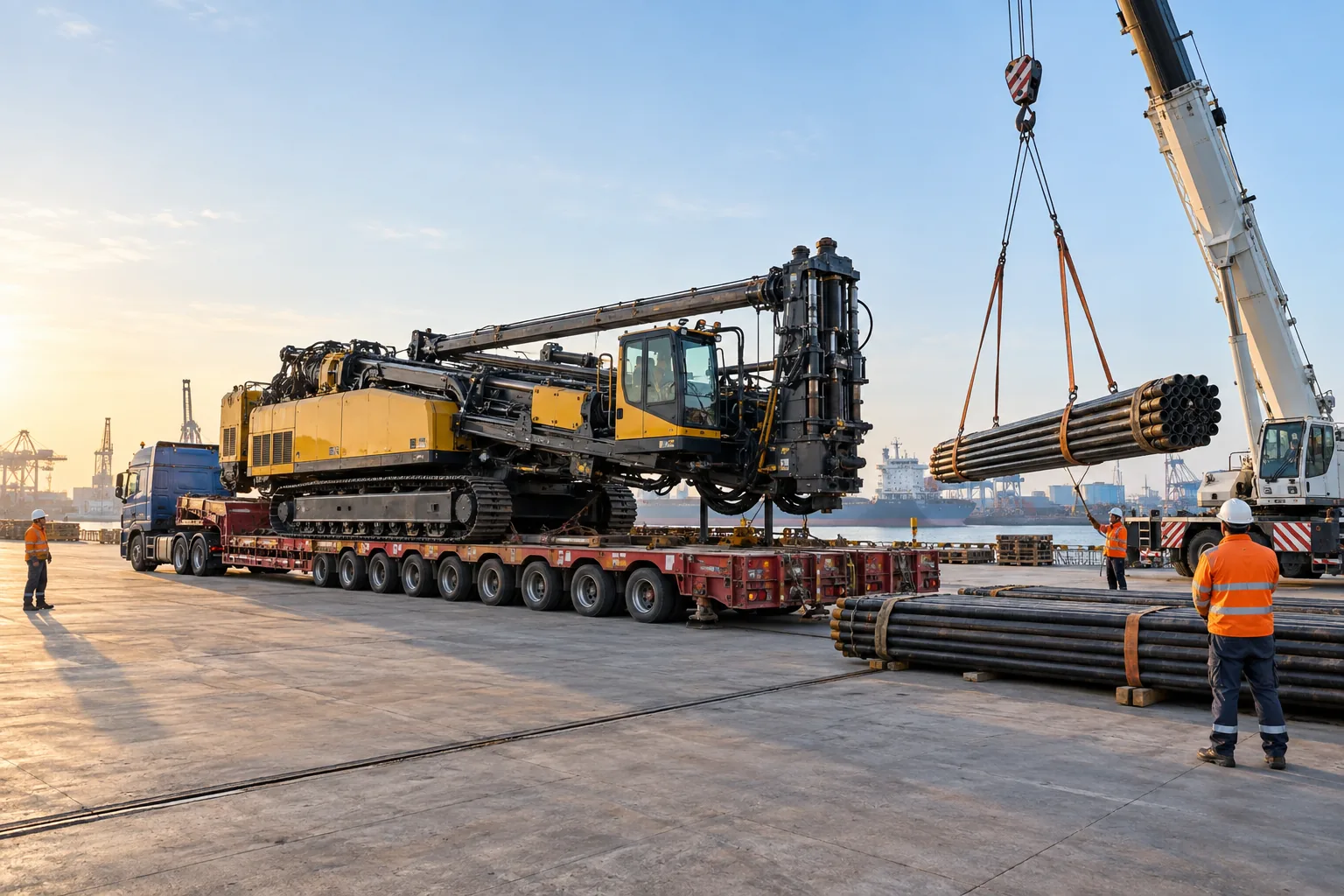
Breakbulk and project cargo quotations are built from far more than an ocean freight rate. This practical guide follows an HDD equipment inquiry from project setup and cargo verification through inland transport, heavy-lift operations, port handling, sea fastening, risk allowances and the final customer quotation.
Why a Breakbulk Quotation Is More Than an Ocean Freight Rate
A breakbulk or project cargo quotation may look like a simple request for an ocean freight rate. In practice, it is a connected engineering and commercial exercise covering cargo data, inland access, equipment selection, lifting arrangements, port capability, vessel suitability, sea fastening, insurance and contractual allocation of risk.
A missed abnormal-load permit, an undersized crane or an excluded heavy-lift surcharge can turn a profitable booking into a loss. A reliable quotation therefore does more than present a price. It explains the assumptions behind that price, defines what is included, identifies provisional or reimbursable items and records the conditions that could change the final cost.
This article uses a shipment of horizontal directional drilling equipment as a working example. The available list contains 14 cargo categories from three pickup areas in eastern China. Their combined stated weight is approximately 142.52 to 144.52 metric tons. The 58-ton drilling rig is the controlling unit because its size and weight determine the road vehicle, permits, cranes, vessel space and securing plan.
1 Open the Inquiry as a Project
Before requesting rates, create one controlled inquiry record. It should identify the shipper, consignee, project, cargo list, pickup points, intended port pair, delivery window, Incoterm, quotation currency and operational restrictions. Every later rate must be traceable to the same cargo revision and scope.
| Control item | What must be confirmed |
|---|---|
| Cargo | Piece count, packed dimensions, gross weight and photos |
| Route | Pickup addresses, load port, discharge port and final site |
| Schedule | Cargo-ready date, required arrival date and split-shipment tolerance |
| Commercial | Incoterm, currency, payment terms and quotation validity |
| Operations | Deck stowage, transshipment, lifting points and packaging status |
| Compliance | Dangerous goods, oil residues, batteries, pressure vessels and permits |
If these items are incomplete, the quotation should be described as a budgetary estimate or subject-to-confirmation offer. It should not be presented as a final all-inclusive price.
2 Establish the Cargo Baseline
The cargo baseline is the version of the packing list used for engineering and pricing. The case shipment includes an 18 m x 3.6 m x 3.4 m drilling rig weighing 58 tons, a control cabin, mud pump, reamers, grease, two groups of 9-meter drill rods, a mud motor, generator, feeding machine, mud tanks and a vibration screen.
| Controlling data | Current information | Pricing consequence |
|---|---|---|
| Largest unit | Rig: 18 x 3.6 x 3.4 m, 58 t | Controls abnormal road transport, crane capacity and stowage |
| Long cargo | 120 drill rods, each 9 m long | Requires bundling, blocking and efficient stowage |
| Multiple origins | Dafeng, Dongying and Wuxi | Creates vehicle positioning, consolidation and timing costs |
| Weight range | Approx. 142.52-144.52 t total | Final freight may change after verified weighing |
Several entries require clarification before a firm quotation. The Dongying drill rods are shown as 43-45 tons. The 7-ton weight for the three large reamers may be a combined weight or a per-piece weight. The mud-tank dimensions are described as combined. These are material differences, not administrative details.
Data that must be verified
- Packed dimensions rather than bare-machine dimensions.
- Actual gross weight for every unit and bundle.
- Center of gravity, certified lifting points and base-frame strength for the 58-ton rig.
- Whether the equipment contains fuel, hydraulic oil, lubricants, batteries or pressurized components.
- MSDS and transport classification for the grease and any other chemical products.
- Packaging, weather protection, lifting marks and securing points.
3 Design the Transport Chain Around the Controlling Unit

The controlling unit determines the entire transport chain. Once the 58-ton rig is placed on a lowbed or modular trailer, the loaded height, width, length and axle loads may exceed normal road limits. A route survey must therefore consider factory gates, turning radii, bridge capacity, underpasses, toll stations, overhead lines, roadworks, port gates and quay access.
Because the cargo originates in three areas, the forwarder should compare two commercial structures. The first is to consolidate everything at one load port and ship under one booking. The second is to use more than one origin port. The first may increase inland cost but simplifies the ocean movement and destination delivery. The second may shorten some pickup legs but creates multiple bookings, customs entries, sailing dates and release arrangements.
The decision should be based on the total door-to-port or door-to-door cost, not on the lowest standalone ocean rate.
4 Build the Cost Model in Six Layers
A robust project cargo estimate separates confirmed, provisional and reimbursable charges. The following six layers make the quotation easier to audit and update.
Layer 1 Cargo preparation
- Site survey, route survey and engineering review.
- Weatherproofing, rust prevention, wrapping and edge protection.
- Skids, cradles, steel frames, timber cases or pallets.
- Bundling and banding of drill rods.
- Certified weighing, measurement and third-party inspection.
- MSDS, non-dangerous-goods certificates, fumigation and technical documents.
Layer 2 Inland collection and abnormal road transport
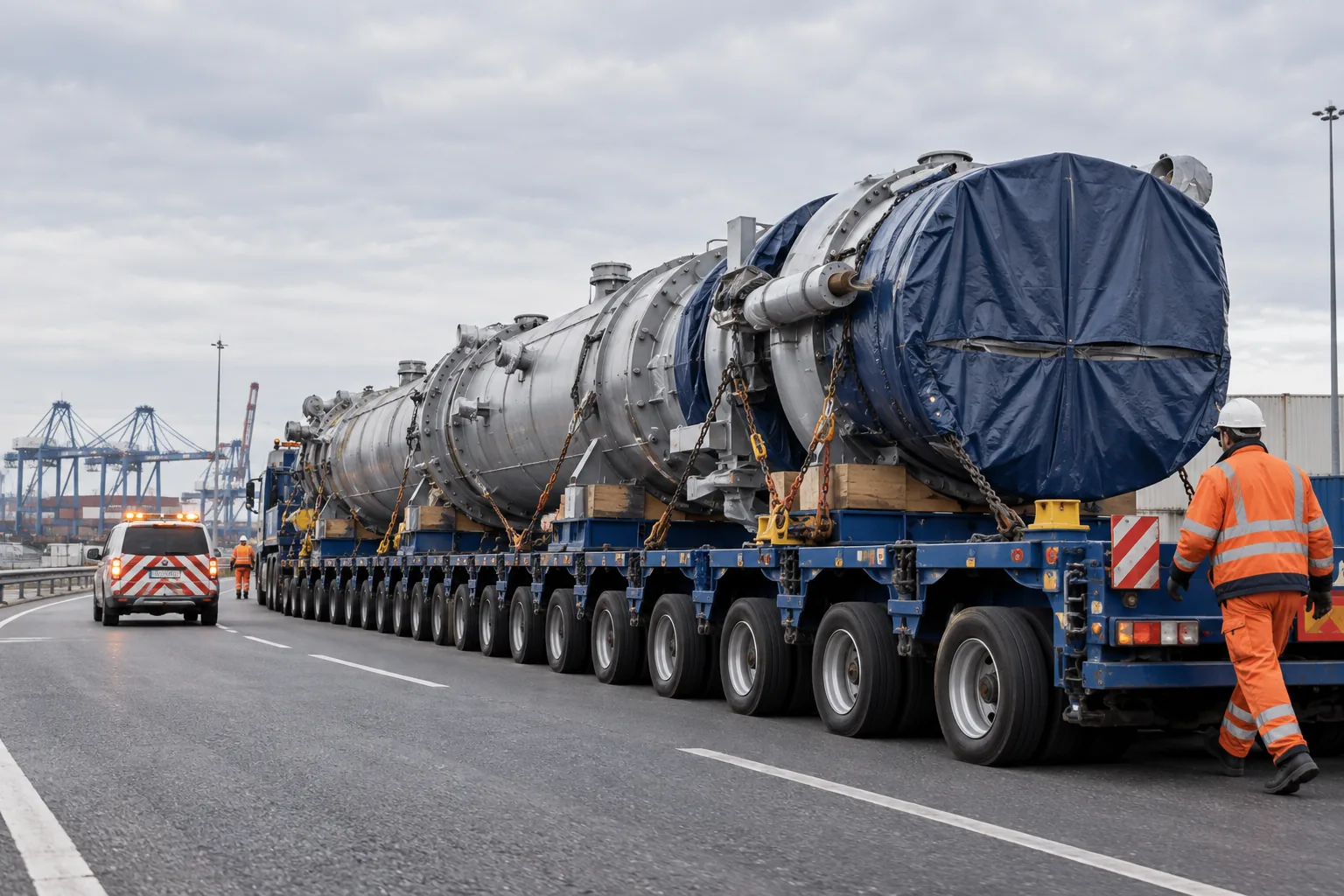
- Standard flatbed or lowbed trucks for smaller units.
- Multi-axle modular trailer or heavy lowbed for the controlling unit.
- Abnormal-load permits, escort vehicles and traffic coordination.
- Temporary removal or lifting of road furniture and overhead obstructions.
- Factory loading crane, lifting beam, spreader, slings and rigging crew.
- Vehicle mobilization, empty mileage, standby and detention.
Crane capacity must be selected against working radius and rigging configuration, not cargo weight alone. A 58-ton lift may require a crane with a nominal capacity far above 58 tons. If the ground cannot safely support the outriggers, steel mats or civil preparation may also be required.
Layer 3 Origin port operations
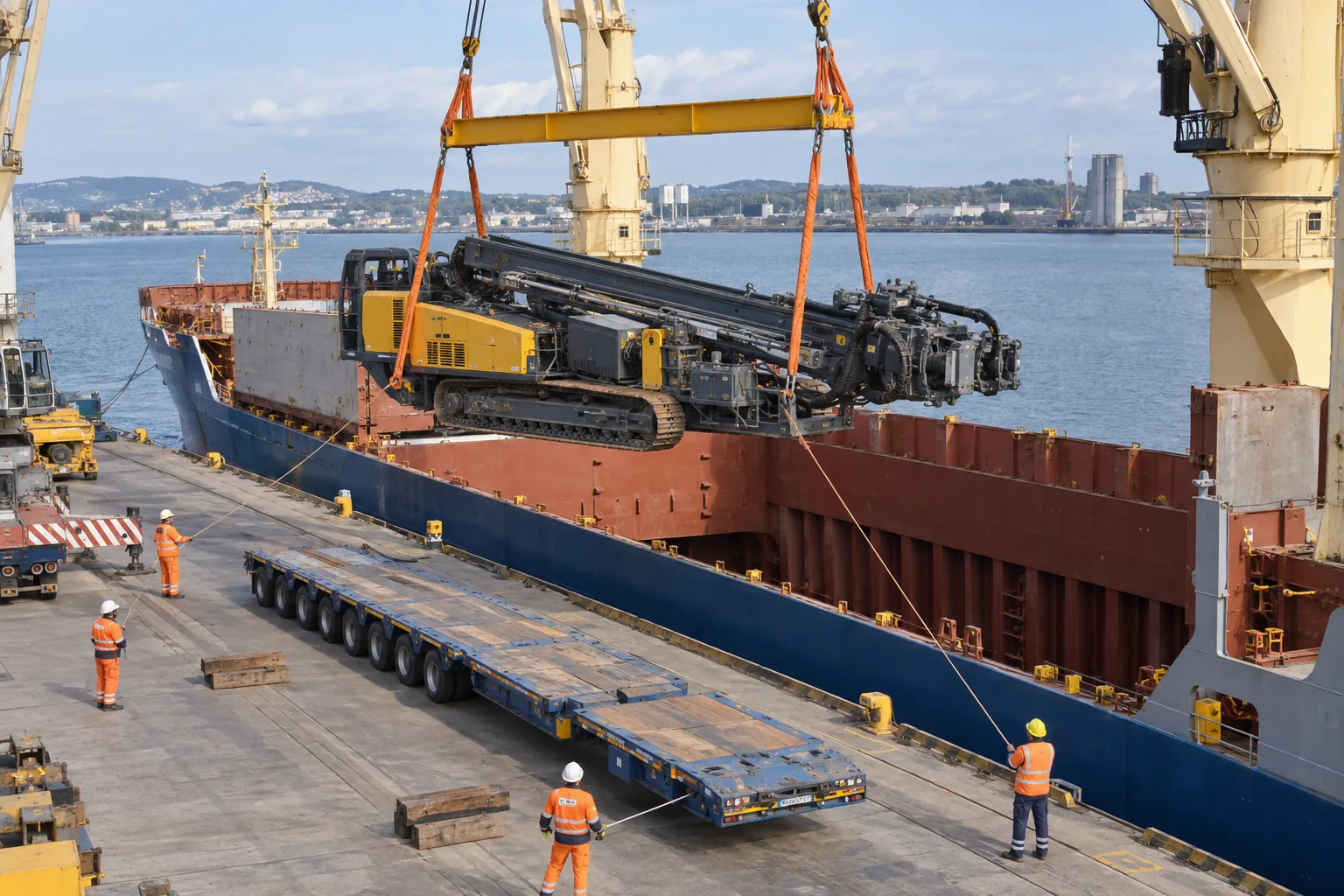
- Gate, weighing, tally, terminal handling and internal shifting.
- Truck discharge, quay storage and delivery alongside the vessel.
- Shore crane, floating crane or vessel-crane charges.
- Heavy-lift, overlength, overwidth and special-handling surcharges.
- Night, weekend, holiday, weather delay and overtime charges.
- Customs declaration, inspection handling, manifest and document fees.
Port storage deserves special attention. Breakbulk sailings can move, and oversized cargo often occupies more ground area than its weight suggests. Early delivery to the terminal may therefore generate significant storage and shifting costs.
Layer 4 Ocean freight and carrier surcharges
Breakbulk freight may be charged by weight ton, measurement ton, revenue ton, square-meter deck space or a lump sum per unit. Under a typical weight-or-measure basis, one revenue ton is the greater of one metric ton or one cubic meter.
The rig has a simple external volume of about 220.32 cubic meters, calculated from 18 x 3.6 x 3.4 m. On a W/M basis, it could therefore attract approximately 220.32 revenue tons rather than 58 weight tons. A heavy or awkward unit may instead receive a negotiated lump-sum price based on stowage, crane requirements and lost space.
- Basic ocean freight and minimum freight.
- Heavy-lift, long-length, overwidth and deck-stowage surcharges.
- Fuel, low-sulfur, congestion, canal, war-risk and seasonal surcharges.
- Transshipment and intermediate-port handling.
- Bill of lading, documentation, amendment and release fees.
- Deadfreight or cancellation charges if booked space is not used.
Layer 5 Dunnage, lashing and sea fastening
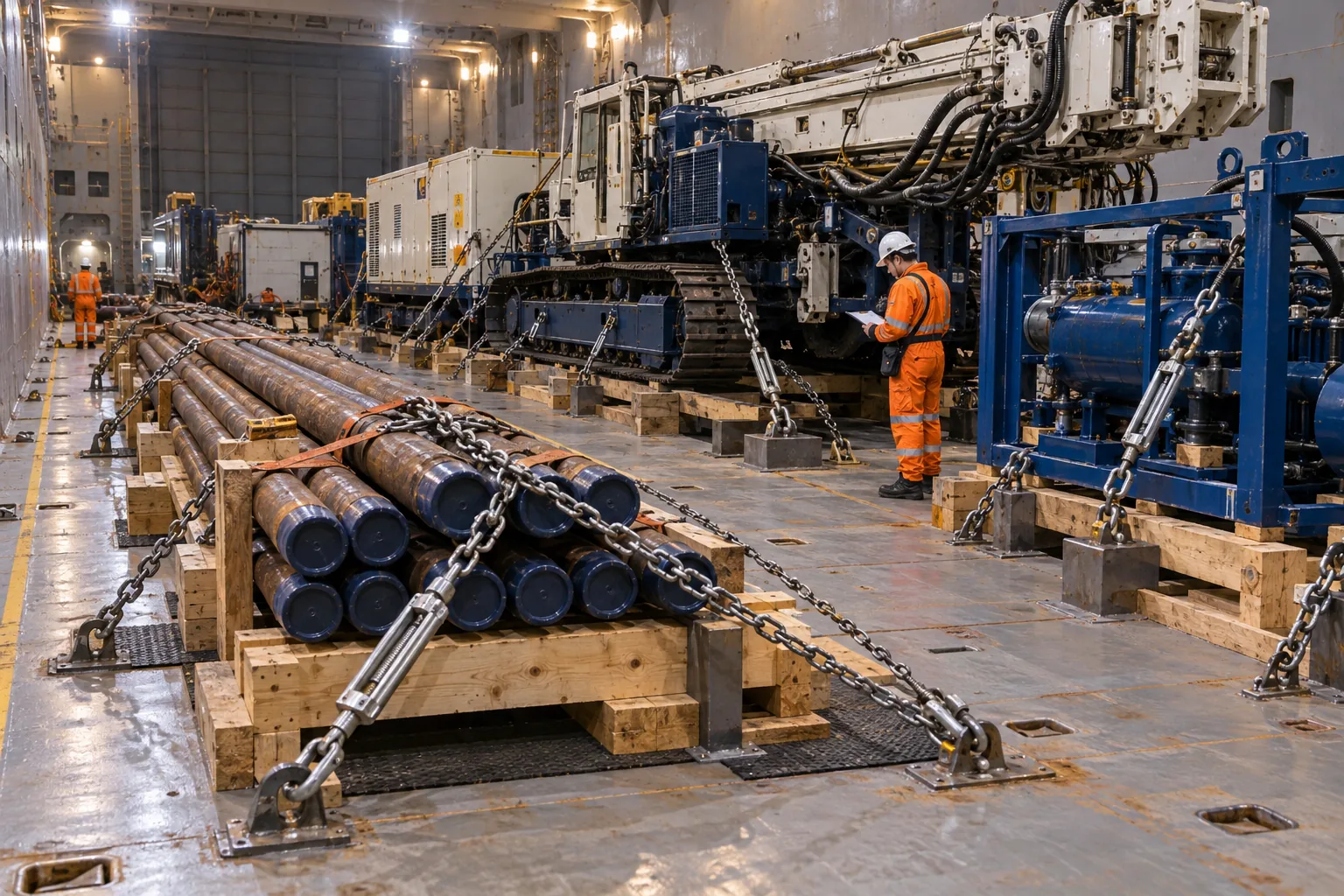
- Timber dunnage, steel stools, load-spreading beams and anti-slip material.
- Chains, wire ropes, turnbuckles, shackles and protected contact points.
- Welded stoppers and their removal after discharge.
- Lashing design, calculations and marine warranty or survey attendance.
- Labor for installation, inspection and voyage re-tightening where required.
Carrier quotations must state whether materials, welding, lashing labor and survey attendance are included. The words 'liner terms' or 'hook terms' alone may not resolve every responsibility.
Layer 6 Destination and final delivery
- Discharge crane, floating crane or heavy-lift surcharge.
- Terminal handling, tally, security, storage and port documentation.
- Import customs clearance, inspection, duties and taxes.
- Destination lowbed transport, permits, escorts and route survey.
- Site crane, unloading crew, standby and delivery-site preparation.
For CFR and CIF offers, the freight forwarder should still explain which destination charges are excluded. For DAP or other extended scopes, local agents must quote the same cargo revision and understand the weight, dimensions and required lifting method.
6 Uncontrollable Cost Risks
| Risk | Potential cost effect | Commercial control |
|---|---|---|
| Weight or dimension variance | Re-rating, larger vehicle or larger crane | Quote against verified packed data; reserve re-rating rights |
| Sailing change | Truck waiting, storage, rebooking | State schedule is indicative and pass through delay costs |
| Weather or congestion | Crane standby, vessel delay, storage | Define force-majeure and waiting-time treatment |
| Permit or route change | Longer route, new escort, civil works | Make route approval a condition precedent |
| Unsuitable lifting points | Engineering, fabrication, refusal to handle | Require certified lift information before firm booking |
| Cargo misclassification | Testing, re-declaration, rejection or penalty | Obtain MSDS and written cargo declaration |
| Currency and fuel movement | Margin erosion | Use validity dates and adjustment clauses |
| Destination rule change | New tax, permit or port charge | Use local-agent confirmation and pass-through wording |
7 Structure the Customer Quotation
A professional offer should not show only one total. It should allow the customer to understand the scope and allow the forwarder to defend legitimate adjustments.
- Quotation basis: cargo revision, piece count, weight, dimensions, route, schedule and Incoterm.
- Itemized charges: inland transport, permits, cranes, origin port, ocean freight, lashing, customs, insurance and destination services.
- Charging rule: weight ton, measurement ton, revenue ton, square meter or lump sum.
- Inclusions: vehicles, equipment, labor, materials, documentation and taxes that are covered.
- Exclusions: duties, examinations, storage, detention, demurrage, weather delay, route works and unreported dangerous goods.
- Validity and adjustment basis: sailing, space, exchange rate, fuel and carrier confirmation.
- Payment terms and treatment of reimbursable third-party costs.
Recommended internal calculation
Estimated project cost = cargo preparation + inland transport + permits and escorts + cranes + origin port charges + ocean freight + sea fastening + documentation + insurance + destination charges + contingency.
Customer price = estimated project cost + finance cost + management cost + risk allowance + target margin.
The risk allowance should reflect the maturity of the cargo data and the execution plan. It should increase when dimensions are estimated, the sailing date is distant, the port is unfamiliar or the lifting method is unresolved.
8 Information Still Required for the HDD Shipment
- Discharge port, final delivery address, cargo-ready date and required arrival date.
- Incoterm and exact quotation scope.
- Final packed dimensions and gross weight for every item.
- Center-of-gravity drawing, lifting plan and base details for the 58-ton rig.
- Exact pickup addresses, loading conditions and site contacts.
- Confirmation whether the 7 tons for the large reamers is total or per piece.
- Confirmation whether mud-tank dimensions and weight are combined or per unit.
- Final weight and bundling arrangement for the 100 drill rods.
- MSDS for grease and confirmation of any fuel, oil, batteries or pressure systems.
- Permission or prohibition for deck stowage, transshipment and split shipment.
- Declared cargo value and insurance requirements.
Conclusion
Project cargo profitability depends less on a headline freight rate than on disciplined scope control. Identify the controlling unit, verify the cargo data, engineer the transport chain, compare total-route options and separate fixed, provisional and reimbursable costs.
For this HDD shipment, the 58-ton drilling rig, three pickup regions, 9-meter drill rods, uncertain weight entries and possible oil or chemical residues are the principal quotation risks. A budgetary offer can be issued while these matters are open, but a firm executable quotation should follow only after they are confirmed in writing.
Source and operational note
Cargo specifications and quantities are based on the supplied 260922 List of Items PDF and 260922 HDD Equipment Shipment List workbook. Illustrations are editorial visuals created for this article and are not operational lift plans.
Request a project cargo quotation
For a practical quotation, send TengYoda Logistics the final packed dimensions and gross weight of every unit, pickup addresses, cargo-ready date, discharge port, final delivery address, cargo value, lifting information and details of any fuel, oil, batteries, chemicals or pressure systems.