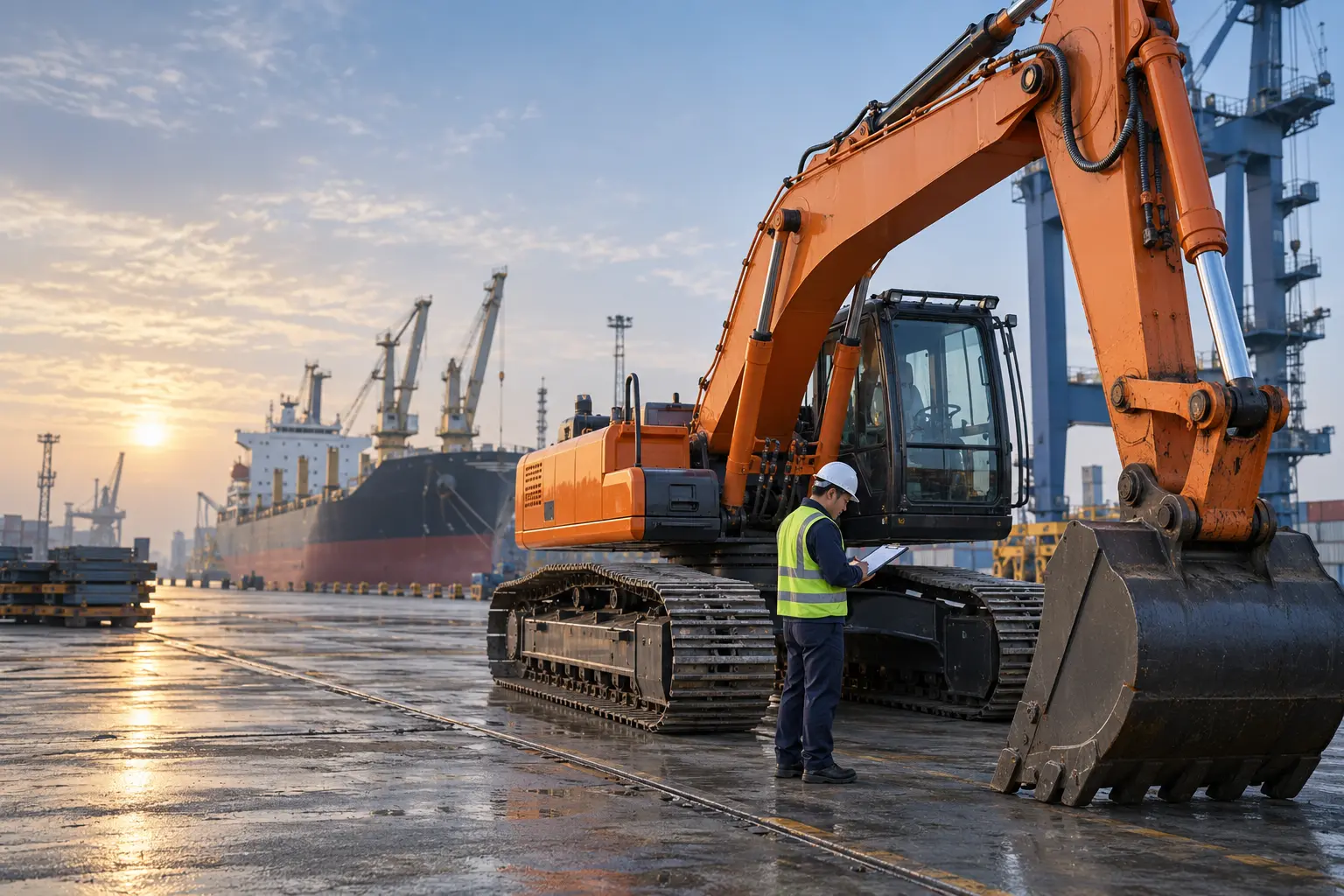
A recent project-cargo enquiry looked straightforward at first: > “Please quote a 30–35 ton excavator from Tianjin or Shanghai, China, to Caldera or Limón, Costa Rica. It can move by RoRo, breakbulk or flat rack. We need the earliest available vessel, preferably in the last week of September.” The request already identified the cargo, possible Chinese ports, two Costa Rican ports, three transport methods and a target period. Yet it still did not contain enough information for a responsible final quotation. For a standard carton shipment, weight and dimensions drive much of the rate. For a tracked excavator, the exact model, transport condition, lifting method, ability to move under its own power and removable parts can change the shipping method, port, vessel and total cost. This case study explains how an experienced freight forwarder turns an urgent heavy-equipment enquiry into a workable shipping plan—and how an importer should compare RoRo, breakbulk and flat-rack offers from China to Costa Rica.
Quick answer
There is no universally cheapest method for a 30–35 ton excavator.
- RoRo may be efficient when a suitable service exists and the excavator is operational, safe to drive and accepted by the vessel operator.
- Breakbulk can suit a complete or partly dismantled machine when suitable lifting points, port equipment and geared-vessel space are available.
- Flat rack gives container-network possibilities and a defined securing platform, but weight, width, height, over-gauge restrictions and carrier equipment limits must be checked.
The right comparison uses the same confirmed cargo condition, origin scope, destination port and delivery responsibility. A low ocean-freight number alone does not identify the lowest total cost.
Why “30–35 tons” is not enough for a quotation
Two excavators in the same weight class may have different undercarriage widths, boom lengths, counterweights, cabins and attachments. Even the same model can be quoted differently depending on whether the bucket, arm, boom or counterweight is removed.
The first professional response should request:
- Exact manufacturer and model
- Transport dimensions: length × width × height
- Accurate gross or operating weight
- Manufacturing year and new/used condition
- Whether the machine is fully operational and can drive by itself
- Whether the boom, arm, bucket or counterweight can be removed
- Current location in China
- Cargo-ready date
- Photos from all four sides, plus undercarriage and cabin
- Lifting points, centre-of-gravity or lifting diagram where available
- Final destination in Costa Rica, not only the port name
Without these details, a forwarder can discuss possible methods but should not promise a firm rate or vessel acceptance.
The three transport options
Option 1: RoRo shipping
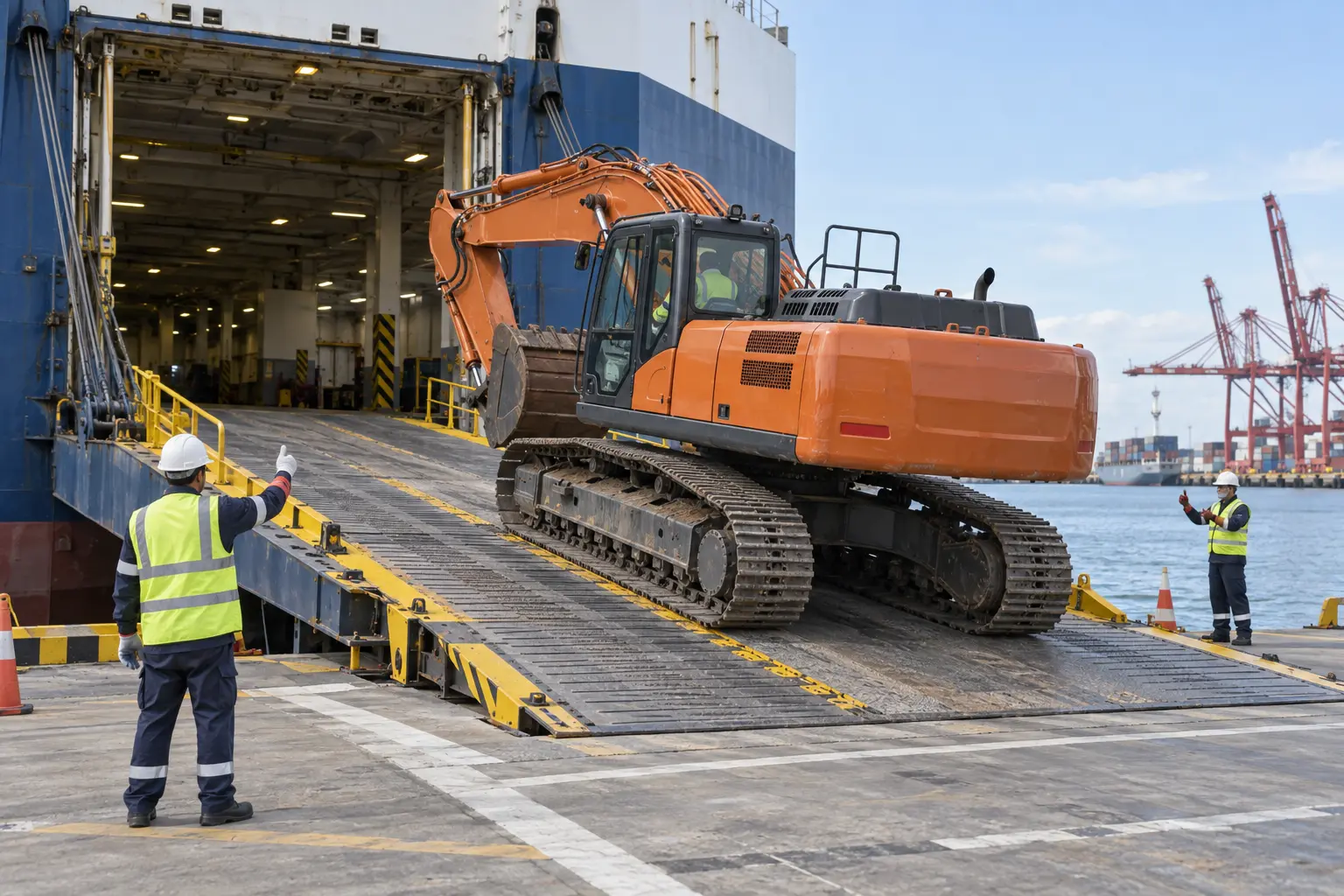
RoRo—roll-on/roll-off—allows suitable mobile cargo to move onto and off the vessel using a ramp. For an excavator, the operator or terminal team normally drives the unit under controlled procedures.
RoRo can be attractive because:
- The machine may remain largely assembled.
- Loading avoids a full crane lift where direct driving is permitted.
- The excavator is normally secured inside the vessel, protected from open-deck exposure.
- Port operations can be efficient on a suitable service.
However, “it has tracks” does not automatically mean it is RoRo cargo. The carrier may check:
- Whether the engine, steering, brakes and hydraulics work reliably
- Ground clearance, ramp angle and track condition
- Overall dimensions and weight
- Fuel level, battery isolation and leakage condition
- Safe boom and bucket position
- Whether the machine can be started without specialist equipment
- Availability of RoRo service to an acceptable Costa Rican port
Non-running equipment may require a mafi trailer, tug or alternative loading arrangement, subject to carrier approval and added cost. Loose spare parts should not be left in the cabin unless the carrier specifically accepts and documents them.
Option 2: Breakbulk shipping
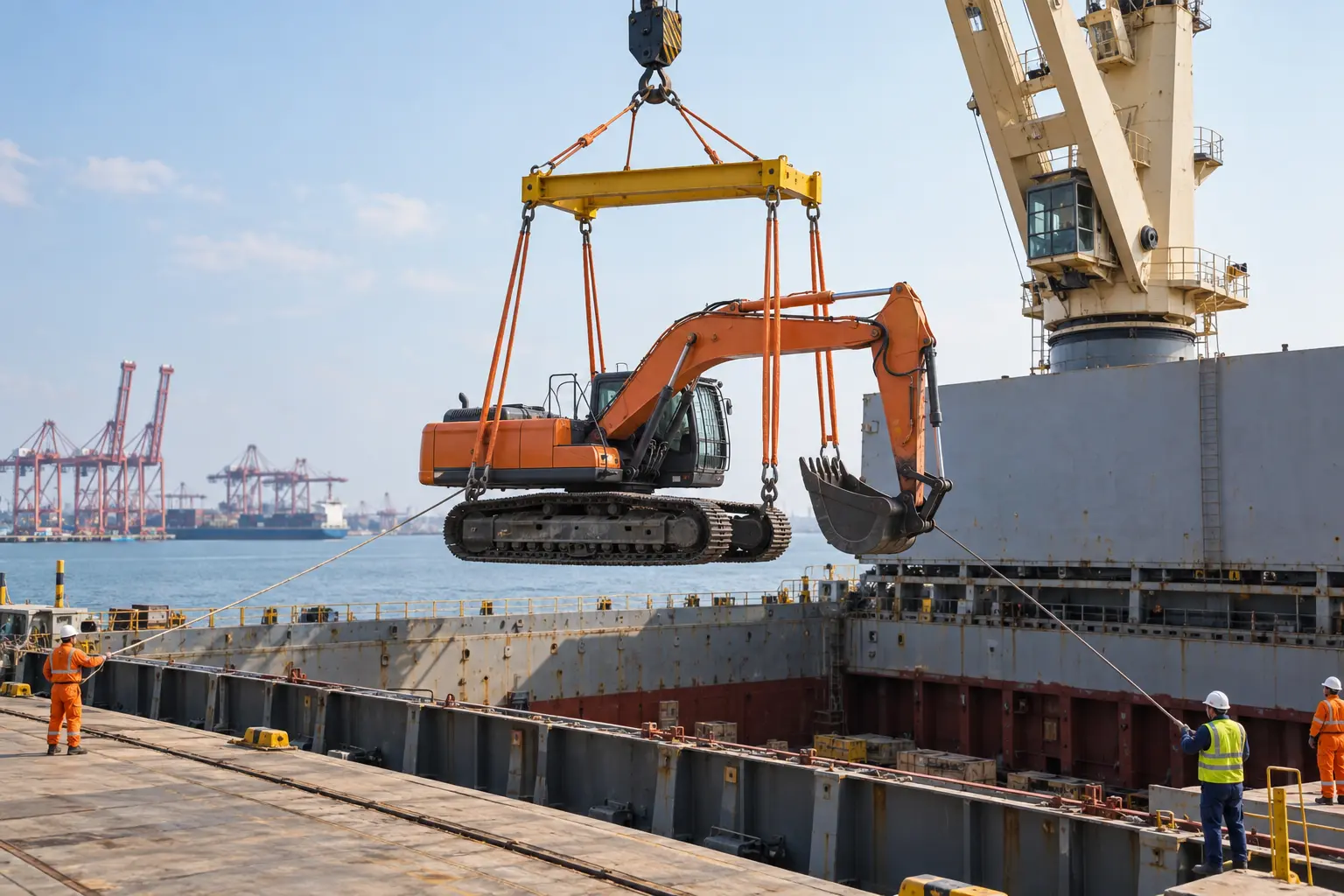
Breakbulk cargo is loaded as an individual unit rather than inside a standard container. A geared vessel may lift the excavator between quay and cargo hold using approved lifting gear.
Breakbulk is worth considering when:
- The machine is too large or heavy for the available flat rack.
- RoRo service is unavailable or the excavator cannot be driven safely.
- A suitable project-cargo vessel connects the required regions.
- The boom, bucket or counterweight can be separated to improve stowage.
The lift needs more than an estimated weight. A competent plan may require certified lifting points, a lifting drawing, centre-of-gravity information, sling and spreader selection, port-lifting approval and a method statement.
Breakbulk quotations can also be sensitive to cargo volume. A machine occupying a large stowage footprint may be priced on revenue tons or another carrier basis, not only on its weight.
Option 3: Flat-rack shipping
A flat rack is container equipment with a platform and end structures but no full sidewalls or roof. It can carry out-of-gauge machinery that cannot fit inside a standard container.
The excavator is positioned on the platform, supported with suitable dunnage, blocked and secured to approved lashing points. Depending on size, parts may be removed to reduce width, height or overall occupied space.
Advantages can include:
- Access to container shipping networks on eligible routes
- A defined platform for loading and securing
- Easier interchange through container terminals than some conventional project cargo
- Potential protection of removed parts in a separate case or container
Important restrictions include:
- Maximum payload and concentrated-load limits
- Equipment availability at the origin
- Over-width, over-height and over-length approval
- Lifting and terminal-handling method
- Slot loss and out-of-gauge surcharges
- Route and transshipment acceptance
- Correct weight distribution across the platform
A 30–35 ton excavator is close enough to common equipment limitations that the actual machine and carrier specification must be checked. It is unsafe to assume that every 40-foot flat rack can take the cargo simply because its published maximum payload appears higher than the machine weight.
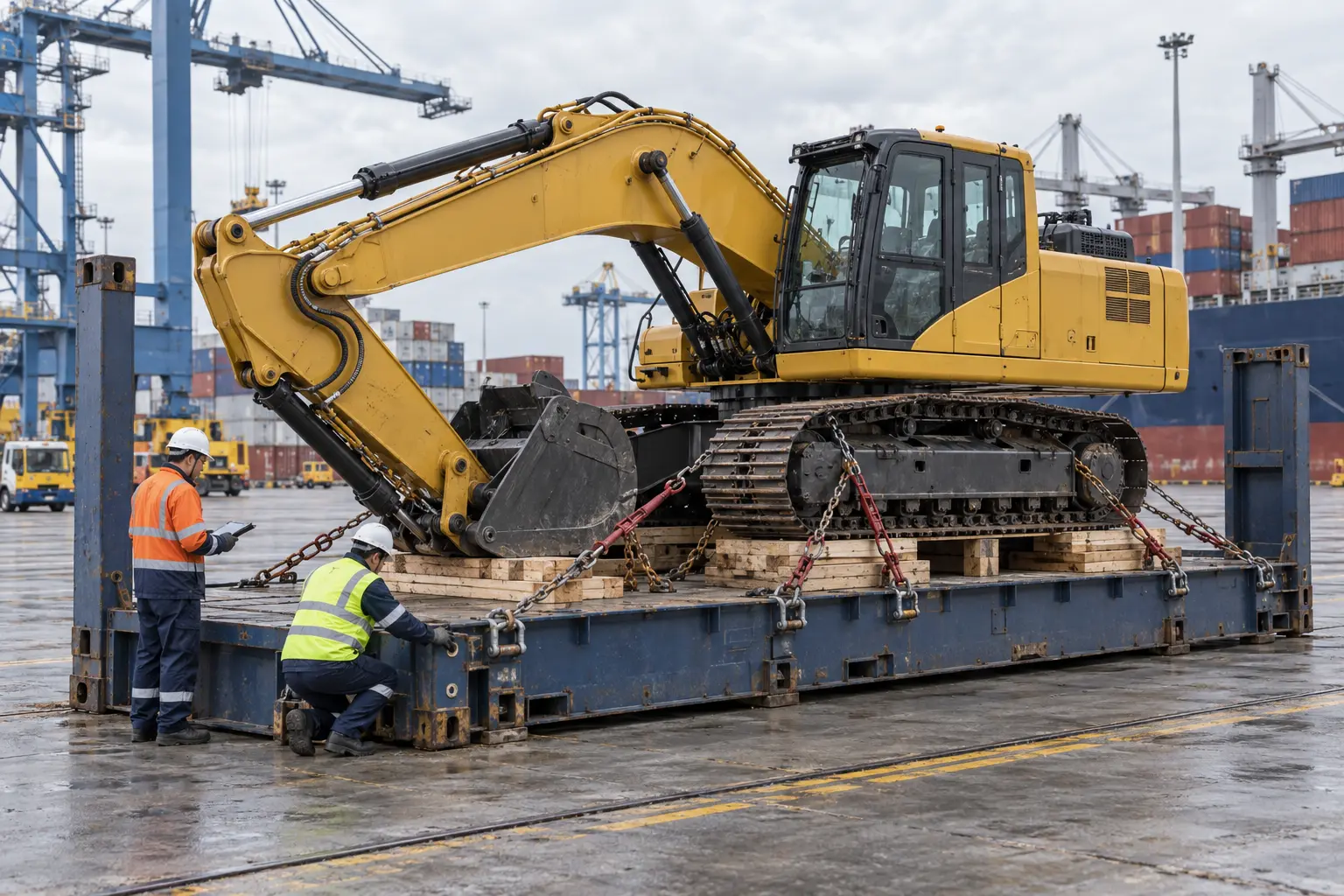
RoRo vs breakbulk vs flat rack
| Factor | RoRo | Breakbulk | Flat rack |
|---|---|---|---|
| Basic loading method | Driven or moved via vessel ramp | Lifted by crane | Loaded and secured to container platform |
| Machine condition | Usually must be safely operational, unless special handling is accepted | Can suit non-running cargo | Can suit running or non-running cargo |
| Disassembly | Often limited, subject to clearance | May reduce lift/stowage size | Often useful to reduce out-of-gauge dimensions |
| Main technical concern | Ramp, operation, leakage and carrier rules | Lift plan, weight and lifting points | Payload, load distribution, OOG and lashing |
| Schedule availability | Depends on vehicle/project route | Depends on project vessel/parcel space | Depends on container line, equipment and OOG approval |
| Destination handling | Ramp discharge and terminal release | Crane discharge and project handling | Container-terminal handling and flat-rack release |
| Best use case | Operational mobile machine on suitable route | Heavy unit needing direct lifting | Machine within approved equipment and route limits |
The decision should be documented as a comparison—not based on habit. Sometimes the ocean rate for one method is lower while its China inland transport, dismantling, lifting or destination handling makes the final cost higher.
Tianjin or Shanghai: choose the origin after checking the machine
The customer proposed Tianjin or Shanghai. The right port is not selected only by which city has the lower ocean rate.
Origin selection should consider:
- Current machine location
- Road transport distance and permit requirements
- Whether the excavator can travel as one piece
- Low-bed trailer availability
- Height restrictions, escorts and route survey needs
- Port receiving rules and storage allowance
- Vessel and equipment availability
- Loading method offered at the terminal
If the excavator is in northern China, Tianjin may reduce inland distance. If a more suitable sailing, flat-rack allocation or project vessel is available through Shanghai, the longer inland move may still produce a better overall plan.
For out-of-gauge road transport, the forwarder needs the transport dimensions after any planned dismantling—not the excavator's dimensions while working on site.
Caldera or Limón: the destination changes the route
Puerto Caldera is on Costa Rica's Pacific side, while the Limón–Moín port complex serves the Caribbean side. Costa Rica's port authority JAPDEVA publishes information for the Limón–Moín complex on its official website.
The destination decision should consider:
- Which port the selected vessel or carrier actually serves
- Final job-site location and inland distance
- Local heavy-haul capability and permits
- Terminal equipment and project-cargo acceptance
- Import-broker experience with machinery
- Port, storage and delivery charges
- Whether transshipment creates additional handling risk
The nearest-looking port on a map is not always the cheapest delivered option. A reliable forwarder should ask for the final Costa Rican delivery location and compare the complete chain through both ports where practical.
Why the “earliest vessel” cannot be confirmed first
The enquiry requested a vessel in the last week of September. That urgency is understandable, but project cargo must first be acceptable to the vessel.
A meaningful schedule check normally follows this order:
- Confirm machine details and transport condition.
- Select one or more feasible shipping methods.
- Obtain preliminary origin and destination acceptance.
- Request carrier space, vessel and equipment confirmation.
- Check cargo cut-off, port-receiving window and documentation deadline.
- Confirm whether inland transport can meet the cut-off.
- Place the booking only after rate and operational conditions are accepted.
A published departure date is not the same as confirmed project-cargo space. For breakbulk and RoRo, schedules may be subject to inducement, rotation or operational changes. For flat racks, the line must still approve the over-gauge dimensions and equipment allocation.
What a complete cost comparison should include
The ocean freight is only one line. Ask each provider to identify the following:
China origin
- Low-bed trailer or other inland transport
- Road permits, escort or route survey where required
- Dismantling and reassembly responsibility
- Port entry, receiving and storage
- Customs declaration and documentation
- Crane, ramp, flat-rack or special loading
- Dunnage, chains, welding or certified lashing
- Survey, photos and method statement
International transport
- Ocean freight and rate validity
- Bunker, project-cargo or out-of-gauge surcharges
- Transshipment and routing
- Equipment or vessel-space confirmation
- Marine cargo insurance, if purchased
Costa Rica destination
- Carrier and terminal charges
- Crane, ramp or flat-rack handling
- Customs brokerage, duty and tax
- Inspection, cleaning or quarantine-related cost if applicable
- Storage and free-time conditions
- Heavy-haul delivery, permits and escort
- Unloading equipment at the final site
If one quotation excludes destination handling while another includes it, their totals cannot be compared fairly. The article on why freight quotes change after pickup explains why verified dimensions, weight and cargo condition matter.
Preparing a used excavator for export
Used construction machinery should be inspected before collection. The preparation plan may include:
- Remove soil, plant material and excessive grease from tracks and undercarriage.
- Check for leaking fuel, engine oil, hydraulic fluid and coolant.
- Reduce fuel to the carrier's permitted level.
- Isolate batteries where required.
- Lower and secure the boom, arm and bucket.
- Lock rotating and moving parts.
- Protect exposed hoses and ports after dismantling.
- Pack removed pins, tools and small parts in an identified case.
- Record serial number, model plate and pre-shipment condition.
- Take photos before loading and after securing.
Destination import and biosecurity requirements should be checked with the Costa Rican importer and customs broker before shipment. China export clearance and vessel acceptance do not guarantee destination import release.
Documents and evidence commonly requested
- Commercial invoice and packing list
- Sales contract or ownership evidence
- Exact model, serial number and manufacturing year
- Technical specification sheet
- Transport dimensions and weight
- Photos and condition report
- Export declaration information and HS classification
- Lifting drawing or lifting-point details for breakbulk
- Flat-rack packing and securing plan where required
- Insurance information
- Consignee, broker and destination-contact details
If the machine contains batteries, fluids, refrigerants or other restricted characteristics, use the China restricted-cargo checklist before booking.
How a strong first reply builds trust
The customer asked for an urgent rate. A weak reply would say, “Yes, we can do it—price coming soon.” A stronger reply explains what can be checked and requests the information required to produce a usable answer.
In this case, the reply confirmed that RoRo, breakbulk and flat rack could be reviewed from China to Costa Rica, and that Caldera and Limón could be compared where necessary. It then asked for the exact model, dimensions, weight, year, operating condition, detachable parts, current location and cargo-ready date.
That response does three things:
- It shows the enquiry has been understood.
- It avoids inventing a price before the cargo is defined.
- It moves the customer toward the next operational decision.
Professional freight forwarding is not simply replying quickly. It is asking the questions that prevent a quick answer from becoming an expensive mistake.
How TengYoda would handle this shipment
For a China-origin excavator project, TengYoda Logistics can coordinate the enquiry through a staged review:
- Verify the machine specification, photos and transport condition.
- Check whether dismantling reduces inland or ocean cost without creating excessive reassembly risk.
- Compare Tianjin, Shanghai or another practical Chinese port.
- Request suitable RoRo and project-cargo options.
- Review oversized cargo transport, flat-rack and breakbulk feasibility.
- Clarify origin loading, export, lashing and survey responsibilities.
- Coordinate with the consignee or destination partner on port and delivery requirements.
- Present confirmed items, conditional items and exclusions clearly.
We do not assume that every machine must use the same shipping method. The objective is to match the actual excavator, available service and Costa Rican delivery requirement while keeping handling and cost risks visible.
For a project review, send the machine details through the TengYoda enquiry form. The China freight quotation checklist can also help prepare the information.
Frequently asked questions
Can a 35 ton excavator ship on a 40-foot flat rack?
Possibly, but not automatically. The forwarder and carrier must check exact cargo weight, concentrated load, dimensions, weight distribution, flat-rack specification, equipment availability and route approval. Removed parts and securing materials also affect the final load.
Is RoRo always cheaper than breakbulk?
No. RoRo may reduce lifting work, but service availability, port choice, machine condition, measurement basis and destination charges affect the total. Compare the complete origin-to-destination scope.
Does the excavator need to run for RoRo?
Carriers generally prefer safe, fully operational units that can be driven. A non-running machine may require special equipment or may be refused. Obtain route-specific acceptance before moving it to port.
Should the boom and counterweight be removed?
Only after comparing savings and risks. Removal may reduce transport size, but it adds labour, lifting, packing, missing-part and destination-reassembly costs. Use the machine manufacturer's procedures and qualified technicians.
Is Caldera or Limón better for an excavator?
It depends on vessel service, final delivery location, terminal capability, destination charges and inland heavy-haul arrangements. The best port is the one producing the safest and most practical complete route—not simply the lowest ocean rate.
How early should the booking start?
Start as soon as the exact machine and ready date are known. Project cargo needs more time than standard containers for technical approval, inland planning, port windows, equipment allocation and documentation.
Final checklist
Before accepting a quotation, confirm:
- Exact excavator model, serial number, dimensions and weight
- Running condition and leakage status
- Removable parts and final transport dimensions
- China pickup location and inland-haul scope
- Approved mode: RoRo, breakbulk or flat rack
- Confirmed origin and Costa Rican destination port
- Loading, lifting and securing responsibility
- Vessel, equipment, space and cut-off status
- Included origin and destination charges
- Customs, duty, tax and importer responsibilities
- Insurance basis and declared cargo value
- Final-site access and unloading arrangements
An urgent machinery enquiry deserves a fast response—but the response should lead to verified data, carrier acceptance and a complete transport plan. That is how a freight forwarder reduces cost without hiding the risks.
Reference and practical note
This article provides general logistics information. Vessel schedules, rates, equipment, port acceptance and import rules change. Confirm the actual machine, route and current requirements with the carrier, port, customs broker and relevant authorities before shipment.