An enquiry for 500 Toyota Corolla sedans from China to Oman may sound simple: find a vessel, obtain a rate and book the shipment. In practice, the freight rate is only one part of the decision. During a recent route review, we had to answer several connected questions: - Should the vehicles move by RoRo or in 40HQ containers? - Is the quoted rate based on cubic metres, vehicles or containers? - Can four sedans genuinely fit inside one 40HQ? - What equipment is required to load and unload the upper vehicles? - Is the container carrier-owned (COC) or shipper-owned (SOC)? - Are destination unloading and rack-disposal costs included? - If the vehicles originate inland, does a Yangtze River barge connection really reduce the total cost? This case study shows how we worked through those questions. The purpose is not to publish a permanent freight tariff. Rates change, and every booking still requires carrier confirmation. The useful lesson is the method: calculate the known cost, expose the missing cost and test whether the operational plan can actually be completed at destination.
1. Start with the exact vehicle—not only the model name
“Toyota Corolla” is not enough information for a final booking. The sedan, hatchback and Corolla Cross have different dimensions. Model year, trim, petrol, hybrid and electric configurations can also change weight and regulatory treatment.
For the initial calculation, we used the following Corolla Sedan reference dimensions:
| Item | Working value |
|---|---|
| Length | 4.630 m |
| Width | 1.780 m |
| Height | 1.435 m |
| Maximum reference kerb weight | 1,430 kg |
| Calculated shipping volume | 11.826 CBM per vehicle |
The volume calculation is:
`4.630 × 1.780 × 1.435 = 11.826 CBM`
For 500 vehicles:
`11.826 × 500 = 5,913.20 CBM`
These are planning figures, not a substitute for the seller’s vehicle specification sheet. Toyota also states that dimensions and weights are approximate and subject to vehicle variation. Before booking, we would request the model year, powertrain, exact trim, VIN list and actual condition of every vehicle.
2. The first option: RoRo from Nansha to Duqm
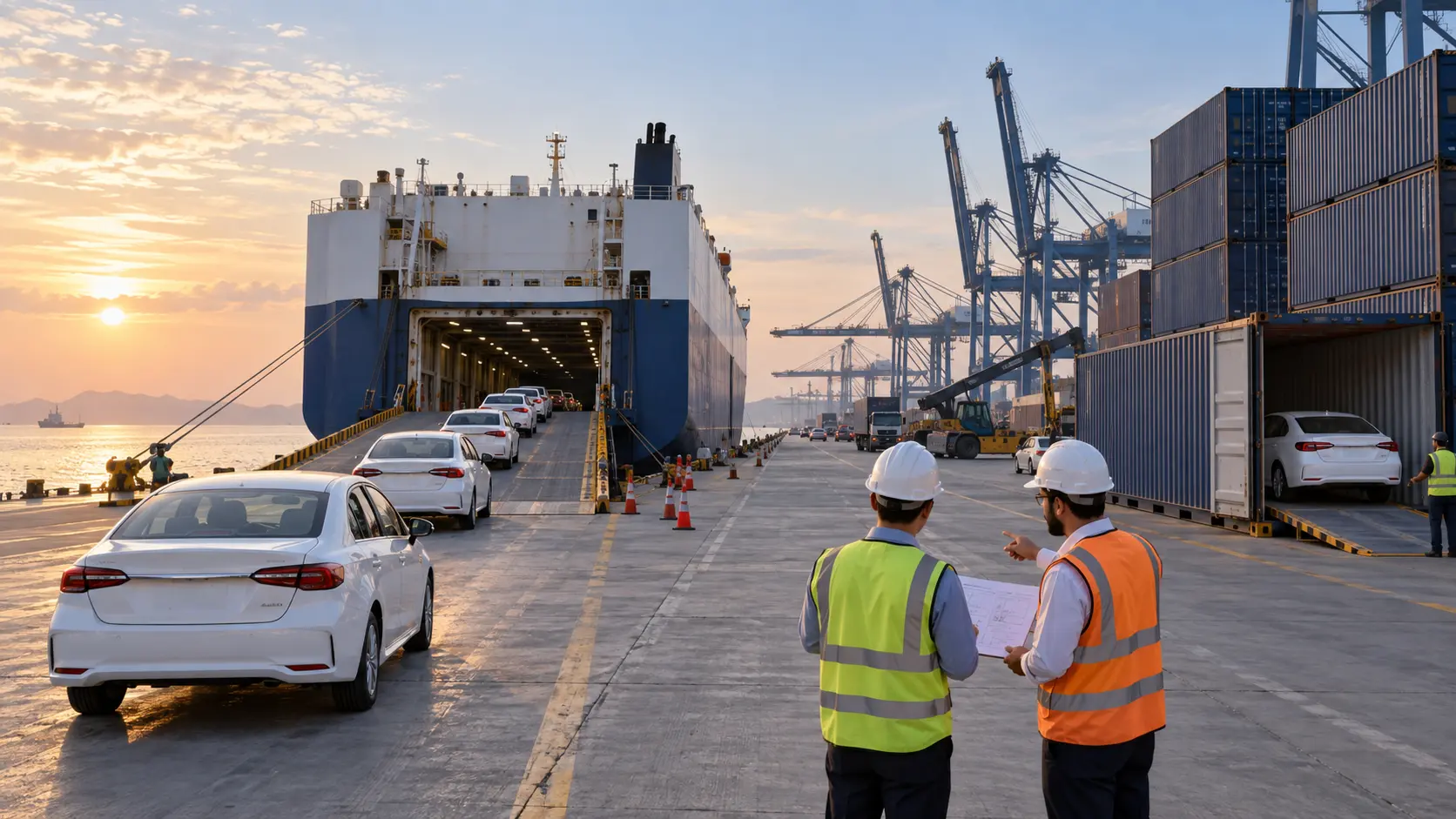
The first working option was a RoRo service from Nansha, China, to Duqm, Oman.
The indicative rate structure received for this case was:
- Ocean freight: USD 235 per CBM
- Carrier handling: USD 100 per bill of lading
- Nansha terminal charge: CNY 35 per CBM
- Booking, customs declaration, tallying, documentation and operation: CNY 2,300 per shipment
- Vehicles must be operational and driven during loading and discharge
- Other charges such as labelling or amendments: at cost if incurred
Using the estimated 5,913.20 CBM, the known-cost calculation was approximately:
| RoRo cost item | Calculation | Estimated amount |
|---|---|---|
| Ocean freight | 5,913.20 CBM × USD 235 | USD 1,389,603 |
| Carrier handling | Per shipment | USD 100 |
| Nansha volume charge | 5,913.20 CBM × CNY 35 | CNY 206,962 |
| Fixed origin charges | Per shipment | CNY 2,300 |
| Total CNY charges | CNY 209,262 |
Using a working conversion rate of CNY 6.71 to USD 1 for this internal comparison, the known RoRo cost was approximately USD 1,420,890, or USD 2,841.78 per vehicle.
RoRo remains operationally attractive for a large fleet. Vehicles can be driven on and off the vessel, and there is no container rack to dismantle. However, RoRo pricing based on measurement can become expensive for a high-volume sedan order. The vehicles must also meet the carrier’s running-condition, fuel, battery and leakage requirements.
3. The alternative: four sedans in one carrier-owned 40HQ
The second option used carrier-owned 40HQ containers, or COC containers.
Without a professional rack, a 40HQ can normally accept only two Corolla-size sedans on the floor. Three cars cannot simply be parked end to end because their combined length exceeds the container’s usable internal length.
A certified automotive rack changes the geometry. It raises and tilts selected vehicles, allowing their horizontal footprints to overlap while keeping the cars physically separated. A specialist system can make four compact cars in one container possible, but the rack design, vehicle combination and clearances must be verified before loading.
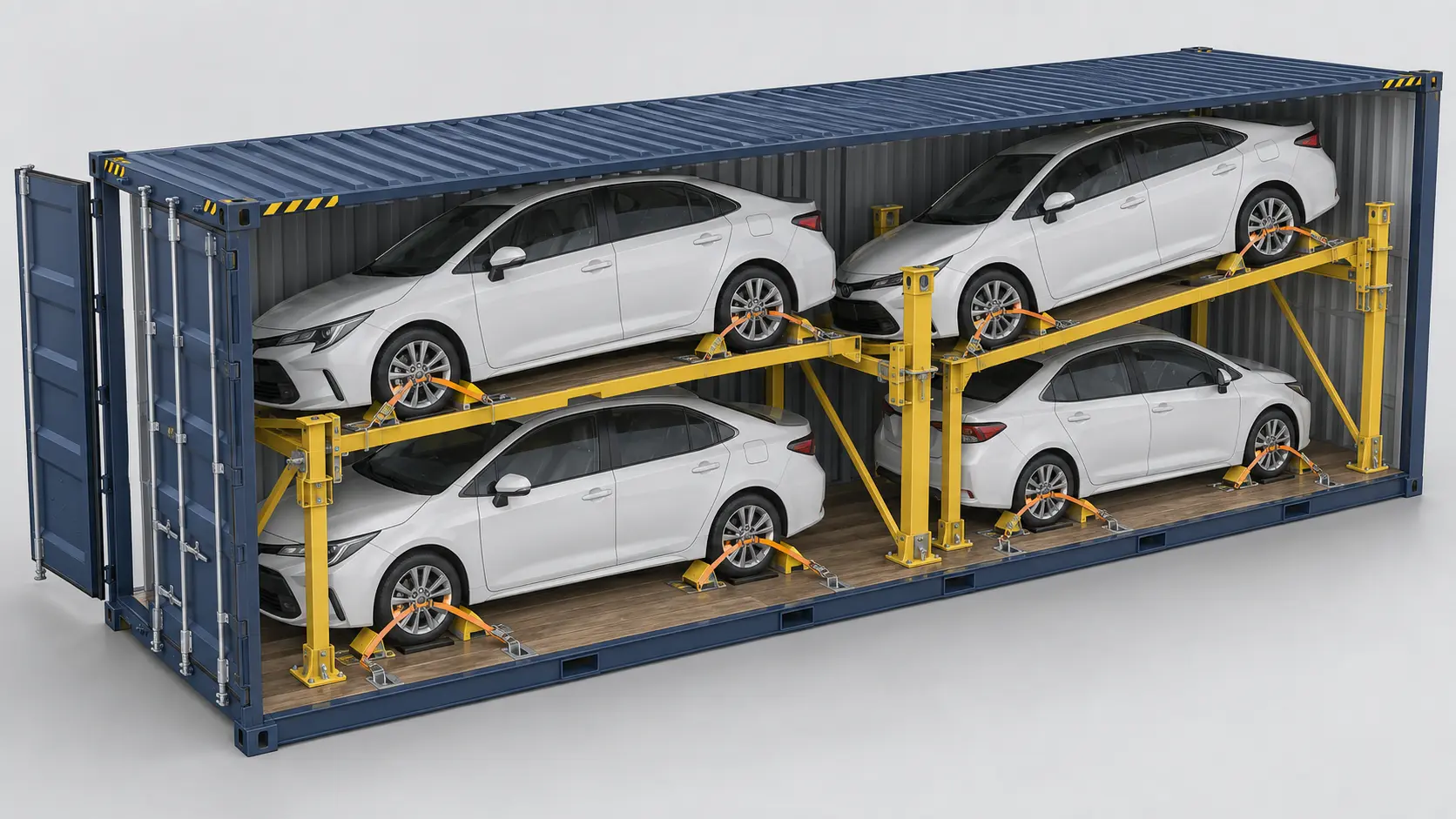
For this comparison, the known COC-container costs were:
- Nansha–Duqm ocean freight: USD 8,300 per 40HQ
- Nansha origin charges: CNY 2,500 per container
- Loading and lashing: CNY 1,000 per container
- Professional vehicle rack: estimated CNY 500 per vehicle
- Loading assumption: four cars per 40HQ
The known cost per container was therefore:
| 40HQ cost item | Estimated amount |
|---|---|
| Ocean freight | USD 8,300 |
| Origin charges | CNY 2,500 |
| Loading and lashing | CNY 1,000 |
| Four rack positions | CNY 2,000 |
| Total CNY cost | CNY 5,500 |
| Converted CNY cost at 6.71 | USD 819.67 |
| Known cost per 40HQ | USD 9,119.67 |
At four cars per container, the known cost was approximately USD 2,279.92 per car.
For 500 cars, the plan would require 125 × 40HQ containers, with a known total cost of approximately USD 1,139,959.
4. The headline saving—and why we do not stop there
The initial comparison showed:
| Option | Known cost per vehicle | Known cost for 500 vehicles |
|---|---|---|
| RoRo, Nansha–Duqm | USD 2,841.78 | USD 1,420,890 |
| Four-car 40HQ COC plan | USD 2,279.92 | USD 1,139,959 |
| Initial difference | USD 561.86 | USD 280,931 |
On paper, the container plan reduced the known cost by almost 20%. That is a meaningful opportunity—but it is not yet a guaranteed saving.
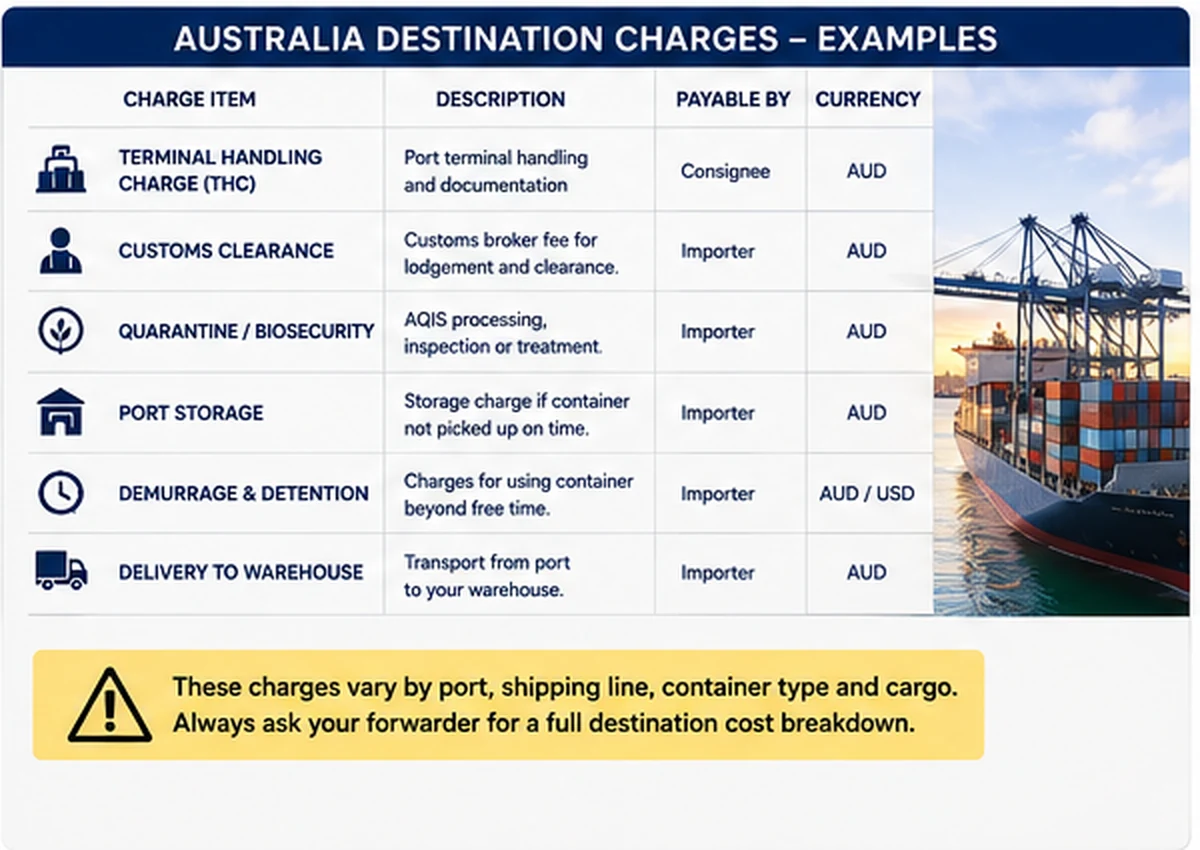
The comparison did not yet include every possible destination cost, such as:
- Discharging the container from the vessel
- Moving the container to a suitable vehicle-handling yard
- Mobile ramps, dock access or container grounding
- Hydraulic or chain-hoist equipment for lowering the rack
- Skilled labour to release the upper vehicles safely
- Rack dismantling, storage, recycling or return freight
- Container detention if unloading takes too long
- Vehicle customs clearance, duties and taxes
- Damage survey, insurance or exceptional carrier requirements
This is where a low ocean rate can become an expensive shipment. A transport plan is only cheaper if the importer can complete the destination operation without delay, damage or unplanned equipment hire.
5. How the four-car loading operation should work
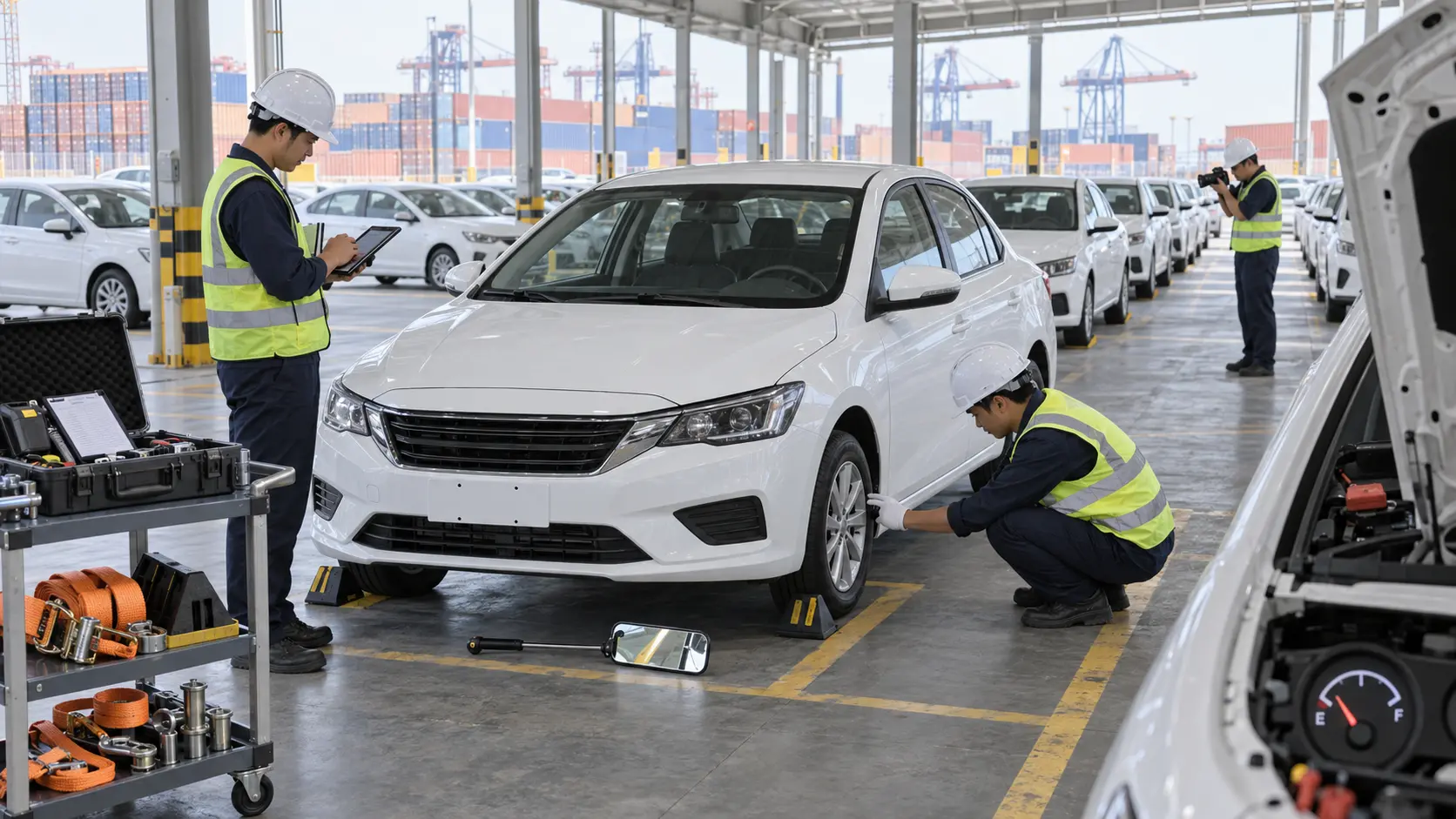
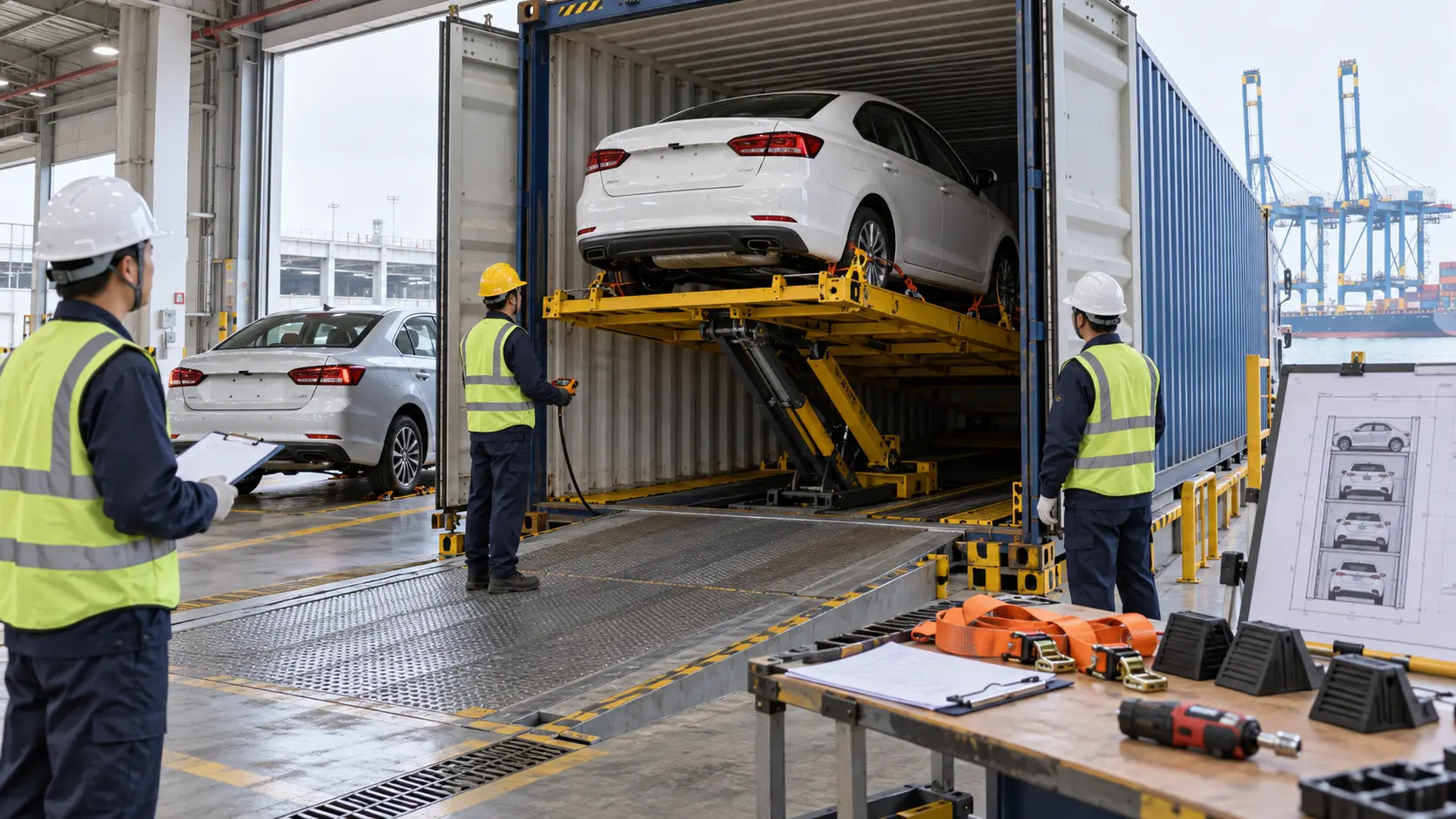
The four-car arrangement cannot be created with ordinary straps alone. A typical removable in-container rack operation follows a controlled sequence:
- Inspect the empty 40HQ, floor and approved securing points.
- Install the rear rack assembly according to the manufacturer’s drawing.
- Drive the first vehicle onto the lowered rack platform.
- Secure all four wheels before raising or tilting the platform.
- Raise the platform using the approved lifting method and insert the mechanical safety locks.
- Position and secure the lower vehicle beneath the raised vehicle.
- Repeat the process for the door-end pair.
- Check roof, bumper, underbody and container-wall clearance.
- Verify weight distribution, rack locks, wheel chocks and strap tension.
- Photograph the complete loading and securing condition before sealing the container.
Before accepting a low rack price, we would ask the supplier for:
- Rack photographs and an actual loading video
- Safe working load and test or certification information
- A loading drawing based on the exact Corolla dimensions
- A complete unloading manual and equipment list
- Confirmation that the ocean carrier accepts the system
- Responsibility for rack failure or vehicle damage
6. Unloading at Duqm must be planned before loading at Nansha
The destination cannot discover the rack system only after the container arrives.
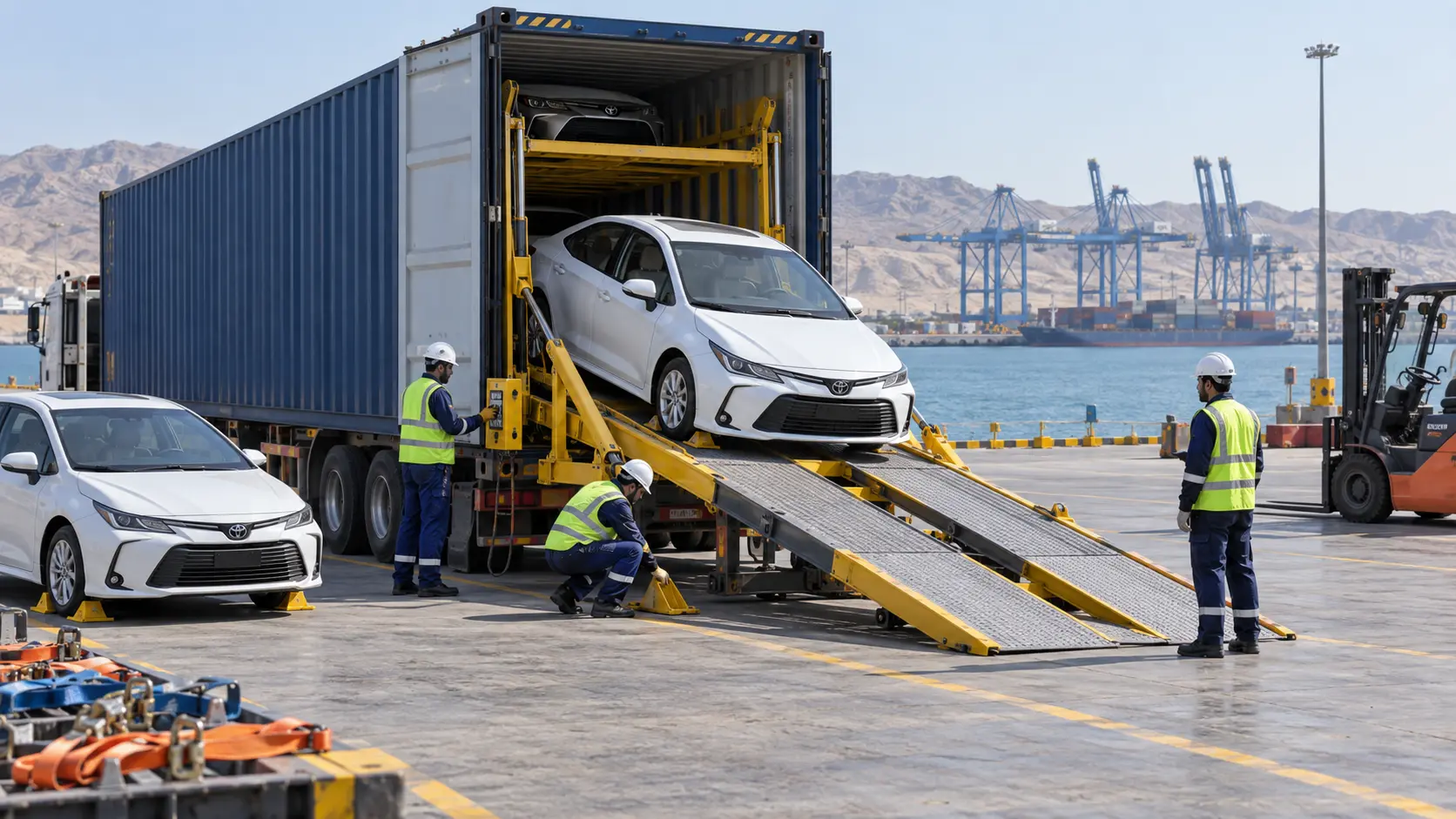
Before departure, the Duqm-side agent should confirm access to:
- A dock-height platform or rated mobile vehicle ramp
- The lifting mechanism required by the selected rack
- Trained vehicle-handling personnel
- Wheel-chock, strap and locking-pin tools
- A safe parking and inspection area
- A plan for dismantling and disposing of or returning the rack
The unloading order is generally the reverse of loading, but the exact sequence depends on the rack design. In many arrangements, the lower vehicle nearest the doors is removed first, creating space to lower and discharge the upper vehicle. The front rack can then be dismantled before the rear pair is handled.
7. COC and SOC are not the same quotation
The USD 8,300 container rate in this case was based on a carrier-owned container (COC). The shipping line supplies the equipment, and the consignee must return the empty container to the nominated depot within the allowed free time.
A shipper-owned container (SOC) is owned or supplied by the cargo side. It may be useful for special projects or where empty-container return is difficult, but it is not automatically cheaper. The carrier normally reviews the SOC separately and may require:
- A valid CSC safety plate and inspection status
- Container age, specification and ownership details
- Photographs and structural-condition evidence
- SOC acceptance for the selected vessel and route
- Separate terminal or handling approval
For this reason, we did not insert an unconfirmed SOC figure into the comparison. The correct answer was to wait for the carrier’s review rather than promise a price that might later be rejected.
8. What if the cars originate in Chongqing?
We also reviewed an inland-origin concept involving a Chongqing–Shanghai Yangtze barge and a separate Shanghai–Sohar ocean rate.
The initial inputs were:
- Shanghai–Sohar ocean freight: USD 8,550 per 40-foot container
- Chongqing–Shanghai barge: CNY 5,000 per container
At the same working exchange rate, those two lines alone equalled approximately USD 9,295 per container—before adding origin terminal costs, vehicle racks, loading, lashing, Shanghai transfer operations and destination unloading.
There is another important point: Sohar and Duqm are different Oman ports. Comparing a Shanghai–Sohar rate directly with a Nansha–Duqm rate can be misleading if the final inland delivery point is not included. The cheapest port-to-port rate may create a longer and more expensive final delivery.
For inland China cargo, we compare the complete chain:
factory → vehicle yard → loading port or river terminal → transshipment → Oman port → unloading yard → final destination
9. Our recommended lower-risk execution plan
For a shipment of 500 vehicles, we would not immediately load all 125 containers based only on a drawing and a low rack price.
Phase 1: Validate the data
- Obtain the exact model, year, powertrain and dimensions.
- Separate petrol, hybrid and electric vehicles.
- Confirm running condition, keys, battery status and fuel policy.
- Prepare the VIN and vehicle-condition lists.
Phase 2: Obtain written approvals
- Confirm vehicle acceptance with the selected ocean carrier.
- Confirm whether the cargo must be declared under the carrier’s dangerous-goods policy.
- Approve the rack and lashing method.
- Confirm Duqm terminal and off-terminal handling requirements.
Phase 3: Run one test container
- Load four representative vehicles.
- Record loading time, clearances and all securing points.
- Verify the actual loading cost.
- Send the loading and unloading instructions to the Oman agent.
- Confirm that the destination team can lower and remove every vehicle safely.
Phase 4: Scale the programme
Once the test is accepted, divide the remaining volume into controlled batches. This reduces yard congestion, allows time for document correction and limits the number of vehicles exposed if the carrier changes a requirement.
10. What importers should request before choosing a vehicle-shipping quote
Before comparing two offers, ask both forwarders to confirm the same scope:
- Exact origin and destination port
- RoRo, COC container or SOC container
- Rate basis: per vehicle, CBM, metric tonne or container
- Origin terminal and documentation charges
- Rack, loading and lashing charges
- Vehicle-running and fuel requirements
- Destination unloading method and cost
- Free time, detention and storage rules
- Customs clearance, tax and inland delivery exclusions
- Carrier approval and rate validity
A useful quotation should show not only what is included, but also what is still unknown.
Conclusion: lower cost comes from controlling the whole operation
The initial 40HQ solution showed a potential saving of approximately USD 562 per vehicle compared with the RoRo working estimate. For 500 cars, that difference was large enough to deserve serious investigation.
But the better solution was not simply “use containers.” The better solution was:
- verify the exact vehicle;
- use an approved rack;
- test one container;
- plan unloading in Oman before loading in China;
- confirm the carrier’s vehicle and dangerous-goods requirements;
- include detention and destination handling in the final comparison; and
- scale only after the process works.
That is how freight costs are reduced without transferring hidden risk to the importer.
If you are comparing RoRo, container or project-cargo options from China, TengYoda Logistics can prepare a route-specific loading and landed-cost plan. Learn more about our RoRo and project cargo service, review our sea freight solutions, or contact our team with the vehicle list, origin city and destination port.
Frequently asked questions
Can four Toyota Corolla sedans fit in one 40HQ?
Potentially, yes—when a vehicle-specific, approved automotive rack system is used. Four cars cannot be safely loaded by ordinary floor loading and straps alone. Final feasibility depends on the exact model dimensions, rack geometry and carrier acceptance.
Is RoRo safer than container shipping for cars?
Both can be safe when professionally operated. RoRo simplifies loading and discharge, while a sealed container offers additional enclosure and access control. Container risk increases when unapproved racks, poor lashing or improvised destination unloading are used.
Does the importer need special equipment to unload four cars from a container?
Yes. The destination normally requires a suitable ramp or dock, the rack’s specified lifting or lowering equipment, trained personnel and sufficient space to dismantle the rack and inspect the vehicles.
Is an SOC container cheaper than a carrier-owned container?
Not necessarily. SOC equipment requires separate carrier acceptance and valid container documentation. Purchase, positioning, terminal handling and disposal or reuse costs must be included before comparing it with a COC rate.
When should the freight forwarder check vehicle dangerous-goods requirements?
Before booking. Requirements depend on the powertrain, battery type, fuel condition, stowage method and carrier policy. Petrol, hybrid and electric vehicles should be identified separately in the booking data.
Technical references
- Toyota Corolla Sedan specification table
- Trans-Rak R-RAK vehicle container system
- Maersk requirements for booking vehicles
Pricing disclaimer: All monetary figures are an illustrative case calculation based on rate inputs available on the review date. They are not a current offer, tariff or guarantee of space. Final charges depend on carrier confirmation, actual vehicle details, sailing date, equipment, terminal rules and destination services.