Importing goods from China to Australia can be very cost-effective, but the lowest supplier price or ocean freight rate does not always mean the lowest total import cost. Many expensive problems happen after the purchase order has already been placed. The problem is often not the ocean freight itself. Unexpected costs can come from incorrect Incoterms, poor packaging, biosecurity requirements, customs documentation, destination charges, port storage, demurrage, detention or choosing the wrong shipping method. For Australian importers, especially those buying from China for the first time, the most important principle is simple: Identify the risks before the cargo leaves China. Here are 12 common mistakes that can increase the cost of importing from China to Australia.
1. Looking Only at the Supplier's Product Price
A supplier may offer a very attractive unit price, but that does not tell you how much the product will actually cost when it reaches your warehouse in Australia.
A more useful calculation is:
Product Cost + China Logistics + International Freight + Insurance + Australian Destination Charges + Customs Clearance + Duty/GST + Final Delivery
This is your approximate landed cost.
Two Chinese suppliers may quote almost the same product price, but their total logistics costs can be very different.
For example:
- One factory may be close to Shenzhen or Guangzhou port.
- Another supplier may require expensive inland trucking.
- One supplier may use compact export packaging.
- Another may use oversized cartons that waste container space.
For bulky products such as furniture, cabinets, building materials and equipment, poor packaging can significantly increase the cost per unit.
The correct question is not simply:
"Which supplier is cheaper?"
It should be:
"Which option gives me the best total landed cost in Australia?"
2. Not Understanding EXW, FOB, CIF, DAP and DDP
One of the most common mistakes when buying from China is comparing quotations with different Incoterms.
An EXW quotation cannot be directly compared with an FOB quotation.
EXW
The supplier makes the goods available at the agreed location, commonly the factory.
The buyer normally takes responsibility for more of the China-side logistics.
FOB
FOB is commonly used for ocean freight.
The seller and buyer have defined responsibilities under the agreed FOB terms, with the buyer normally controlling the main international freight after the FOB delivery point.
CIF
The seller arranges the main freight and insurance to the named destination port according to the agreed terms.
However:
CIF does not mean all Australian destination charges are included.
DAP
Transportation is arranged to the named destination, while import customs clearance, duties and taxes generally remain the buyer's responsibility.
DDP
The seller takes on significantly more responsibility, including agreed import-side obligations.
Before accepting any quotation, ask:
What exactly is included and excluded?
A very cheap quotation can become expensive when the importer discovers additional charges later.
For a broader explanation of the shipping process, see our Shipping from China to Australia Guide.
3. Comparing Only the Ocean Freight Rate
Imagine two freight quotations:
Forwarder A: Ocean Freight USD 2,900
Forwarder B: Ocean Freight USD 3,200
Forwarder A appears cheaper.
But that comparison is incomplete.
A more accurate comparison should include:
China Origin Charges + Ocean Freight + Australian Destination Charges + Customs Clearance + Local Delivery
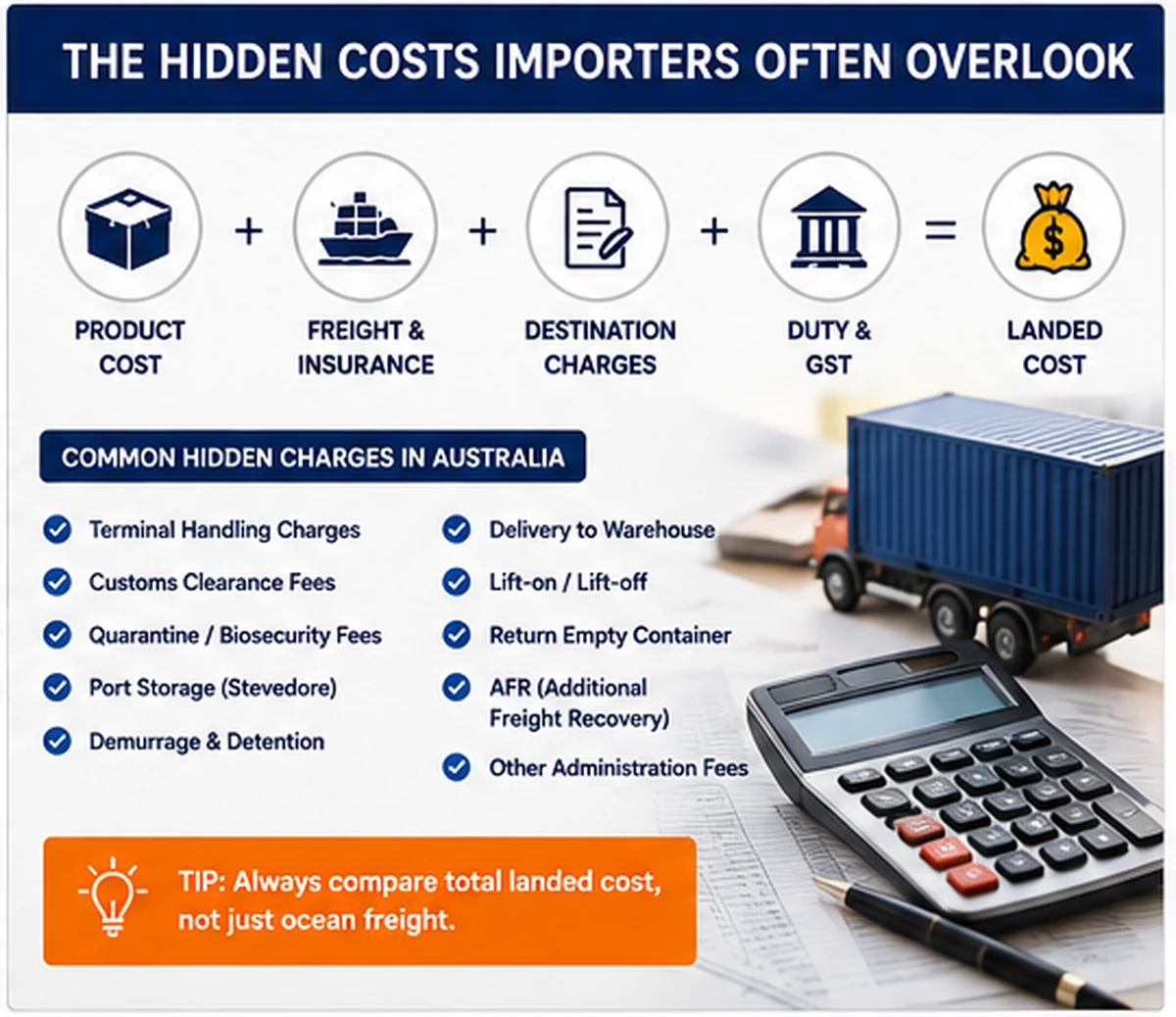
Possible additional costs can include:
- Terminal handling
- Documentation
- Customs clearance
- Biosecurity inspection
- Port storage
- Demurrage
- Detention
- Lift-on / lift-off
- Container delivery
- Empty container return
- Other administration or carrier charges
This is particularly important with LCL shipments.
A low LCL ocean freight rate can sometimes be followed by relatively high destination handling charges.
Always ask your freight forwarder:
"What will I still need to pay after the cargo arrives in Australia?"
4. Ignoring Australian Biosecurity Requirements
Australia has strict biosecurity requirements.
Importers need to consider not only the product itself, but also the cargo, packaging and container condition.
Potential biosecurity concerns can include:
- Soil
- Plant material
- Seeds
- Insects
- Bark
- Timber packaging
- Wooden pallets
- Wooden crates
- Dunnage
- Contaminated containers
The exact import conditions depend on the product and packaging.
Before shipping, the importer, supplier and freight forwarder should check the current Australian import requirements applicable to the actual cargo.
The important principle is:
Biosecurity should be checked before shipment, not after the container arrives in Australia.
5. Using Non-Compliant Solid Timber Packaging
This is especially important for:
- Machinery
- Stone
- Furniture
- Building materials
- Industrial equipment
- Heavy cargo
Chinese factories often use solid timber pallets, crates, timber frames or blocks to protect cargo.
However, timber packaging entering Australia may be subject to biosecurity requirements.
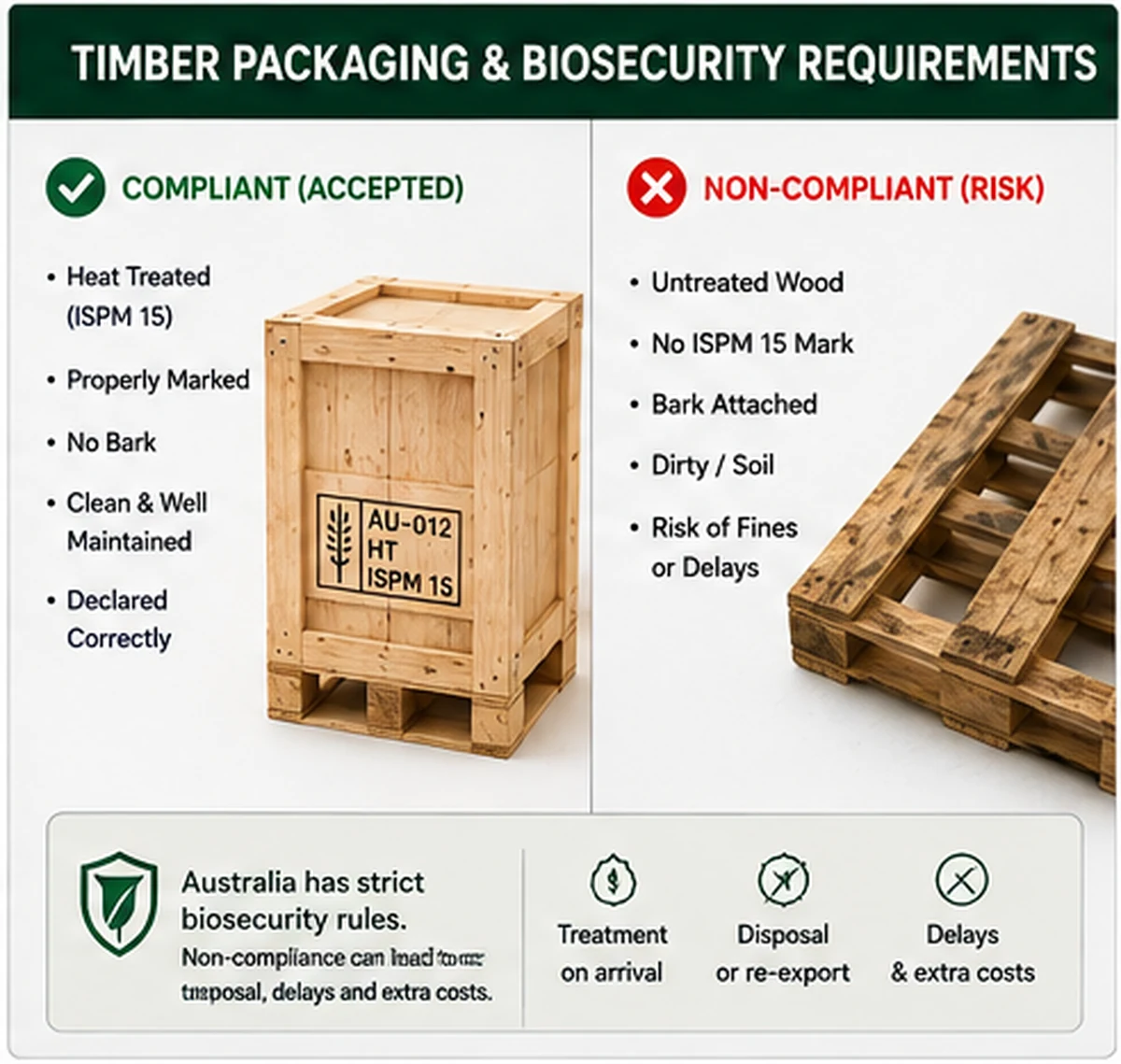
Before loading, check whether the packaging is:
- Properly treated where required
- Properly marked where required
- Free from bark
- Free from soil and contamination
- Correctly declared
- Suitable for Australian import requirements
If suitable for the cargo, plywood or other engineered packaging materials may sometimes simplify the packing arrangement.
Do not wait until the container has already been loaded to ask:
"Can this wooden packaging enter Australia?"
By then, changing the packaging can be expensive and may delay the shipment.
6. Preparing the Packing Declaration Too Late
A Packing Declaration may be required for relevant Australian sea freight shipments.
A common problem happens like this:
Freight Forwarder → Importer → Chinese Supplier → Supplier does not understand the document → Vessel is already approaching Australia
This creates unnecessary pressure.
The better approach is to prepare the relevant documents early.
Before or shortly after shipment, make sure the responsible parties understand what information is required.
Documents that are prepared early are much easier to correct than documents requested after the container has already arrived.
7. Using the Wrong HS Code
The HS code can affect:
- Customs duty
- GST calculation
- Import restrictions
- Biosecurity requirements
- Anti-dumping measures
- Product permits
- Trade agreement eligibility
Do not simply copy an HS code from a similar product found online.
Products that appear very similar can sometimes have different tariff classifications.
This is especially important for products such as:
- Steel products
- Aluminium products
- Wheels
- Building materials
- Chemicals
- Machinery
- Electrical products
If the shipment value is significant or the product classification is uncertain, confirm the HS classification before shipping.
8. Not Checking Whether Preferential Duty Treatment May Apply
China and Australia have a free trade agreement.
Depending on the product and applicable rules of origin, eligible goods may qualify for preferential tariff treatment.
However:
"Made in China" does not automatically mean the goods qualify for every preferential tariff treatment.
The importer still needs to consider:
- Product origin
- Applicable rules of origin
- Correct tariff classification
- Required supporting documentation
For regular Australian importers purchasing significant volumes from China, this can be worth checking before shipment.
Even a small percentage difference in duty can become significant over multiple containers.
9. Not Budgeting for GST, Duty and Import Charges
First-time importers sometimes calculate:
Product Price + Shipping = Total Cost
That is rarely the complete picture.
Australian import costs can also include applicable:
- Customs duty
- Import GST
- Customs processing charges
- Customs brokerage
- Shipping line charges
- Biosecurity charges
- Delivery charges
Always estimate these costs before the vessel arrives.
This is particularly important for cash flow.
If the importer does not have the required funds ready when the cargo is available, the delay itself can create additional storage or container charges.
10. Waiting Until the Vessel Arrives to Start Customs Clearance
This is one of the most avoidable mistakes.
The container arrives.
Then everyone starts asking:
Where is the Commercial Invoice?
Where is the Packing List?
What is the HS Code?
Do we have the Packing Declaration?
Do we need a treatment certificate?
Meanwhile, the container is already at the port.
A better approach is to prepare the clearance documents before arrival.
Typical documents may include:
- Commercial Invoice
- Packing List
- Bill of Lading
- Packing Declaration where applicable
- Certificate of Origin where applicable
- Treatment documents where applicable
- Product information
- Import permits where required
Your customs broker may require additional information depending on the cargo.
The key principle is:
Prepare before ETA, not after arrival.
11. Ignoring Australian Destination Charges
The ocean freight rate is only one part of the total shipping cost.
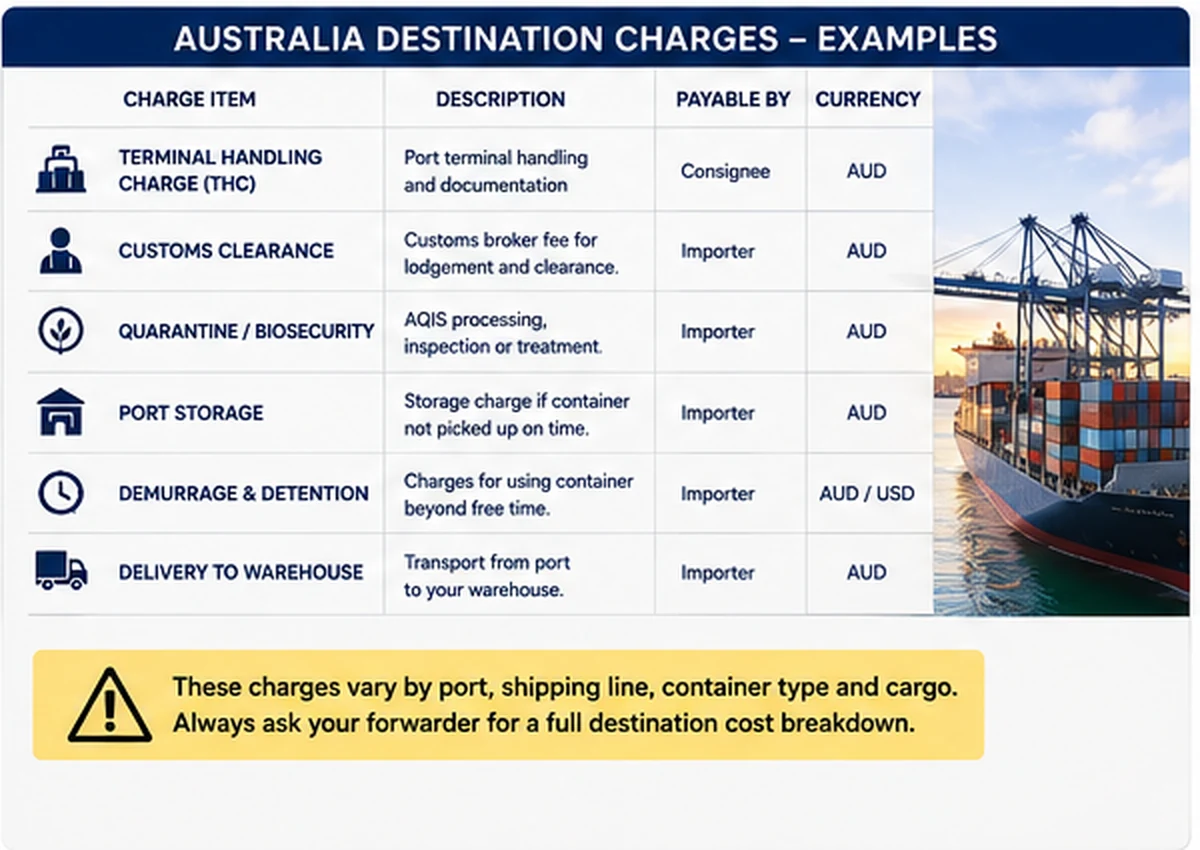
Depending on the shipment, destination-side costs may include:
Terminal Handling Charges
Port or terminal-related handling costs.
Customs Clearance
Customs broker and import processing costs.
Biosecurity / Quarantine
Inspection, processing or treatment costs where applicable.
Port Storage
Charges that may occur when cargo or a container remains at the terminal beyond the relevant free period.
Demurrage and Detention
Container-related charges that may apply depending on the shipping line's free-time conditions.
Delivery to Warehouse
Transport from the port or destination facility to the importer's warehouse.
These charges vary by:
Port + Shipping Line + Container Type + Cargo + Customs/Biosecurity Situation
This is why importers should request a complete destination cost breakdown, rather than comparing only ocean freight.
12. Ignoring Container Free Time and Empty Return Deadlines
For FCL shipments, receiving the container is not the end of the process.
A typical Australian FCL delivery may look like:
Port → Container Pickup → Warehouse → Unloading → Empty Container Return
Every stage needs coordination.
Delays can happen because:
- Shipping line charges remain unpaid
- Cargo release has not been issued
- Customs clearance is incomplete
- Biosecurity processing is pending
- The warehouse cannot receive the container
- Transport has not been arranged
- The empty container is returned late
Once a container becomes available, time becomes important.
Always confirm:
Who is clearing the cargo?
Who is arranging container pickup?
Where will it be unloaded?
How quickly can the warehouse unload it?
Who is returning the empty container?
What is the applicable free time?
Good destination planning can prevent unnecessary demurrage, detention and storage costs.
Bonus: Choosing the Cheapest Shipping Route Without Checking Reliability
The cheapest route is not always the cheapest business decision.
For example:
Option A
Lower ocean freight + Transshipment + Longer transit time + Higher delay risk
Option B
Slightly higher freight + More direct routing + Shorter transit time + Better schedule reliability
If Option A delays your stock for several weeks, the inventory shortage may cost much more than the freight saving.
When comparing shipping options, consider:
Freight Rate + Transit Time + Route + Shipping Line + Transshipment + Schedule Reliability
For businesses with regular stock requirements, reliability can be more valuable than saving a few hundred dollars on one container.
A Better China-to-Australia Import Process
The most effective way to avoid expensive mistakes is to plan the shipment before production is finished.
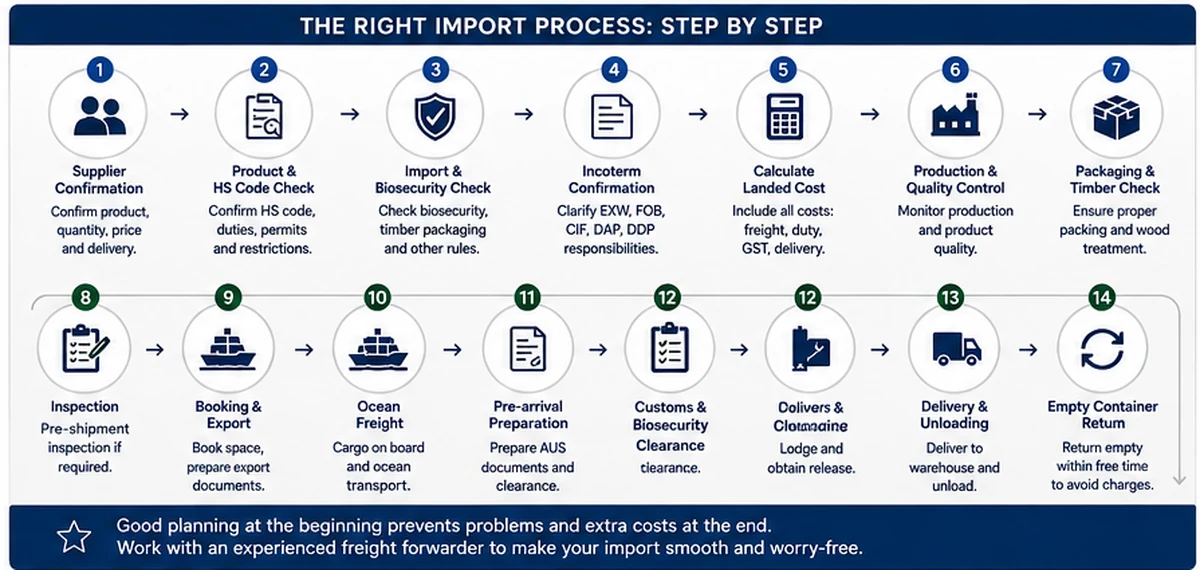
A better process looks like this:
1. Supplier Confirmation
Confirm product, quantity, price, production time and supplier location.
2. Product & HS Code Check
Confirm the product classification and identify potential import restrictions.
3. Import & Biosecurity Check
Review relevant Australian customs and biosecurity requirements.
4. Incoterm Confirmation
Clearly understand EXW, FOB, CIF, DAP or DDP responsibilities.
5. Calculate Landed Cost
Estimate product, freight, duty/GST, destination charges and delivery.
6. Production & Quality Control
Monitor production and confirm final product specifications.
7. Packaging & Timber Check
Make sure the export packaging is suitable for Australia.
8. Inspection
Inspect the goods before shipment where appropriate.
9. Booking & Export
Book shipping space and prepare China export documentation.
10. Ocean Freight
Cargo begins international transportation.
11. Pre-Arrival Preparation
Send the required documents to the Australian customs broker before ETA.
12. Customs & Biosecurity Processing
Complete the applicable destination procedures.
13. Delivery & Unloading
Arrange container or cargo delivery to the final destination.
14. Empty Container Return
For FCL shipments, return the empty container within the applicable time.
Most expensive logistics problems can be prevented somewhere in the first half of this process.
Frequently Asked Questions
What documents do I normally need when importing from China to Australia?
Common commercial documents include a Commercial Invoice, Packing List and Bill of Lading.
Depending on the product and shipment, additional documents may include a Packing Declaration, Certificate of Origin, treatment documentation, product certificates or import permits.
Can I use wooden pallets when shipping to Australia?
Potentially yes, but timber packaging can be subject to Australian biosecurity requirements.
Check the current requirements before the goods are packed and shipped.
Can I combine products from several Chinese suppliers into one shipment?
Yes.
For example, you may purchase:
- Furniture from Foshan
- Lighting from Zhongshan
- Hardware from Guangzhou
- Accessories from Yiwu
The goods can be collected into a China warehouse and consolidated into one LCL or FCL shipment.
This can simplify supplier coordination and international transportation.
You can also read our First Time Importing from China Guide for a complete purchasing and logistics workflow.
Should I use LCL or FCL from China to Australia?
It depends on the cargo volume, weight, packaging, destination and total shipping cost.
LCL can be suitable for smaller shipments.
As the volume increases, compare the total LCL cost against a 20GP, 40GP or 40HQ container.
For larger shipments, you may also find our 40HQ Shipping Cost from China to Australia Guide useful.
Should I arrange customs clearance before the vessel arrives?
Where possible, the relevant documentation should be prepared and reviewed before arrival.
Waiting until the cargo is already at the destination port can increase the risk of delays and additional charges.
Importing from China to Australia?
The biggest cost in international shipping is not always the freight rate.
Very often, the expensive problem is something that could have been identified before the cargo left China.
TengYoda Logistics helps overseas importers coordinate shipments from China, including:
- Factory pickup
- Supplier coordination
- China warehousing
- Multi-supplier consolidation
- LCL sea freight
- 20GP / 40GP / 40HQ FCL shipping
- Export customs coordination
- Shipping documentation
- Australia destination coordination
- Door-to-door logistics solutions
If you are preparing a shipment from China to Australia, send us:
Product name + supplier city + quantity + CBM + gross weight + Australian destination postcode + Incoterm
We can help you review the shipping process and identify potential logistics risks before the cargo is shipped.
Need a China-to-Australia shipping plan? Contact TengYoda Logistics for a solution based on your actual cargo.